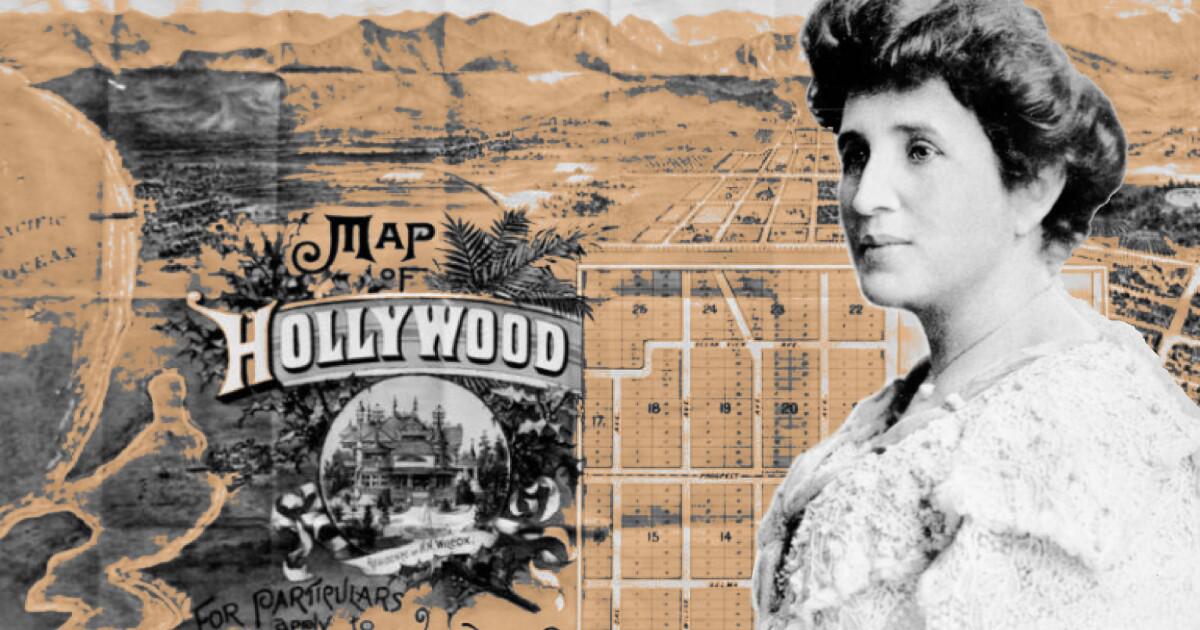
Registration of Hollywood as a Residential Real Estate Subdivision
On 1 February 1887, in what is now Los Angeles County in the US state of California, Harvey Wilcox formally registered his privately owned agricultural land as a residential real estate subdivision. This registration marked the first official use of the name Hollywood in public land records. At the time of registration, the project had no association with film or entertainment activity and was conceived solely as a residential real estate development.
The name Hollywood was proposed by Wilcox’s wife, Daeida Wilcox. Contemporary and later historical sources indicate that the name was inspired by hollyhock plants commonly found in the surrounding area. Through this registration, Hollywood entered official records as a planned housing scheme, with defined plot subdivision, structured street layouts, and residential land use regulations established in accordance with prevailing urban planning practices of the period. The development also included explicit restrictions prohibiting industrial activity within the subdivision. The stated objective was the creation of a controlled residential environment intended for middle and upper income households, located away from industrial zones and urban congestion.
The registration of Hollywood occurred within a broader pattern of land use change prevalent in the United States during the late nineteenth and early twentieth centuries. Between approximately 1880 and 1910, agricultural land on the peripheries of major cities was increasingly converted into planned residential subdivisions. This process was particularly pronounced in Los Angeles County, where railway expansion, population growth, and rapid urbanisation significantly altered patterns of land ownership and use.
[img:Images/otd-1-feb-2nd.jpg | desc:Most of us are familiar with the Hollywoodland sign perched on a hillside in Los Angeles, visible in this image. The sign has become almost as iconic as Hollywood itself. Wherever Hollywood is mentioned around the world, it is these large white letters rising from the hills that immediately come to mind.To understand the true story of Hollywoodland, and the journey from a real estate settlement to the global symbol known as Hollywood, it is essential to distinguish clearly between two different figures: Harvey Wilcox and Harry Chandler. Harvey Wilcox was the individual who, on 1 February 1887, registered his agricultural land in Los Angeles County as a residential real estate project under the name Hollywood.The role of Harry Chandler, by contrast, emerged several decades later. In 1923, he and other real estate developers illuminated the Hollywoodland sign as part of a large-scale promotional campaign for nearby housing developments. During this period, Chandler and his associates also acquired surrounding land and expanded real estate development in the area.Real estate developers, including Harry Chandler, officially lit the Hollywoodland sign on 13 July 1923. The sign was fitted with approximately 4,000 light bulbs that illuminated in sequence each night, first spelling “HOLLY,” then “WOOD,” and finally “LAND.” This staged illumination was designed to maximise visibility and enhance the promotion of the area.The sign was originally intended as a temporary installation, planned to remain in place for only 18 months. At the time, no one anticipated that it would still exist a century later or that it would evolve into a global cultural landmark.By the 1940s, the sign had deteriorated significantly. Consequently, during repair work carried out in 1949, the word “LAND” was removed, allowing the sign to represent the city itself and the rapidly growing film industry.The sign visible today is not the original wooden structure. By 1978, the original sign had completely decayed and was replaced with a new steel version. Funding for this reconstruction was raised through a sponsorship campaign in which eight donors each sponsored one letter, contributing 27,777.77 US dollars per letter. Hugh Hefner, founder of Playboy, played a notable role in this effort by sponsoring the letter “Y.” In total, approximately 222,000 US dollars were raised to install the steel sign, which continues to stand today as one of the most enduring symbols of Hollywood. (Syed Shayan Archive Head)]
The Hollywood subdivision formed part of this wider transformation. Although the land had previously been used for agricultural purposes, its registration reflected a deliberate transition toward residential development through formal subdivision, road planning, and regulatory controls. During this period, Hollywood remained a sparsely populated rural settlement marketed primarily on the basis of residential order, open land, and environmental quality.
Film related activity emerged only at a later stage. The availability of land, relatively low property values, and favourable physical conditions subsequently attracted film producers and associated enterprises. Over time, the residential subdivision expanded to accommodate studios, commercial functions, and cultural infrastructure. This gradual process transformed a formally registered housing scheme into a centre of film production with global cultural and economic significance.
Harvey Wilcox is documented as holding strong religious convictions and initially envisaged Hollywood as a community governed by moral regulation, including strict prohibitions on alcohol consumption and non residential activities. These principles were reflected in the original development restrictions. Notwithstanding this intent, a significant shift occurred approximately twenty four years after registration. In 1911, the establishment of Nestor Studios marked the first permanent film studio in the area, initiating a long term transformation of Hollywood’s functional identity.
Read More >