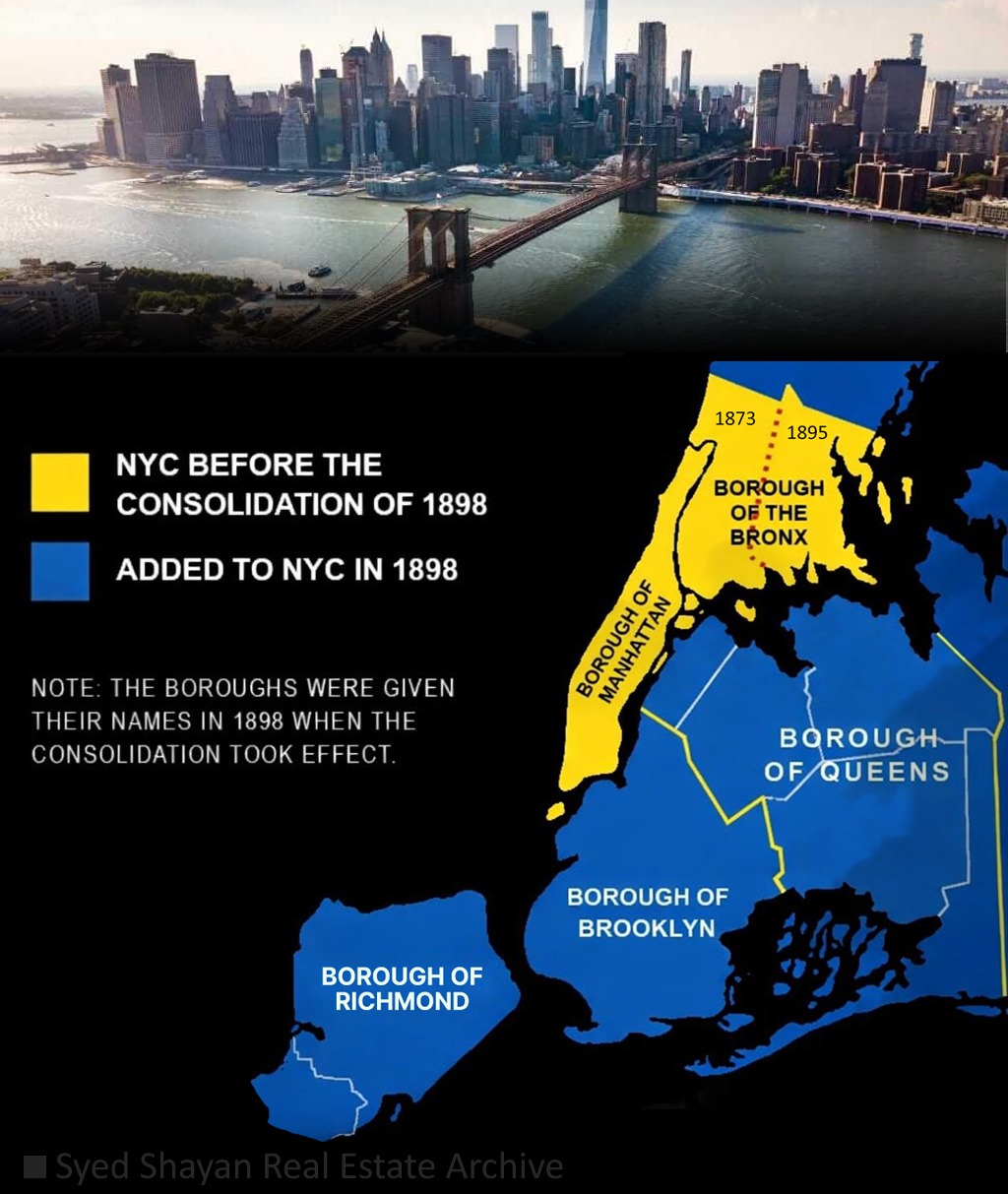
The Establishment of Greater New York on 1 January 1898
On 1 January 1898, New York City assumed its modern form in an event historically known as Greater New York. On this date, Manhattan, the Bronx, Brooklyn, Queens and Staten Island were consolidated into a single urban entity. Prior to this union, Brooklyn was an independent city and, by population, the fourth largest city in the United States, while Queens and Staten Island were largely agricultural, semi rural areas with separate administrative identities. The Bronx functioned under a distinct county structure, and Manhattan faced intense population pressure within a limited geographical space.
From a real estate perspective, this decision of consolidation carried exceptional significance. After 1898, Manhattan, already the most expensive district, entered a phase of vertical development centred on the Financial District and Midtown, while Brooklyn and Queens emerged for the first time as large scale residential zones. Staten Island became closely linked to port related and logistical activities, while the Bronx developed as an industrial centre and later as a hub of middle class housing. It was at this stage that modern zoning concepts took root in New York, subsequently shaping the structured division of urban land into residential, commercial and industrial uses.
The modern concept of urban transport also emerged from this period with the opening of the New York City subway in 1904. A coordinated underground railway network enabled extensive housing development across Queens, Brooklyn and the Bronx. The geographical continuity and spatial expansion evident in New York’s real estate values today can be traced directly to this formative era.
Historically, the impact of this consolidation on real estate was profound. For the first time, a true mega city came into existence in which the port, industry, financial institutions, housing and transport were integrated within a single urban system. The long term appreciation of land values was a direct outcome of this decision, while the systematic growth of zoning practices, the subway network and commercial scale development only became possible after 1 January 1898. As a result, New York came to rank among the cities with the most expensive real estate markets in the world.
The annexation of New York with surrounding areas, known in historical terminology as boroughs, is regarded as one of the earliest models of the modern mega city. London, Paris, Tokyo and other global cities later adopted similar models, each shaped by its own historical and administrative context.
It is also important to clarify that the name New York did not originate after the consolidation of 1898. The name had existed for nearly two centuries prior. The city was named New York in 1664 when the British Empire seized the Dutch settlement of New Amsterdam and renamed it in honour of the Duke of York. The change introduced in 1898 was not one of nomenclature but of urban structure, a transformation historically defined as Greater New York.
Read More >