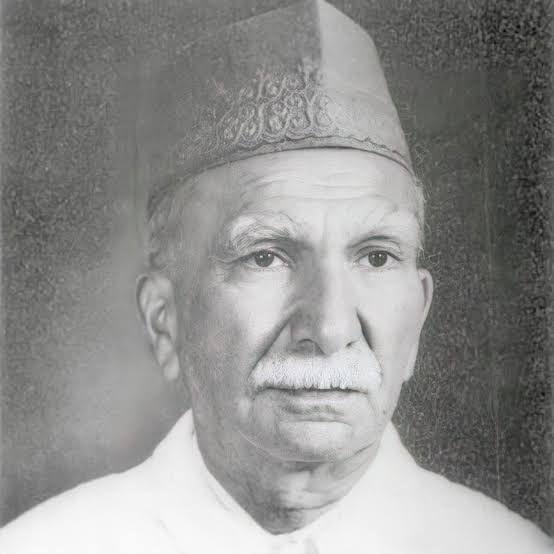
Today marks the birth anniversary of Baba e Karachi, Jamshed Nusserwanjee Mehta, the first Mayor of Karachi, the man who transformed a modest port town into a modern city of Asia.
Born on 7 January 1886, Jamshed Nusserwanjee Mehta’s life story is inseparable from the transformation of Karachi itself, from a small harbour settlement into an organised modern metropolis.
Owing to his services, Karachi was at the time referred to as the Paris of the East, a city whose streets and buildings rivalled those of Paris and London in cleanliness, order, and civic discipline.
He belonged to a middle class Parsi family. Upon entering practical life, he established his identity not only through commerce but equally through social service.
When Jamshed Nusserwanjee Mehta was elected a member of the Karachi municipal institution in 1911, the city was expanding rapidly in both population and area, yet its administrative structure remained weak and poorly coordinated. Essential civic matters such as clean water supply, drainage, sanitation, roads, and residential planning operated without any coherent system. Through sustained effort, close observation, and administrative experience, he succeeded in formulating building by laws for Karachi that for the first time subjected construction to defined principles. These regulations prescribed minimum road widths, building heights, protection of footpaths, access to light and ventilation, and clear separation of residential and commercial zones, ensuring that no construction obstructed civic life. These by laws later became the foundation of Karachi’s urban planning framework.
Subsequently, from 1922 to 1933, he served continuously for eleven years as President of the Karachi Municipality, as the office of Mayor had not yet been formally established during that period. In recognition of his long and effective services, when the Karachi Municipality was granted the status of a Municipal Corporation in 1933, he was appointed the first Mayor of Karachi. Although his tenure as Mayor lasted only one year from 1933 to 1934, he remained the city’s chief administrative head for a total of twelve years.
The grand Municipal Corporation building on M A Jinnah Road stands as a visible testament to the vision and labour of Jamshed Nusserwanjee Mehta, the architect of modern Karachi. The foundation stone of this historic structure was laid in 1927, and its construction was completed during his presidency. Built primarily of yellow Jodhpur stone, with sections using local Gizri stone, the building set a lasting architectural standard for Karachi, defining the form and character appropriate to the city’s civic structures.
The building was formally inaugurated in 1932. Its most distinctive feature, the tall clock tower, remained for decades a defining landmark of the city. When Karachi was elevated to the status of a Municipal Corporation in 1933, Jamshed Nusserwanjee Mehta assumed office as the city’s first Mayor within this very building. It continues to function as Karachi’s administrative centre and stands as a reminder of the high construction standards and urban planning ideals of his era.
The period from 1922 to 1934 under Jamshed Nusserwanjee Mehta is regarded as the golden age of Karachi’s construction and development. During his presidency and mayoralty, numerous buildings and projects were completed that continue to be sources of pride for the city. According to authenticated historical records, the major works and developments of his tenure include the following.
[img:Images/7-jan-2nd.jpeg | desc:Since Jamshed Nusserwanjee Mehta was born in 1886, his centenary logically fell in 1986. However, the commemorative postage stamp was issued by Pakistan Post on 7 January 1988. According to historical records, the primary reasons for this delay lay in the extended governmental approval process, as the issuance of commemorative stamps requires clearance from the Postage Stamps Advisory Committee, followed by design preparation and printing, a process that commonly takes one to two years. In addition, centenary commemorations of prominent figures are often not confined to a single day but extend over one or two years. In this case, the centenary observances of Jamshed Nusserwanjee Mehta commenced in 1986, and the issuance of the stamp in 1988 formed part of the formal conclusion of these commemorations. Furthermore, the period between 1986 and 1988 was marked by political and administrative transitions in Pakistan, during which delays in the release of official commemorative items were not uncommon. Similar precedents exist in Pakistan’s history, where commemorative stamps or coins relating to figures such as Allama Iqbal and Quaid e Azam were issued one or two years later than their actual birth anniversaries. The crucial point in this instance is that the stamp clearly bore the word Centenary, confirming that it was issued expressly to mark the hundredth anniversary of Jamshed Nusserwanjee Mehta’s birth.(Explanatory Note: Syed Shayan, Editorial Head, Syed Shayan Real Estate Archive)]
Jamshed Memorial Hall was constructed specifically for the Theosophical Society. As Jamshed Nusserwanjee Mehta was an active member of the Society, he played a central role in its establishment.
The Karachi Chamber of Commerce and Industry building on I I Chundrigar Road was completed in 1934. Its planning and municipal approval were granted during the administrative tenure of Jamshed Nusserwanjee Mehta.
Although work on Jahangir Kothari Parade and Lady Lloyd Pier at Clifton had commenced earlier, their refurbishment and organisation as a structured public recreational space were finalised during his period of administration.
In the field of health and education, major efforts were undertaken for the expansion of Lady Dufferin Hospital, providing improved facilities, and dozens of primary school buildings were constructed across Karachi. These schools were designed to be airy and well lit.
In residential planning, organised housing schemes such as Jamshed Quarters and Parsi Colony were developed. These represented some of the earliest planned residential settlements in Karachi, characterised by wide roads and regulated layouts.
Beyond buildings, he established a comprehensive system of water supply both above and below ground. Improvements to the Dumlottee Water Works and the construction of water pumping stations at various locations across the city were carried out during his tenure, forming one of the most advanced systems in the subcontinent at the time.
A notable feature common to all buildings constructed during his period was the emphasis on wide roads and natural airflow. He enforced regulations ensuring that no building could be constructed in a manner that narrowed public roads.
It is these outstanding contributions that led the citizens of Karachi to remember him with the title Baba e Karachi.
Jamshed Nusserwanjee Mehta passed away on 1 August 1952. However, the Karachi inherited by Pakistan had already been shaped during his tenure. The port, the roads, municipal order, and the concept of regulated land use all stem from that formative era.
In recognition of his services, the Government of Pakistan issued a commemorative postage stamp on 7 January 1988 to mark the centenary of his birth. In later historical and academic references, he came to be remembered with the title Maker of Modern Karachi.
Read More >