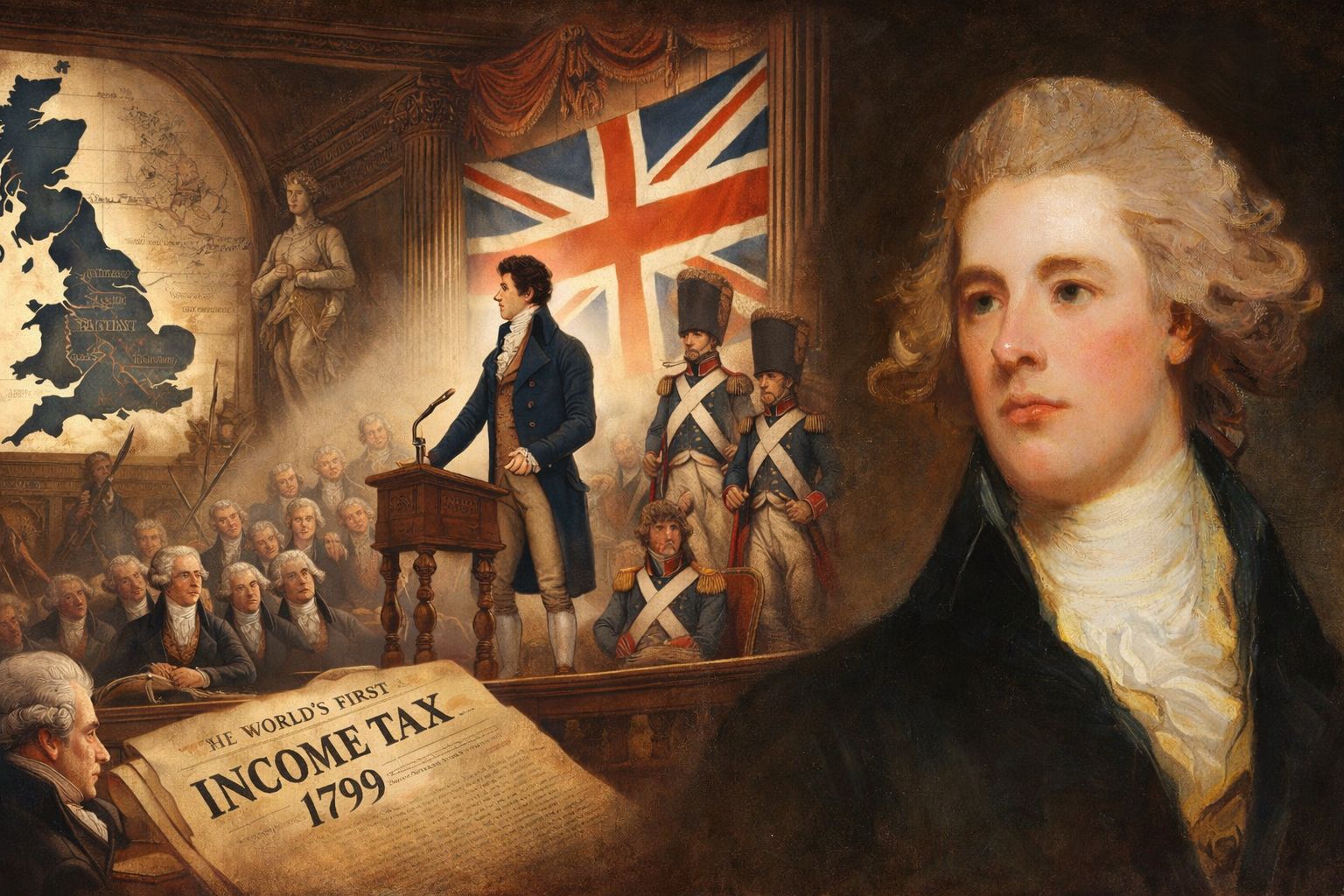
9 January 1799 marks the day when, for the first time in history, the state declared rental income derived from real estate as taxable income.
London: In the history of economic thought, 9 January 1799 is remembered as a decisive moment when the British Prime Minister, William Pitt the Younger, formally imposed income tax on rents derived from property. This measure was not introduced as part of a planned economic reform but was driven by the extraordinary financial pressures arising from the ongoing war against the French ruler, Napoleon Bonaparte.
Prior to this, Britain had a land tax that was limited strictly to ownership. The 1799 law, however, brought income directly within the scope of state taxation for the first time. This included both rental income from property and the estimated annual value of land.
Before 1799, although a land tax existed in Britain, its scope was narrow. It applied only to land ownership and had no connection with the income or rent generated from that land. Whether the land lay idle or produced no profit, the owner was required to pay tax solely on the basis of ownership.
The law enacted on 9 January 1799 clearly established, for the first time, the fundamental distinction between owning land and earning from land. Under this law, rental income from property and the estimated annual value of land were formally recognised as income and brought within the framework of state taxation. As a result, property was transformed from a mere asset of ownership into an income generating economic asset.
Following this law, real estate ceased to be merely a symbol of family inheritance or social prestige and became a commercial asset that the state began to view as a profit generating unit. For the first time, the government became a direct participant in the income derived from property.
Although William Pitt described this tax as temporary and promised to abolish it after the end of the war, and although it was indeed repealed briefly in 1802, its importance for state financial management led to its reintroduction in 1803. This concept later became the foundation of modern income tax, rental income tax, and property tax systems across the world.
[img:Images/9-jan-otd-2nd.jpeg | desc:This image shows a printed page of the historic legislation approved by the British Parliament, commonly known as the Income Tax Act of 1799, enacted during the reign of King George the Third. The document formally declares the authority of the state to levy tax on the income of its citizens, a measure introduced in response to the severe financial pressures generated by the ongoing war with France. Through this legislation, rental income and the estimated annual value of land were, for the first time, formally brought within the framework of state taxation, marking a decisive shift in the treatment of property from a mere object of ownership to a measurable economic asset. This page is widely regarded as one of the earliest and most fundamental documentary foundations of modern income tax, rental income tax, and property taxation systems, and it remains preserved within the British national and parliamentary archives.]
At the time, the tax applied only to individuals with an annual income exceeding sixty pounds. A lower rate was imposed on incomes between sixty and two hundred pounds, while incomes above two hundred pounds were taxed at ten percent, equivalent to two shillings per pound. By the standards of the era, this was considered a bold and revolutionary step.
Through this law, a new philosophy emerged: since the state provides protection for property, builds roads, maintains law and order, and delivers public services, its share in the profits derived from property was considered legitimate. In this way, a social contract took shape between the citizen and the state, under which citizens contributed a portion of their property income to enable defence, wartime needs, and public welfare activities.
During this period, three key concepts were articulated for the first time, forming the foundation of the modern global real estate market.
First, the concept of rental income, whereby property that generates rent is treated as a business activity and taxed accordingly.
Second, the concept of annual value, under which property may be taxed on the basis of its potential annual value even if it is not rented out.
Third, the concept of capital value, which established that property itself constitutes an economic force, not merely the income derived from it.
The law of 9 January 1799 granted the state the right to require citizens to disclose details of their income and property. For the first time, individuals were compelled to provide formal information about their income and assets to the government, laying the foundation for modern tax returns and declaration systems. Prior to this, property records often remained concealed, but taxation made formal documentation unavoidable.
Read More >