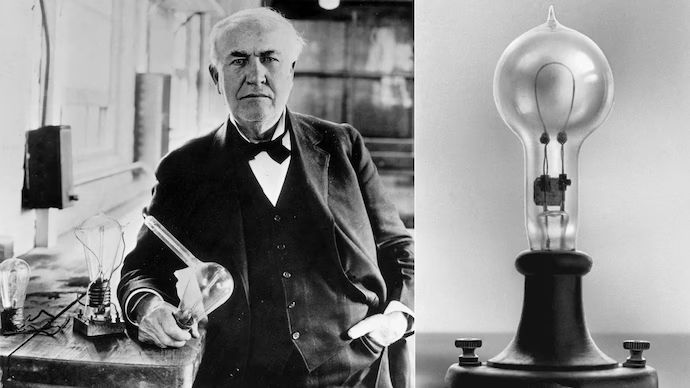
When Thomas Edison First Demonstrated the Successful Delivery of Electricity to Homes and Urban Communities
Although Thomas Edison had already developed the electric light bulb in 1879 and had illuminated public spaces on a commercial scale in New York through the Pearl Street Power Station in 1882, the use of electricity at that stage remained limited to a small number of buildings and confined areas.
On 19 January 1883, in the town of Roselle, New Jersey, electricity was supplied to an inhabited community through an overhead wiring system using pole-mounted cables. Under this arrangement, the First Presbyterian Church of Roselle became the first public building to be illuminated, with Edison himself present to supervise the installation. This demonstration conclusively proved that electricity was no longer restricted to laboratories or isolated facilities, but could illuminate homes, streets, roads, and marketplaces after dark. Until then, underground wiring had been prohibitively expensive, limiting access to electricity largely to affluent individuals or select commercial institutions. Overhead wiring, by contrast, offered a far more economical and scalable solution.
Edison’s true significance lay not merely in the invention of the electric bulb, but in his capacity to transform that invention into a functioning urban system. While Nikola Tesla possessed revolutionary concepts for transmitting electricity over long distances, Edison was the first to present a practical, working model that carried electricity out of experimental settings and into populated urban neighbourhoods and ordinary homes.
Edison did not invent a bulb in isolation. He unified electricity generation, transmission, measurement, and safety into a coherent system that enabled society to move beyond darkness. He understood that a bulb, without electricity available inside homes, would remain little more than a novelty. Once the bulb had been created, the real challenge before him was the establishment of a complete system for the production, transmission, and distribution of electricity.
[img:Images/otd-19-jan-2nd.jpeg | desc:These two images depict, with historical authenticity, the town of Roselle in the US state of New Jersey and a public exhibition of the complete early electricity supply system. Roselle is the settlement where, on 19 January 1883, electricity was first delivered to homes through Thomas Edison’s overhead wiring system, while the exhibition image presents Edison’s entire electricity supply framework, including bulbs, wiring, and related equipment, as it was displayed to the public.]
Guided by this understanding, Edison turned his attention to power stations, wiring infrastructure, and distribution networks, ensuring that electricity did not remain the privilege of laboratories or wealthy elites, but became an integral part of everyday urban life. Historians broadly agree that Edison’s principal achievement was not the invention of the bulb itself, but the creation of a system capable of delivering electricity reliably and safely.
Edison transformed electricity from an isolated invention into an organised grid system. He developed electric meters, fuses, switches, generators, and all essential components of distribution, without which electricity could never have entered common use.
This vision first took concrete form in 1882 with the Pearl Street Power Station in New York, which demonstrated for the first time that electricity could be generated at a central location and distributed via underground cables across an entire urban block. This model subsequently became the foundation of modern power grids worldwide.
The later experiment with overhead wiring in New Jersey marked another decisive advance. Installing cables on poles was both more economical and more effective for extending electricity to distant urban areas. Electricity was no longer confined to a handful of large residences, but spread into ordinary streets and neighbourhoods, becoming a fundamental element of modern urban life.
Through Edison’s sustained efforts, electricity reached a stage at which it could be generated, measured, distributed in units, and sold at a defined price.
Read More >