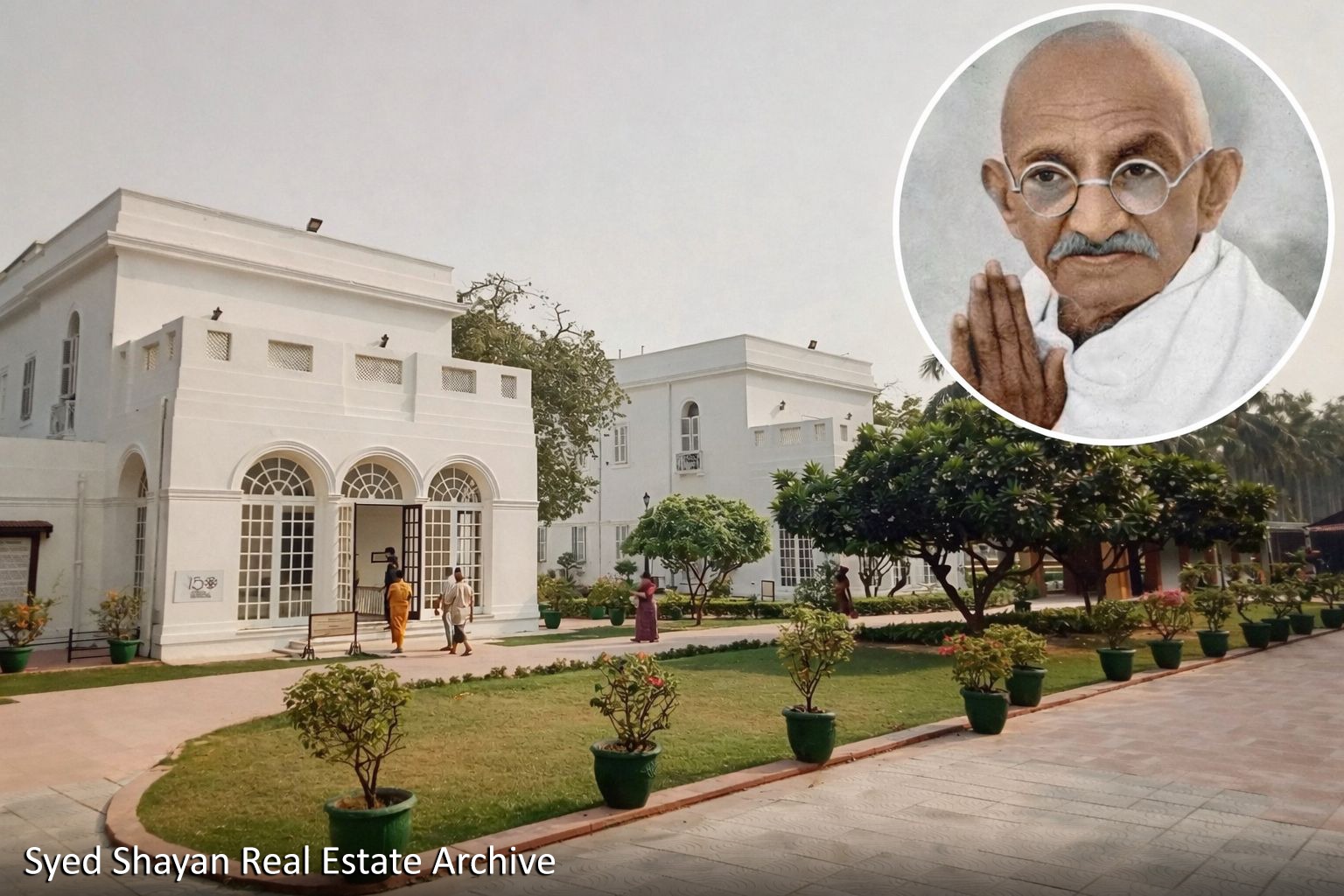
30 January Marg, New Delhi (An address shaped not by geography, but by history)
Birla Bhavan is situated within Lutyens’ Delhi, an area regarded as India’s most exclusive, secure, and expensive residential zone. This district is home to foreign diplomatic residences, official homes of central ministers, and several of the country’s most important constitutional institutions.
It was on the lawn of Birla Bhavan that Mahatma Gandhi was shot and killed on 30 January 1948.
The house originally belonged to the renowned industrialist Ghanshyam Das Birla, commonly known as G D Birla. He was among the most powerful and influential industrial figures of British India and the founder of the Birla Group, which remains one of India’s leading industrial families today.
In 1928, Birla established this property as his private residence. At the time, its postal address was 2 Albuquerque Road, New Delhi.
When British rule in Delhi was at its height, this residence emerged with a corresponding sense of authority and refinement. Its spacious courtyards, high ceilings, and white finished structure reflected the colonial architectural standards and aesthetic sensibilities of the era. Standing amid the tree lined avenues of Lutyens’ Delhi, the house appeared as though history itself had chosen it as a place of refuge.
After 1947, when India was engulfed in severe communal violence following Partition, Mahatma Gandhi assumed a mediating role in Delhi between political leadership, Muslim representatives, Sikh leaders, and the Congress leadership.
G D Birla’s house provided a secure, relatively non political yet highly influential setting within the city. For this reason, Gandhi spent the final 144 days of his life there, from September 1947 until 30 January 1948. His stay was not motivated by personal comfort but represented a deliberate effort to revive peace and reconciliation.
Although Gandhi’s personal life was rooted in simplicity and ascetic discipline, his close relationship with the Birla family made this arrangement possible. The house became not only his residence but also a centre for political consultation, informal dialogue, and decisions of national consequence.
Daily evening prayer meetings were held on the lawn, where Gandhi prayed with attendees, engaged in conversation, and reflected on national conditions. On 30 January 1948, he stepped out of his room to attend one such prayer meeting when Nathuram Godse fired upon him, bringing an era to an end.
Long after this event, the house was designated a national memorial. In 1971, the Government of India purchased the property from the Birla family, and in 1973 it was converted into a national museum and memorial under the name Gandhi Smriti. Today, the rooms, the lawn, the corridors, and the pillars remain silent witnesses to that final day. A permanent exhibition preserves Gandhi’s life, ideas, and last moments.
The significance of Birla House is not confined to the fact that Gandhi was killed there. It also lies in the way this property embodies the early formation of the Indian state after independence, efforts to ease religious tensions, and the enduring memory of an individual sacrifice made at a decisive moment in history.
Read More >