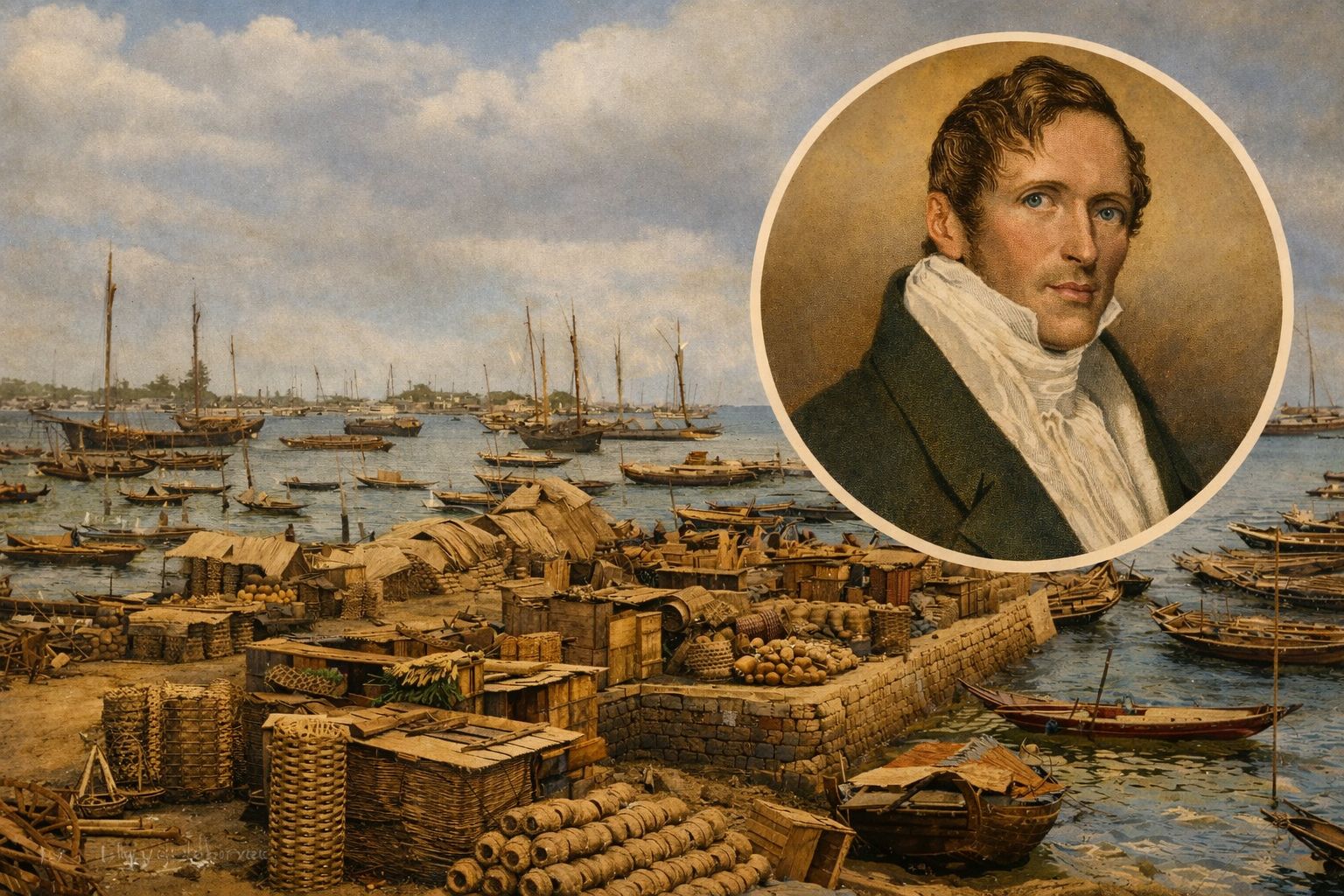
The Selection of Land That Gave Birth to Singapore
On 29 January 1819, a decision was taken that would quietly but decisively alter the course of maritime trade and urban development in Southeast Asia. On that day, Sir Stamford Raffles, a senior administrator of the British East India Company and then Lieutenant Governor of Bencoolen in Sumatra, arrived at an island that was scarcely more than a scattering of fishing settlements. That island would later become known to the world as Singapore.
Raffles was not engaged in an act of conquest, nor was he founding a city in the conventional sense. His purpose was strategic. Britain sought to secure its commercial interests in the region and to counter the expanding Dutch dominance over regional trade routes. What Raffles undertook at Singapore was, in modern terms, an act of site selection grounded in geography rather than grand design.
At the time of his arrival, Singapore was neither a recognised political entity nor an urban centre. The land fell loosely under the influence of the Sultanate of Johor, and there existed no formal system of land ownership as understood in European legal tradition. Authority over land was exercised through local custom and allegiance rather than written title or registry.
[img:Images/otd-29-jan-2nd.jpeg | desc:These images document the transitional condition of Singapore in the period following Sir Stamford Raffles’ arrival and his selection of the site in 1819. The coastal scene shown is not simply a depiction of early port activity, but a visual record of the initial economic framework upon which Singapore’s later urban economy was constructed. The wooden vessels, temporary jetties, and shoreline warehouses indicate a space that remained informal in structure, yet was increasingly drawn into regional and international trading networks.The second image, portraying a colonial street lined with shophouses, illustrates the gradual transformation of a port settlement into an ordered urban landscape. When viewed together, these images demonstrate that Singapore’s development was not the result of sudden planning or abrupt intervention, but rather a cumulative process shaped by deliberate land selection, the steady growth of commerce, and the progressive formation of urban infrastructure. It was this measured and sustained evolution that ultimately enabled Singapore to emerge as a major global trading centre and a modern city of lasting historical significance.(Syed Shayan- Archive Head)]
The decisive factor in Raffles’ choice lay in Singapore’s geographical position. Situated at the entrance to the Strait of Malacca, the island occupied one of the most critical maritime corridors in the world. For centuries, this narrow passage had carried the flow of trade between China, India, the Arab world, and Europe. To establish a port at this point was, in effect, to place a commercial foothold at the crossroads of global maritime traffic.
Raffles understood that a secure and open port at such a location would draw ships not through coercion, but through convenience. Trade would follow geography, and settlement would follow trade. In this sense, the selection of Singapore was less an act of imperial ambition than a recognition of spatial inevitability.
A formal treaty with the Sultan of Johor and the Temenggong was concluded on 6 February 1819, establishing British administration and granting Singapore the status of a free port. With this, land that had previously existed outside formal legal frameworks entered a new phase of regulated use, construction, and commercial development.
From this single decision emerged a modest port, which gradually evolved into a town, then a city, and eventually a city state. In 1965, Singapore became an independent nation, its foundations still traceable to that initial act of land selection in 1819. Sir Stamford Raffles has since been remembered not merely as an administrator, but as the figure most closely associated with the island’s transformation.
Today, the land once occupied by fishing communities stands among the most valuable and efficiently organised urban and commercial spaces in the world. Singapore ranks among the world’s wealthiest nations by income and economic output. Its port is counted among the busiest globally, commonly ranked second in container traffic, and functions as the world’s largest transshipment hub, a central node in the global shipping network where goods are redistributed across continents.
In the history of urban development and real estate, 29 January 1819 endures as a reminder that the fate of cities is often shaped not by grand proclamations, but by the quiet precision of choosing the right place at the right moment.
Read More >