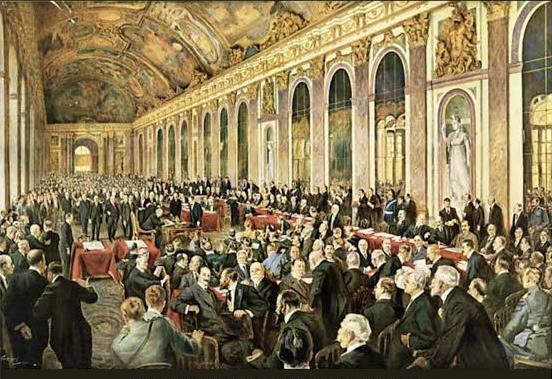
On this date, the Paris Peace Conference formally commenced, marking a decisive moment in the shaping of the modern world map.
The structure of the world map and globe as they are recognised today is fundamentally rooted in the decisions taken following the Paris Peace Conference, which began on 18 January 1919.
Prior to the conference, much of the world was organised under a limited number of vast imperial systems. These included the Ottoman Empire, extending across Asia, Europe, and Africa; the Russian Empire, spanning Eastern Europe and Central Asia; the German Empire, one of Europe’s dominant military powers; and the Austro Hungarian Empire, comprising multiple ethnic and political regions within Central Europe.
The First World War brought about the collapse of these empires. In the period following the Paris Peace Conference, approximately fifteen new states and political entities appeared on the world map, replacing the Ottoman, Austro Hungarian, German, and Russian imperial structures.
The states and territories that emerged after the conference are listed below, arranged according to the empires from which they originated.
1. Ottoman Empire:
Following the First World War, this empire was divided under the Mandate System. Iraq came under British influence. Palestine and Transjordan were placed under British administrative control. Syria and Lebanon came under French administration under mandate arrangements. The Hejaz region, now part of Saudi Arabia, was recognised as an independent political entity.
2. Austro Hungarian Empire:
This transformation represented one of the most significant political reorganisations in Central Europe. Austria was reduced to a smaller German speaking state. Hungary emerged as an independent and sovereign country. Czechoslovakia was created through the unification of Czech and Slovak territories. Yugoslavia was formed by consolidating Serbia, Croatia, and Slovenia into a major Balkan state.
3. Russian Empire:
The combined effects of revolution and global war led to the emergence of several independent states. Poland was re established, drawing territory in part from Germany and Austria. Finland gained independence in Northern Europe. Estonia, Latvia, and Lithuania emerged as sovereign states collectively known as the Baltic States.
4. German Empire:
Germany experienced significant territorial reductions. A corridor was granted to Poland to provide access to the sea. Portions of German territory, including the Sudetenland, were incorporated into Czechoslovakia. Alsace Lorraine was returned to France. Danzig was designated as a Free City.
5. Africa and Asia:
Germany’s overseas colonies were redistributed among the victorious powers. Tanganyika was transferred to British control. Namibia was placed under South African and British administration. Cameroon and Togo were divided between France and Britain. Shandong, a region of China, was transferred to Japan.
[img:Images/otd-18-jan-2nd.jpg | desc:These four men constituted the central decision making authority at the Paris Peace Conference of 1919, convened in the aftermath of the First World War, and are collectively remembered as the Big Four. David Lloyd George, Prime Minister of Britain, approached the settlement with an eye to preserving the European balance of power, regulating the terms imposed upon Germany, and safeguarding British imperial and strategic interests. Georges Clemenceau, Prime Minister of France, was driven primarily by the imperative of containing Germany and securing France against any future threat. Woodrow Wilson, President of the United States, entered the conference as the advocate of a moralised peace, articulated through his Fourteen Points and the ambition of constructing a new international order. Vittorio Orlando, Prime Minister of Italy, sought recognition of Italy’s wartime sacrifices through territorial and political concessions. Taken together, the decisions of these four figures profoundly reshaped not only Europe but also the political boundaries and systems of governance imposed across the Middle East, Africa, and Asia, laying the foundations for new states, enduring conflicts, and the international order that evolved over the subsequent decades.(Syed Shayan, Editorial Head)]
The four principal victorious powers of the First World War were Britain, France, the United States, and Italy, collectively known as the Big Four. Through treaties and the mandate system, these powers assumed control over the colonies and territories of the defeated empires. These mandates were established under the authority of the League of Nations, resulting in vast regions of the Middle East, Africa, and Asia being placed under new systems of governance and newly defined borders, often without the consent of local populations.
From a historical perspective, the Paris Peace Conference represented not merely a settlement of war but a reconfiguration of the global balance of power. The victorious states reshaped the emerging international order in accordance with their strategic interests. Although the conference formally concluded the First World War, the creation of artificial borders and the implementation of the mandate system generated enduring instability in Europe and the Middle East. These imbalances contributed to the rise of nationalist and revisionist politics in Europe, ultimately leading to the Second World War. In the Middle East, the continuing conflict between Palestine and Israel, wars involving Egypt and other Arab states, and persistent regional instability constitute a direct historical legacy of the colonial divisions established at Paris. While the conference laid the foundations of the modern world map, it also left unresolved conflicts that continue to influence global politics and human suffering more than a century later.
Read More >