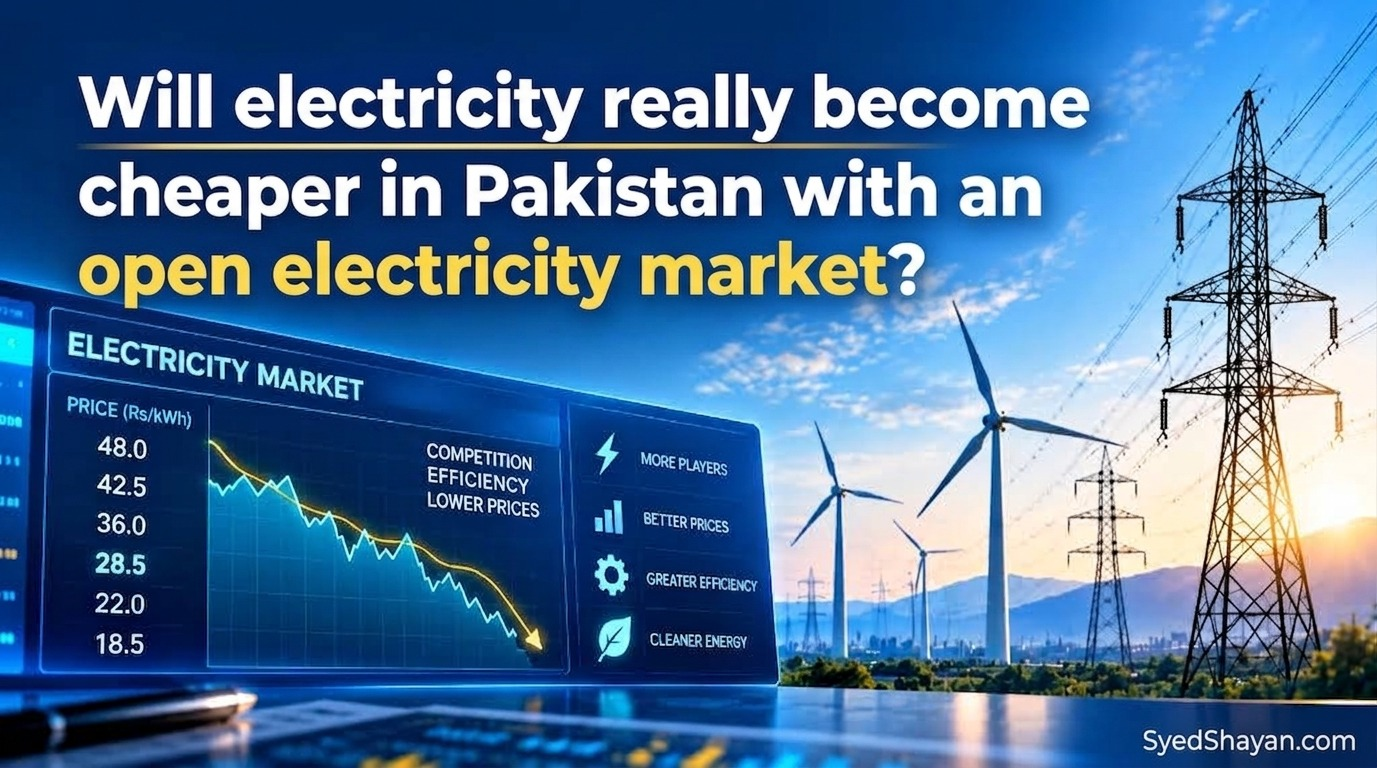
Is Pakistan Moving from Its 30-Year-Old IPP System toward an Open Electricity Market?Public Research Series | Episode 49Topic: How Can Pakistan’s Power System Be Fixed?Title: Can an Open Electricity Market End Expensive Electricity in Pakistan?The first 400 MW auction, a new battery-storage requirement and billions of rupees in potential costs: Is Pakistan ready for an open electricity market?Research & Written by: Syed ShayanA major and potentially transformative change is beginning in Pakistan’s power sector.For nearly three decades, Pakistan has operated under the traditional Independent Power Producer (IPP) model. Under this system, the government entered into long-term agreements with private power plants, often for many years. One of the most controversial features of these arrangements was that payments could be made for the availability of a power plant even when the electricity generated by that plant was not actually purchased. These payments are commonly known as capacity payments.Under the existing structure, large industrial and commercial consumers have not had the freedom to directly purchase electricity from whichever power producer offers them the most competitive price.Now, this traditional model is gradually being supplemented by a new framework known as the Competitive Trading Bilateral Contract Market (CTBCM)—a move toward an open electricity market.Under this system, large industrial consumers will be able to purchase electricity according to their requirements from different electricity suppliers. In theory, this should create genuine competition among power producers and encourage them to offer electricity at more competitive prices.How Would an Open Electricity Market Work?Under the new plan, the government intends to bring a total of 800 MW of electricity into the open-market framework, with 400 MW to be tested in the first phase.In simple terms, imagine two sides of a marketplace.On one side are private electricity producers. On the other are large factories, mills and other major consumers.Power producers would offer their prices for electricity, while buyers would have the option of selecting the supplier offering the most competitive combination of price and service.This could fundamentally change the relationship between electricity producers and large consumers.Instead of relying entirely on centrally arranged power procurement, industrial consumers could have greater choice, while generators would have a stronger incentive to compete on price and reliability.How Will the Electricity Reach the Consumer?This raises an obvious question: if a factory in Lahore purchases cheaper electricity from a solar or wind power plant in Sindh or southern Punjab, how will that electricity physically reach Lahore?The answer is that the power producer would not need to build a separate transmission line all the way from its plant to the factory.Instead, the electricity would be transmitted through the existing national grid and the networks operated by Pakistan’s distribution companies, commonly known as DISCOs.However, the consumer would have to pay a fee for using this transmission and distribution infrastructure.This is known as a wheeling charge.NEPRA has set wheeling charges for different categories of large consumers at approximately PKR 6.23 to PKR 19.62 per unit.Therefore, consumers will not be able to judge the cost of electricity simply by looking at the generator’s quoted tariff.The actual cost will depend on:The price charged by the power producer;Wheeling charges;Applicable taxes; andOther associated costs and charges.The true competitiveness of the open market will therefore depend on the all-in cost paid by the consumer.The New Battery Storage RequirementOne of the most important features of the new framework is the introduction of a battery-storage requirement.New solar and wind power projects are expected to be required to install battery storage alongside their generation facilities so that excess electricity can be stored and used when required.Initially, the battery-storage requirement has been set at a minimum of 10% of the project’s total generation capacity.For example, if projects totaling 400 MW are developed, approximately 40 MW of battery storage would be required.The reason is straightforward.Solar and wind generation is inherently variable.Solar generation is very high during periods of strong sunlight but falls sharply as evening approaches. Wind generation is also dependent on changing wind speeds and therefore cannot be expected to remain constant throughout the day.Battery storage can capture excess electricity generated during periods of high production and release it later, including during periods when demand is high or renewable generation is low.But this raises an important question:Can installing batteries equal to just 10% of generation capacity solve Pakistan’s power-sector problems?The answer is no—not by itself.At this stage, this should be viewed as an initial experiment.The real importance of the development is that, for the first time, Pakistan’s emerging open-market framework is attempting to combine green energy with energy storage.Only after the first auction will we be able to assess in practical terms:How much these batteries actually cost;How much electricity they are able to store;How frequently they are used;What their operating costs are; andHow much technical and economic value they actually provide to the electricity system.This Is Not the Same as a Household BatteryIt is important to understand that these are not ordinary batteries used in homes or small solar systems.The proposed systems are large-scale industrial installations known as Battery Energy Storage Systems (BESS).A grid-scale BESS can include large containerized battery units, inverters, transformers, cooling systems, monitoring equipment and automated protection systems.In other words, this is not a small backup battery.It is a sophisticated industrial system designed to manage and deliver large quantities of electricity to the grid.The cost of such a system cannot be determined simply by looking at its MW rating.The more important measure is its energy-storage capacity in megawatt-hours (MWh) and the number of hours for which it can continuously supply electricity.For example, a 50 MW battery system capable of supplying electricity continuously for four hours would have an energy-storage capacity of 200 MWh.Based on a recent indicative global-market cost of approximately US$110–120 per kWh, the equipment cost of such a system alone would be approximately US$24 million, equivalent to roughly PKR 6.7 billion.What Could 40 MW of Battery Storage Cost?Using the same calculation, the 400 MW first-phase solar projects would require approximately 40 MW of battery storage under a 10% requirement.If the storage system were designed for four hours, this would represent approximately 160 MWh of storage capacity.At the indicative cost mentioned above, the basic equipment cost alone would be approximately US$19 million, or around PKR 5.4 billion.However, equipment cost is obviously not the entire investment.Additional costs may include:Customs duties;Local transportation;Civil works;Grid integration;Installation;Electrical infrastructure;Control and protection systems; andOther associated development costs.Therefore, once the system is fully installed and operational, the practical cost of this 10% storage requirement could potentially reach approximately PKR 6–6.5 billion.These figures are indicative and should ultimately be tested against the actual bids received in Pakistan.A Welcome Step—but With Serious QuestionsNEPRA’s move toward integrating energy storage is certainly a step worth examining positively.However, I have several concerns that I believe must be shared with readers.If Pakistan proceeds without careful economic and technical planning, there is a risk that we could add another financial burden to the electricity system—on top of capacity payments and other expensive charges.Instead of solving one problem, we could potentially create another liability involving battery replacement costs, imported equipment and foreign-exchange requirements.My principal concerns are as follows.1. Technical Limitations of Battery Storage and a Weak GridGlobally, batteries are commonly used for applications such as frequency regulation, voltage balancing and shifting electricity into evening peak periods, often over approximately 2–4 hours.Strong grid systems can absorb a significant amount of inexpensive solar generation directly without requiring every renewable project to have large-scale battery storage.Pakistan, however, has a different challenge.Our fundamental transmission and distribution infrastructure remains weak in many areas.Therefore, attempting to compensate for shortcomings in the NTDC and DISCO transmission and distribution systems by relying on very long-duration storage—such as 8–10 hours—without first strengthening the grid could prove technically inefficient and economically extremely costly.Battery storage should complement a strong grid, not become a substitute for fixing a weak one.2. Supply-Chain Risks and Foreign-Exchange PressureDeveloped economies generally have greater access to capital and more stable currencies. This makes it easier for them to absorb the cost of upgrading battery technologies, including Lithium Iron Phosphate (LFP) systems.Pakistan faces a very different economic environment.The country regularly faces foreign-exchange constraints, and heavy dependence on imported battery systems could create an additional demand for dollars.If Pakistan moves toward 8–10 hours of storage, battery cells and modules may eventually require replacement after several years of operation.Depending on the technology, operating conditions and degradation profile, major replacement costs could therefore become a recurring foreign-exchange liability.This issue must be incorporated into the financial model from the beginning rather than being treated as a future problem.3. The Risk of Putting the Cost of Grid Inefficiency on BatteriesPakistan’s core electricity problem is not simply the absence of batteries.One of the fundamental challenges is the weakness and inefficiency of the country’s transmission and distribution infrastructure.If battery storage is used to conceal or compensate for failures in the NTDC and DISCO networks, the country could end up paying for an expensive technological solution to a problem that fundamentally requires grid investment and reform.Battery storage is undoubtedly an important technology for the future.But it should not become a mechanism through which the cost of an inefficient grid is transferred to electricity consumers.What NEPRA Should Clarify Before the First AuctionBattery storage may well be part of Pakistan’s future electricity system.But the country must proceed carefully.Before the first 400 MW auction, NEPRA should clearly disclose:How many hours of storage will be required?What is the expected total cost of the storage system?Who will ultimately bear that cost?What are the expected operating and maintenance costs?How will battery degradation and replacement be handled?Will the cost ultimately be passed on to electricity consumers?These questions are critical if the objective is genuinely to reduce the cost of electricity.When Will the First Auction Take Place?The auction process is expected to begin in September 2026, although the final date has yet to be announced.Following the issuance of the Request for Proposals (RFP), interested companies are expected to be given approximately two months to submit their commercial bids.For investors and businesses considering participation in this auction, my particular recommendation is to examine every technical and financial aspect of the project extremely carefully.If the concerns surrounding the replacement and operational costs of grid-scale Battery Energy Storage Systems (BESS) prove to be valid, this initiative could gradually become a significant financial burden.Even if, in practical terms, the batteries are used primarily for only one or two hours during peak periods, the project's financial viability and economic model must still be calculated with extreme precision.Before submitting a bid, investors should have a completely transparent picture of:Initial capital expenditure;Battery degradation;Replacement costs;Financing costs;Foreign-exchange exposure;Operating and maintenance expenses;Grid-integration costs;Expected revenue;Contractual obligations; andLong-term profitability.A project may appear financially attractive on paper while becoming significantly more expensive over its operational lifetime.Is Pakistan Really Ready for an Open Electricity Market?The move toward CTBCM and an open electricity market could represent one of the most important structural changes in Pakistan’s power sector in decades.In principle, competition among electricity producers could help large consumers obtain more competitive electricity prices.But an open market does not automatically guarantee cheap electricity.Its success will depend on whether Pakistan can simultaneously:Create genuine competition among generators;Ensure transparent and fair market rules;Strengthen transmission infrastructure;Improve DISCO performance;Establish reasonable wheeling charges;Prevent market manipulation;Develop reliable balancing mechanisms;Integrate renewable energy efficiently; andEnsure that new storage requirements do not simply create another long-term financial burden for consumers.The comparison with the telecommunications sector is useful.Pakistan once had a highly restricted and expensive telephone system. Competition and technological change eventually transformed telecommunications and made mobile services widely accessible.The electricity sector could potentially undergo a similar transformation—but electricity is far more technically complex.Unlike a mobile phone call, electricity must be generated and consumed within a carefully balanced physical system, and the cost of maintaining that system cannot simply disappear through competition.Therefore, the real test will not be whether Pakistan launches an open electricity market.The real test will be whether the new market can deliver reliable electricity at a genuinely lower all-in cost without creating another generation of expensive contractual liabilities.