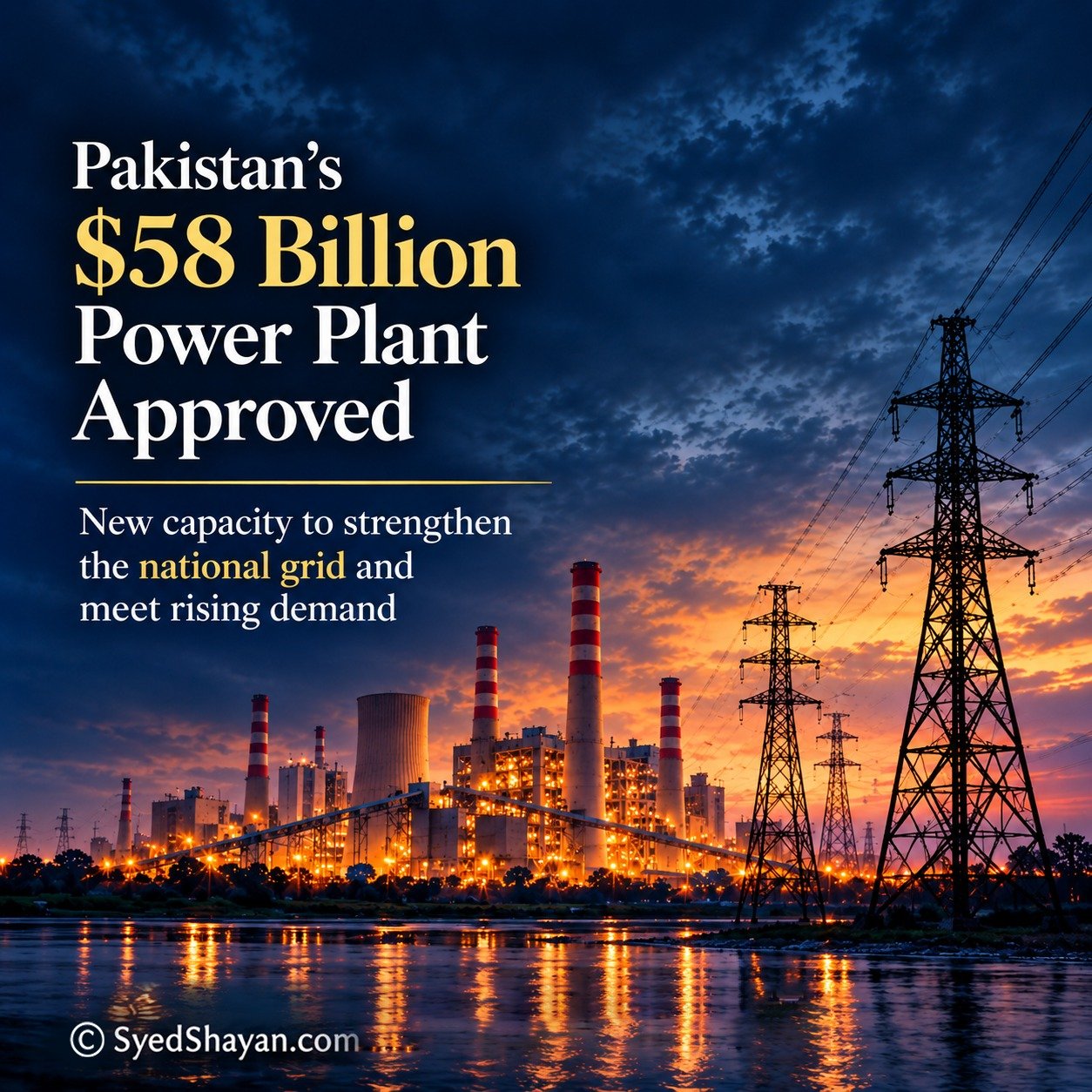
🔳 NEPRA has approved a major plan for electricity generation and transmission for the next eleven years. The estimated cost of the plan is approximately US$58 billion.
▫
When the government itself acknowledges that the country already has more electricity generation capacity than it currently needs, and that billions of rupees are being paid in capacity charges to power plants because many of them are operating below capacity, why has the need suddenly arisen to add more electricity generation and build new power plants by 2035?
▫
The estimated cost of the plan, US$58 billion, has been disclosed, but it is still unclear where the complete funding for such a massive investment will come from. However, NEPRA has directed that the impact of this plan on consumer electricity tariffs should also be calculated. This raises concerns that the burden of this new investment may eventually be passed on to consumers through their electricity bills. Public Research Series | Episode 56 Topic: How Can Pakistan’s Electricity System Be Reformed? Title: The $58 Billion Power Plan: Can Such a Major Decision Be Made by NEPRA Alone? 🔺 If the cost of every development project is ultimately recovered from the public through utility bills, then who will stop governments from approving unnecessary and expensive projects? Written & Researched by: Syed ShayanIn September, NEPRA approved an eleven-year mega plan for Pakistan’s power sector covering the period from 2025 to 2035. Under this plan, an estimated US$58 billion will be spent on new electricity generation projects and the transmission system used to deliver electricity across the country. At the current exchange rate, this amount is approximately PKR 16.07 trillion. I find it surprising that a country which recently approached the International Monetary Fund for financial assistance of only around US$1.3 billion is now planning a US$58 billion investment in the electricity sector. What is the financial thinking behind such a massive plan, and who is designing projects of this scale while knowing that the public is already struggling with expensive electricity and extremely high power bills? According to the plan, government experts have assumed that because Pakistan’s peak electricity demand stood at 26,950 MW in March 2025, it will increase to 35,521 MW by 2035. To meet this projected increase, the plan proposes adding 26,045 MW of new generation capacity, while 2,577 MW of existing capacity will be retired.After these changes, Pakistan’s total electricity generation capacity is projected to reach 62,657 MW. This figure also includes 8,120 MW of net-metering capacity. According to the plan, US$47.08 billion will be required for new power generation projects, while another US$10.65 billion will be needed for the transmission network that carries electricity throughout the country. Together, these expenditures amount to US$57.73 billion, or approximately US$58 billion. I find this US$58 billion power-sector plan deeply concerning. For comparison, when the China-Pakistan Economic Corridor, or CPEC, was initially announced in 2015, it was presented as an investment programme worth US$46 billion and was described at the time as one of the largest development programmes in Pakistan’s history. Its overall value was later reported to be around US$62 billion. CPEC was a broad development programme involving roads, bridges, ports, power plants and projects across several other sectors. By comparison, the current plan estimates that nearly US$58 billion will be spent almost entirely on electricity generation and transmission infrastructure. The central question is: what evidence and assumptions has the government used to conclude that Pakistan’s electricity demand will increase by around 8,500 MW by 2035? Over the past several years, Pakistan’s industrial sector has faced severe economic pressure. High electricity prices and weak business conditions have contributed to a continuing decline in industrial electricity consumption from the national grid.According to the Pakistan Institute of Development Economics, or PIDE, industrial grid electricity consumption declined by 8 percent in financial year 2022-23, by 12 percent in 2023-24, and by a further 6 percent in 2024-25. This represents a cumulative decline of approximately 26 percent across those years. However, during the first nine months of financial year 2025-26, this trend changed. According to the Pakistan Economic Survey, industrial electricity consumption during that period increased by approximately 24 percent compared with the same period of the previous year. One possible reason for this increase is that industries which had previously been generating more electricity on their own may have started returning to the national grid. Therefore, the 2025-26 figures suggest that industrial grid demand has begun to recover. However, they do not prove that electricity demand will continue increasing at the same pace in the years ahead. This raises another fundamental question. If Pakistan’s electricity demand is genuinely expected to reach 35,521 MW by 2035, the government should clearly explain where this additional demand will come from. Is Pakistan planning to establish electricity-intensive heavy industries such as aluminium smelters? Are large artificial intelligence data centres expected to be developed?Is the government expecting the revival of major industrial units that are currently closed or operating below capacity?If so, the government should place the details of these expected developments and their projected electricity consumption before the public.A general assumption based only on population growth or economic improvement should not be enough.For a project costing US$58 billion, it should be clearly identified who the future consumers of this additional electricity will be and when this demand is expected to materialise. At the same time, Pakistan’s existing power system already has substantial generation capacity, but a significant portion of this capacity is not being fully utilised. Despite this, power producers continue to receive capacity payments for keeping generation capacity available.If the new generation capacity also turns out to be greater than actual electricity demand, Pakistan may end up repeating the same problem on a much larger scale. Another important aspect of this plan also deserves close attention. The electricity demand forecasts up to 2035 were prepared by the newly established Independent System and Market Operator, or ISMO, to which the government has transferred important responsibilities relating to power-system and electricity-market planning. This relatively new institution has projected future electricity demand using different assumptions regarding GDP growth. These forecasts have then been used as the basis for planning billions of dollars of new electricity generation and transmission capacity. The question is whether Pakistan should base a nearly US$58 billion investment programme on the long-term forecasts of an institution whose own operational track record is still limited. Before such a major commitment is made, the public should be told who prepared these forecasts, who independently reviewed the assumptions behind them, how reliable the forecasting models have proven when tested against historical data, and who will bear the financial cost if GDP growth or actual electricity demand turns out to be lower than projected. (To be continued. The remaining discussion will follow in the next episode.)