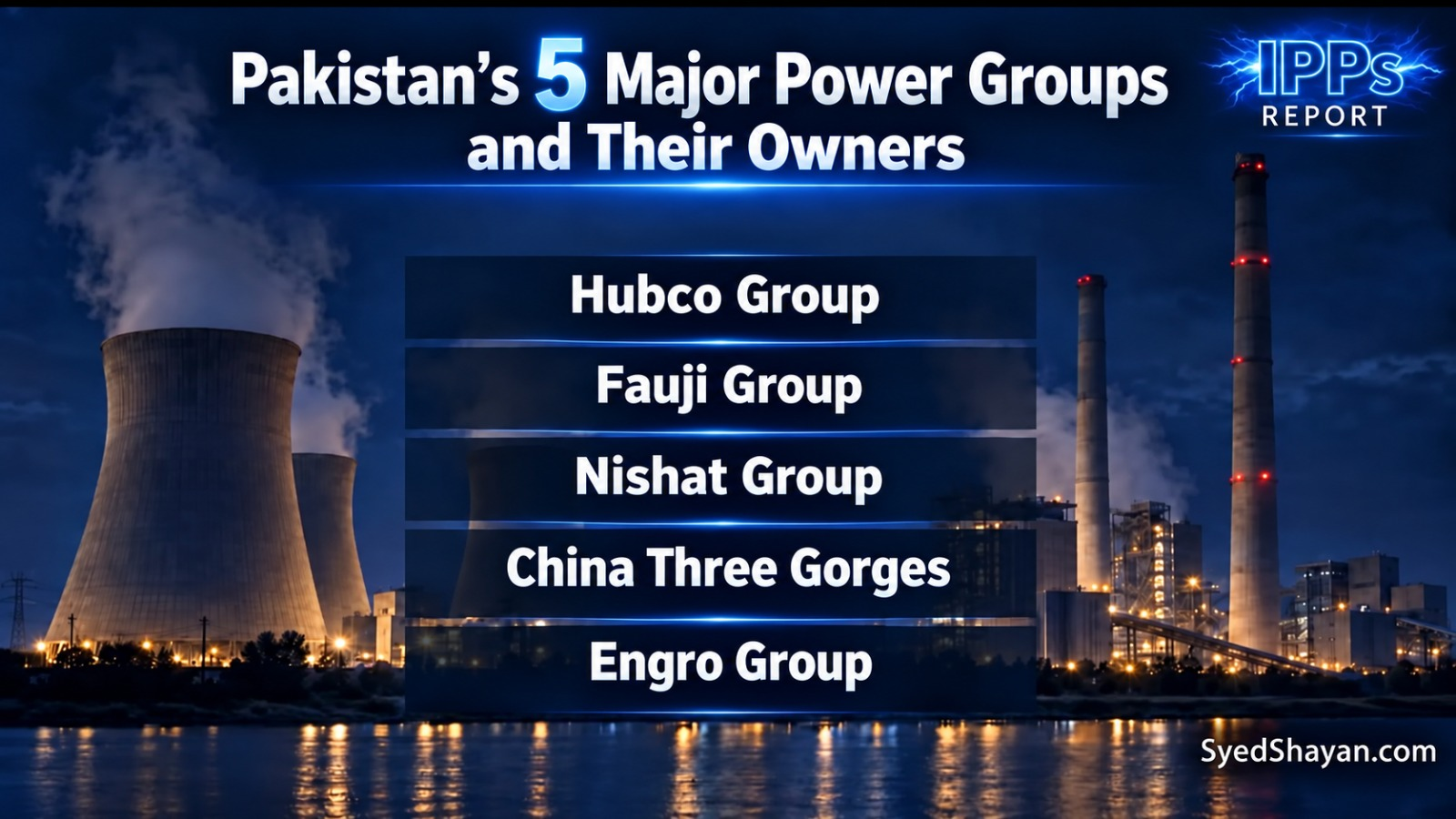
Which Group Has the Most Power Plants in Pakistan?Public Research Series | Part 48Topic: How Can Pakistan’s Electricity System Be Fixed?Title: Pakistan’s Five Major Private Power Groups, Their Independent Power Producers (IPPs), Owners and Capacity PaymentsThe ownership of Pakistan’s power plants and the payments they receive should be made public.Written and researched by Syed ShayanIn this instalment, we examine five major private power groups operating in Pakistan. We explain who owns each group, how many power plants it has, where they are located, how much electricity they can generate, how much they actually produce and how much they receive in capacity payments.This list is based on the number of plants. Some groups have more plants with smaller capacities, while others have fewer but much larger plants. Government power plants, WAPDA facilities, nuclear power plants and K Electric’s own plants are excluded from this list.Official records list each power plant under a separate company name. We have compiled this list by identifying the owners and major business groups behind those companies.The five major private power groups, ranked by the number of plants, are:1. HUBCO Group: The group had six projects. Five remain following the closure of the old Hub plant.2. Fauji Group: Five projects.3. Mansha or Nishat Group: Four projects.4. China Three Gorges: Four projects.5. Engro or Dawood Group: Three major projects, although the ownership of some is being transferred.Electricity generation figures below are expressed in units. One unit of electricity equals one kilowatt hour (kWh).1. HUBCO GroupHUBCO is Pakistan’s largest private power group. Its chairman is Habibullah Khan, and Mega Conglomerate, which is associated with him, is a major shareholder.HUBCO had six projects. Following the termination of the old Hub Power Plant’s agreement, five projects remain:1. Narowal Energy, Punjab: 225 MW.2. Laraib Energy, Azad Kashmir: 84 MW.3. China Power Hub, Balochistan: 1,320 MW.4. Thar Energy, Sindh: 330 MW.5. ThalNova Power, Sindh: 330 MW.These five plants have a combined capacity of 2,289 MW. If they operated at full capacity throughout the year, they could generate approximately 20 billion units of electricity.However, during the financial year 2024 to 2025, these plants generated only 4.44 billion units, using approximately 22% of their combined capacity.The performance of each plant was as follows:Narowal Energy generated approximately 37.9 million units, with capacity utilisation of only 2%. It received approximately Rs 4.48 billion in capacity payments.Laraib Energy generated approximately 353.6 million units, with capacity utilisation of 48%. It received approximately Rs 8.11 billion in capacity payments.China Power Hub generated approximately 671.7 million units, with capacity utilisation of only 6%. Despite this, it received approximately Rs 124.46 billion in capacity payments.Thar Energy generated approximately 1.60 billion units, with capacity utilisation of 61%. It received approximately Rs 39.44 billion in capacity payments.ThalNova generated approximately 1.78 billion units, with capacity utilisation of 68%. It received approximately Rs 31.99 billion in capacity payments.Together, these five projects received approximately Rs 208.48 billion in capacity payments during the financial year 2024 to 2025, while generating approximately 4.44 billion units at only 22% of their combined capacity.Other investors also hold stakes in China Power Hub, Thar Energy and ThalNova. Therefore, the entire amount of approximately Rs 208 billion did not go to HUBCO alone. This was the total capacity payment received by all five projects, with HUBCO benefiting according to its shareholding.All figures are taken from NEPRA’s report on individual power plant performance for the financial year 2024 to 2025.2. Fauji GroupFauji Group’s power projects are associated with the Fauji Foundation and Fauji Fertilizer Company. The group has five major power plants:1. Fauji Kabirwala, Punjab: 170 MW.2. Foundation Power Daharki, Sindh: 179 MW.3. Foundation Wind Energy I, Sindh: 50 MW.4. Foundation Wind Energy II, Sindh: 50 MW.5. FFC Energy, Sindh: 50 MW.These five plants have a combined capacity of approximately 499 MW. If they operated at full capacity throughout the year, they could generate approximately 4.37 billion units of electricity.However, during the financial year 2024 to 2025, they generated approximately 1.47 billion units, using around 34% of their combined capacity.The performance of each plant was as follows:Fauji Kabirwala generated approximately 69 million units, with capacity utilisation of only 5%. It received approximately Rs 2.67 billion in capacity payments.Foundation Power Daharki generated approximately 1.12 billion units, with capacity utilisation of 77%. It received approximately Rs 3.11 billion in capacity payments.Foundation Wind Energy I generated approximately 93.3 million units, with capacity utilisation of 21%. It received approximately Rs 4.63 billion in capacity payments.Foundation Wind Energy II generated approximately 105.4 million units, with capacity utilisation of 24%. It received approximately Rs 4.47 billion in capacity payments.FFC Energy generated approximately 76.4 million units, with capacity utilisation of 18%. It received approximately Rs 2.05 billion in capacity payments.Together, these five projects received approximately Rs 16.93 billion in capacity payments during the financial year 2024 to 2025, while generating approximately 1.47 billion units of electricity.All figures are taken from NEPRA’s report on individual power plants for the financial year 2024 to 2025.3. The Nishat Group of Mian Muhammad Mansha and His FamilyFour major power plants have been associated with this group. Nishat Chunian Power is associated with Mian Mansha’s nephew, Shahzad Saleem. Following a transfer of shares in November 2024, Nishat Mills also became a significant shareholder in the company.1. Nishat Power, Kasur: 200 MW.2. Nishat Chunian Power, Kasur: 200 MW.3. Lalpir Power, Muzaffargarh: 362 MW.4. Pakgen Power, Muzaffargarh: 365 MW.These four plants had a combined capacity of approximately 1,127 MW. If they had operated at full capacity throughout the year, they could have generated approximately 9.87 billion units of electricity.However, during the financial year 2024 to 2025, they generated only approximately 151.6 million units.Nishat Power generated approximately 86.7 million units, with capacity utilisation of only 5%. It received approximately Rs 4.01 billion in capacity payments.Nishat Chunian Power generated approximately 57.2 million units, with capacity utilisation of only 3%. It received approximately Rs 4.05 billion in capacity payments.Lalpir Power did not generate any electricity but received approximately Rs 2.67 billion in capacity payments. Its agreement with the government ended on 30 September 2024.Pakgen Power generated only approximately 7.7 million units, with capacity utilisation below 1%. It received approximately Rs 5.73 billion in capacity payments. Its agreement ended on 31 January 2025.Together, these four plants associated with the Mansha family supplied only 151.6 million units of electricity during the financial year 2024 to 2025, while receiving approximately Rs 16.45 billion in capacity payments.The agreements for Lalpir and Pakgen ended during that financial year. They therefore cannot be treated as plants that remained active throughout the entire year when making comparisons or calculations.All figures are taken from NEPRA’s report for the financial year 2024 to 2025.4. China Three GorgesChina Three Gorges Corporation is a state owned Chinese company belonging to the Chinese government. It has four major projects in Pakistan:1. Karot Hydropower, Jhelum River: 720 MW.2. Three Gorges First Wind Farm, Sindh: 49.5 MW.3. Three Gorges Second Wind Farm, Sindh: 49.5 MW.4. Three Gorges Third Wind Farm, Sindh: 49.5 MW.These four plants have a combined capacity of approximately 868.5 MW. If they operated at full capacity throughout the year, they could generate approximately 7.61 billion units of electricity.During the financial year 2024 to 2025, they generated approximately 2.99 billion units, using around 39% of their combined capacity.The performance of each plant was as follows:Karot Hydropower generated approximately 2.74 billion units, with capacity utilisation of 43%. It received approximately Rs 101.11 billion in capacity payments.Three Gorges First Wind Farm generated approximately 85.6 million units, with capacity utilisation of around 20%. It received approximately Rs 2.72 billion in capacity payments.Three Gorges Second Wind Farm generated approximately 84.5 million units, with capacity utilisation of around 20%. It received approximately Rs 3.83 billion in capacity payments.Three Gorges Third Wind Farm generated approximately 86.2 million units, with capacity utilisation of around 20%. It received approximately Rs 3.95 billion in capacity payments.Together, these four projects generated approximately 2.99 billion units of electricity during the financial year 2024 to 2025, while receiving approximately Rs 111.62 billion in capacity payments.All figures are taken from NEPRA’s report for the financial year 2024 to 2025.5. Engro or Dawood GroupEngro is a Pakistani business group led by Hussain Dawood and his family. His son, Abdul Samad Dawood, also holds important positions within the group. It should be distinguished from Abdul Razak Dawood’s Descon Group.Its power projects were established through Engro Energy. The group later entered into an agreement to sell its stakes in thermal power projects to a Pakistani consortium comprising Liberty Power, Soorty Enterprises and Procon Engineering.Three major power plants have been associated with this group:1. Engro Powergen Qadirpur, Ghotki: 217 MW.2. Engro Powergen Thar, Sindh: 660 MW.3. Tenaga Generasi Wind Power, Sindh: 49.5 MW.These three plants have a combined capacity of approximately 926.5 MW. If they operated at full capacity throughout the year, they could generate approximately 8.12 billion units of electricity.During the financial year 2024 to 2025, they generated approximately 4.72 billion units, using around 58% of their combined capacity.The performance of each plant was as follows:Engro Powergen Qadirpur generated approximately 774.3 million units, with capacity utilisation of 42%. It received approximately Rs 2.56 billion in capacity payments.Engro Powergen Thar generated approximately 3.85 billion units, with capacity utilisation of 73%. It received approximately Rs 59.99 billion in capacity payments.Tenaga Generasi generated approximately 89.2 million units, with capacity utilisation of 20%. It received approximately Rs 4.37 billion in capacity payments.Together, these three projects associated with Engro generated approximately 4.72 billion units of electricity during the financial year 2024 to 2025, while receiving approximately Rs 66.93 billion in capacity payments.These figures relate to projects established by Engro. Where stakes have already been sold, the current income from those projects goes to the new owners according to their respective shareholdings.All figures are taken from NEPRA’s report for the financial year 2024 to 2025.Understanding Capacity PaymentsThis article places particular emphasis on the capacity payments received by projects associated with these five groups.In simple terms, a capacity payment is an agreed payment that the government has committed to making to a power plant, whether or not it generates electricity, provided the plant is ready and available to produce power.These payments cover the plant’s debt obligations, expenses and returns to its owners. The entire amount is not the company’s net profit.Among the five groups discussed here, the ranking by capacity payments received during the financial year 2024 to 2025 was:1. HUBCO projects: Approximately Rs 208.48 billion.2. China Three Gorges projects: Approximately Rs 111.62 billion.3. Projects associated with Engro and the Dawood Group: Approximately Rs 66.93 billion.4. Fauji Group projects: Approximately Rs 16.93 billion.5. Projects associated with the Mansha and Nishat Group: Approximately Rs 16.45 billion.Together, plants associated with these five groups alone received approximately Rs 420.40 billion in capacity payments during the financial year 2024 to 2025.Several of these plants operated at only 5%, 10% or 20% of their full capacity, yet continued to receive billions of rupees in capacity payments under their agreements. The people of Pakistan continued to pay expensive electricity bills, while plants producing limited amounts of electricity continued to receive billions. This is a particularly dark aspect of Pakistan’s power sector history.To be continued in the next instalment.Take Part in Our ResearchWe invite readers to join our research based think tank, SyedShayan.com, and contribute to our work on understanding and improving Pakistan’s electricity system and the structure behind high electricity bills.We are preparing a comprehensive white paper on Pakistan’s electricity system. Once finalised, it will be submitted to the relevant institutions.We encourage committed individuals to introduce our think tank and web portal within their circles, share excerpts from our articles and contribute their views. Together, these efforts can help build an effective public voice, grounded in facts, against high electricity costs.Website: [www.SyedShayan.com](https://syedshayan.com/)5 September 2026