🔲 Disaggregating Pakistan’s 105 Power ContractsOwnership, arbitration exposure, and the case for treating each category on its own terms.A system built to pay, or a system built to reform? Public Investigative Series | Episode 52 Subject: How Pakistan’s electricity system can be put right Title: The 105 contracts are not a single legal object.🔺 When institutions fail to provide the facts, the pursuit of truth becomes a public responsibility.Research and writing: Syed Shayan
▫
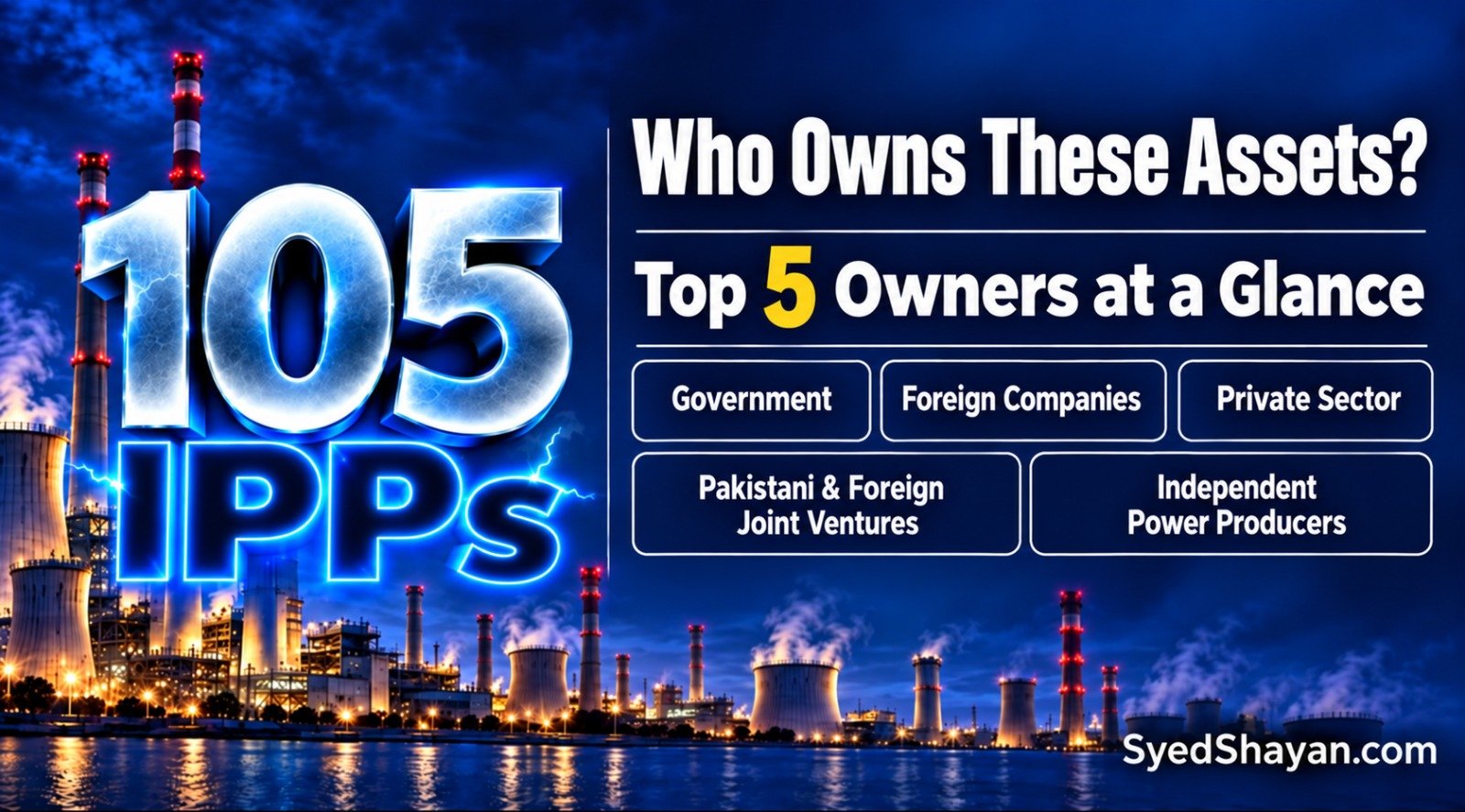
Pakistan’s government contracts with 105 power plants, the independent power producers, or IPPs, are usually discussed as if they were one instrument, subject to one constraint. They are not. Our research finds that only 18 of the 105 projects are wholly foreign. Seventy sit with the state, with military welfare commercial groups, or with wholly Pakistani private owners. A further 17 are joint ventures. Include those 17 and 87 of the 105 projects are wholly or partly in Pakistani ownership.
▫
The government can negotiate with the 18 foreign projects in accordance with international law. The remaining 87 contracts should be examined one by one, so that unnecessary capacity payments, concessions, and profits can be reduced. Household electricity bills can be cut by a substantial margin if that work is done.
▫
Officials have repeatedly said that if these contracts are amended or brought to an end, the companies will take Pakistan to international arbitration. The question is more precise than the warning. Of the 105 contracts, which counterparties actually possess that right? Can state owned plants, military welfare commercial vehicles, and wholly Pakistani private companies take a dispute before a foreign tribunal, or does that right attach only to foreign investors?The public is entitled to know, for every contract, three things: who owns it; whether it contains an overseas arbitration clause; and on what legal and economic basis it has been kept in force, or renewed, after its original term.This installment sets out how many of the 105 counterparties can still knock at the door of an international tribunal. It locates where genuine international arbitration risk still sits. And it asks why, after some IPP terms expired, the government retained those contracts and on what grounds they were renewed.Once public and private plants were folded into a single IPP architecture, the question was no longer whether the system could be changed. It was whether the state intended to change it, or had simply found a convenient way to draw money from household budgets through the electricity bill.When the fiftieth installment of this research was published, many readers asked a prior question: what is the evidence that 105 IPP or power purchase contracts exist at all, and who actually owns the plants behind them?The figure of 105 is not an outside estimate. It is an official number presented by the Ministry of Energy. The more important of the two questions, who the real owners are, is the subject of this piece. The names of the projects and companies attached to all 105 contracts are set out below.For convenience they are grouped into five categories:1. Plants and projects under federal or provincial control. 2. Projects linked to Fauji Foundation, the FFC Group, and other military welfare institutions. 3. Wholly foreign owned IPPs. 4. Pakistani foreign joint venture IPPs. 5. Wholly Pakistani privately owned IPPs.The purpose of this division is to make visible the actual share of the state, of military welfare commercial groups, of foreign investors, and of Pakistani business houses in the country’s power purchase architecture. The classification should make the ownership and structure of the 105 contracts easier to read, and it should reduce the confusion that has surrounded this subject.1. Federal or provincial control, 21 projectsThese are the projects and contracts whose primary control rests with the federal government, a provincial government, WAPDA, the Pakistan Atomic Energy Commission, Azad Kashmir, or another state institution.1. Jagran I Hydropower Project, Azad Jammu and Kashmir; a public hydel project of the AJK government. 2. Chashma Nuclear Power Plant C1, Pakistan Atomic Energy Commission. 3. Chashma Nuclear Power Plant C2, Pakistan Atomic Energy Commission. 4. Chashma Nuclear Power Plant C3, Pakistan Atomic Energy Commission. 5. Chashma Nuclear Power Plant C4, Pakistan Atomic Energy Commission. 6. Central Power Generation Company (GENCO II), Federal public sector generation company. 7. Dural Khwar Hydropower Project, Khyber Pakhtunkhwa; Pakhtunkhwa Energy Development Organization (PEDO). 8. Jamshoro Coal Power Project, Jamshoro Power Company; public sector. 9. Karachi Nuclear Power Plant K2, Pakistan Atomic Energy Commission. 10. Karachi Nuclear Power Plant K3, Pakistan Atomic Energy Commission. 11. Kot Addu Power Company Limited (KAPCO), WAPDA is the largest shareholder, including employee trusts; state influence and control. 12. Malakand III Hydropower Project, Khyber Pakhtunkhwa public hydel project. 13. Neelum Jhelum Hydropower Project, WAPDA; a federal public project. 14. Northern Power Generation Company (GENCO III), Federal public sector generation company. 15. National Power Parks Management Company, Balloki, Federal government. 16. National Power Parks Management Company, Haveli Bahadur Shah, Federal government. 17. Punjab Thermal Power, Trimmu, Government of Punjab. 18. Quaid e Azam Thermal Power, Bhikki, Government of Punjab. 19. Quaid e Azam Solar Power (Private) Limited, Government of Punjab. 20. Ranolia Hydropower Complex, Khyber Pakhtunkhwa, PEDO. 21. WAPDA power projects, An aggregate entry covering WAPDA’s several hydel projects.The list of 21 public projects makes one fact difficult to evade. The consumer pays for their electricity, their debt, their fixed costs, their capacity charges, and, in some cases, a regular return on investment. The public is therefore entitled to ask on what basis, at what rate, and for what purpose capacity charges and profits are being paid to public sector plants.2. Military welfare institutions, 5 projectsThese are not institutions of the Pakistan Army’s defence budget. They are commercial projects of military welfare trusts and of the companies those trusts control. The names that recur are Fauji Foundation and Fauji Fertilizer Company.1. Fauji Kabirwala Power Company Limited, Fauji Foundation. 2. FFC Energy Limited, Fauji Fertilizer Company. 3. Foundation Power Company Daharki Limited, Fauji Foundation. 4. Foundation Wind Energy I Limited, Fauji Foundation. 5. Foundation Wind Energy II Limited, Fauji Foundation.Why, and at what rate, are these five projects paid capacity charges from consumer bills, a return embedded in the tariff, and a return on investment? They are not foreign investors. They are commercial vehicles of Pakistan’s own military welfare institutions. The government should also state, plainly, whether their contracts in fact confer a right to overseas arbitration. If they do not, why are they swept into the international arbitration risk that is used to freeze reform?3. Wholly foreign owned projects, 18These are the projects in which no Pakistani strategic equity partner is in view, or in which beneficial ownership is in practice wholly foreign. Incorporation in Pakistan is not treated here as Pakistani ownership.1. Apollo Solar Development Pakistan Limited, Chinese and Hong Kong sponsors. 2. Best Green Energy Pakistan Limited, Chinese sponsors. 3. Crest Energy Pakistan Limited, Chinese sponsors. 4. Halmore Power Generation Company Limited, British beneficial ownership; the principal owner holds approximately 99.9 percent. 5. Hawa Energy Private Limited, Foreign holding; JCM and related overseas investors. 6. Sahiwal Coal Power (Huaneng Shandong Ruyi Energy Private Limited), China. 7. Jhimpir Power Private Limited, Singapore holding; Canadian JCM and Dubai related capital. 8. Karot Power Company Private Limited, China Three Gorges Group. 9. Mira Power Limited (Gulpur), Korean sponsors. 10. Port Qasim Electric Power Company Private Limited, China and Qatar; both states are foreign. 11. Star Hydro Power Limited, Korean sponsors; Patrind hydropower project. 12. Tavanir Iran, Iranian state electricity supplier. This is not a domestic IPP; it is an import contract. 13. Thar Coal Block 1 Power Generation Company, Shanghai Electric and Chinese sponsors. 14. Three Gorges First Wind Farm Pakistan, China Three Gorges. 15. Three Gorges Second Wind Farm Pakistan, China Three Gorges. 16. Three Gorges Third Wind Farm Pakistan, China Three Gorges. 17. UEP Wind Power Private Limited, Chinese ownership. 18. Zorlu Energy Pakistan Limited, Zorlu Energy, Turkey.In these 18 projects and contracts, international arbitration and the legal protection of foreign investment are the most important questions. The public has a right to know which of them can in fact go to international arbitration; under which contract or statute that right is held; and on what basis the government retained them, rather than amending their terms, or letting them expire, once their original period had run. Foreign ownership is not an unlimited licence for the state to accept every condition it is offered.4. Pakistani and foreign joint ownership, 17 projectsThis is the category that produces the most confusion. The same projects are presented, at different times, as wholly foreign and as the property of a Pakistani group. The facts are more mixed. Pakistani and foreign strategic capital are both present. When a dispute, a contract amendment, or an arbitration risk is assessed, the Pakistani partner’s share should be in public view as well.1. Attock Gen Limited, Attock Group Pakistani corporates, together with overseas holding and beneficial ownership. 2. China Power Hub Generation Company Private Limited, China Power and Pakistani HUBCO. 3. Engro Powergen Thar Private Limited, Pakistani sponsors with a Chinese CMEC stake. 4. Gul Ahmed Wind Power Limited, Pakistani Gul Ahmed Group with InfraCo Asia and other international capital. 5. Harappa Solar Private Limited, Pakistani majority with a Sri Lankan Windforce stake. 6. Helios Power Private Limited, Norway’s Scatec and Pakistani Nizam Energy. 7. HNDS Energy Private Limited, Norway’s Scatec and Pakistani Nizam Energy. 8. Hydrochina Dawood Power Private Limited, Chinese Hydrochina and a Pakistani Dawood partner. 9. Meridian Energy Private Limited, Norway’s Scatec and Pakistani Nizam Energy. 10. Metro Power Company Limited, The Pakistani Ali Muhammad family and InfraCo Asia. 11. SK Hydro Private Limited (Suki Kinari), Chinese Gezhouba majority; Pakistani minority partner. 12. ThalNova Power Thar Private Limited, HUBCO, Thal, Nova and Descon, with Chinese CMEC. 13. Thar Energy Limited, HUBCO and FFC, with Chinese CMEC. 14. Tricon Boston A, Pakistani Sapphire and Tricon, with a foreign strategic partner. 15. Tricon Boston B, Pakistani Sapphire and Tricon, with a foreign strategic partner. 16. Tricon Boston C, Pakistani Sapphire and Tricon, with a foreign strategic partner. 17. Zephyr Power Private Limited, The Pakistani Khalili, Iqbal and Dossa families, and British International Investment (formerly CDC Group). Seventeen projects sit in this category. For each of them the government should state how much of the equity is Pakistani and how much is foreign. It should also say who can amend the contract, and whether a dispute would be decided in Pakistan or abroad. Where both partners are present, calling the project wholly foreign or wholly Pakistani is simply inaccurate.5. Wholly Pakistani private ownership, 44 projectsThese are the projects whose known strategic sponsors are Pakistani private groups, families, industries, or companies, and for which no clear foreign strategic equity partner has been identified. “Pakistani” here means strategic control of the project. It does not mean the nationality of a listed company’s small, daily changing public float.1. ACT Wind Private Limited, Tapal Group and other Pakistani groups. 2. ACT 2 Din Wind Private Limited, Akhtar, Ismail and Tapal groups. 3. AJ Power Private Limited, Pakistani private sponsors. 4. Almoiz Industries Limited, Pakistani sugar and industrial group. 5. Artistic Energy Private Limited, Artistic Milliners. 6. Artistic Wind Power Private Limited, Artistic Milliners. 7. Atlas Solar Limited, Atlas and Shirazi Group. Formerly a Chinese asset; now under Pakistani control. 8. Chinar Energy Limited, Pakistani private sponsor. 9. Chiniot Power Limited, Pakistani sugar group. 10. Din Energy Limited, Din Group. 11. Engro Powergen Qadirpur Limited, Current Pakistani sponsor: Liberty Group. 12. Gul Ahmed Electric Limited, Gul Ahmed Group. 13. Hamza Sugar Mills Limited, Pakistani sugar group. 14. Indus Wind Energy Limited, Indus Group. 15. JDW Sugar Mills Unit II, Pakistani private group. 16. JDW Sugar Mills Unit III, Pakistani private group. 17. Kohinoor Energy Limited, Pakistani private group. 18. Lakeside Energy Limited, Novena and Pakistani groups. 19. Laraib Energy Limited, HUBCO holds a 74.95 percent controlling interest; the remaining known sponsors are also local. 20. Liberty Daharki Power Limited, Liberty Group. Formerly a TNB asset; now Pakistani owned. 21. Liberty Power Tech Limited, Liberty and Makati Group. 22. Liberty Wind Power I Limited, Liberty Group. 23. Liberty Wind Power II Private Limited, Liberty Group. 24. Lucky Electric Power Company Limited, Lucky and Yunus Brothers Group. 25. Lucky Renewables Private Limited, Lucky Group; formerly a Tricon project. 26. Master Green Energy Limited, Master Group. 27. Master Wind Energy Limited, Master Group. 28. Metro Wind Power Limited, Pakistani Iqbal and Metro Group. 29. Narowal Energy Limited, Wholly owned by HUBCO.30. Nasda Green Energy Limited, Surti Group. 31. Nishat Chunian Power Limited, Nishat and Mansha Group. 32. Nishat Power Limited, Nishat and Mansha Group. 33. Orient Power Company Private Limited, Pakistani private sponsors. 34. RYK Mills Limited, Pakistani sugar group. 35. Sachal Energy Development Private Limited, Arif Habib Group. 36. Saif Power Limited, Saifullah Group. 37. Sapphire Electric Company Limited, Sapphire Group. 38. Sapphire Wind Power Company Limited, Sapphire Textile and Bank Alfalah. 39. Shahtaj Sugar Mills Limited, Pakistani private and public shareholders. 40. Tenaga Generasi Limited, Pakistani Dawood Lawrencepur and related groups. 41. Thal Industries Corporation Limited, Pakistani private group. 42. Uch Power Limited, After the 2024 acquisition: Sapphire Fibres and Mindbridge, both Pakistani. 43. Uch II Power Private Limited, After the 2024 acquisition: Sapphire Fibres and Mindbridge, both Pakistani. 44. Yunus Energy Limited, Yunus Brothers and Lucky Group.This is the largest of the five categories, with 44 projects. That size is itself an argument. It is not a sound general claim that power contracts cannot be amended solely because foreign investors would take the state to international arbitration.The public is entitled to know which of these wholly Pakistani companies have an overseas arbitration clause in their contracts; on what basis they are paid capacity charges and a return on investment; and why, after some terms expired, certain contracts were retained or renewed.Until the government itself issues a complete table, these five points should be remembered.21 public + 5 military welfare + 18 wholly foreign + 17 joint venture + 44 wholly Pakistani private = 105. (To be continued. The remainder follows in the next installment.)