▫
In Pakistan, we have repeatedly sought immediate and temporary solutions to the electricity crisis. Whenever electricity fell short, we built more power plants, signed long term agreements with Independent Power Producers (IPPs), and committed to paying for generating capacity for years to come. In the process, however, we overlooked a fundamental question: where would affordable, sustainable and environmentally friendly energy come from for future generations?
▫
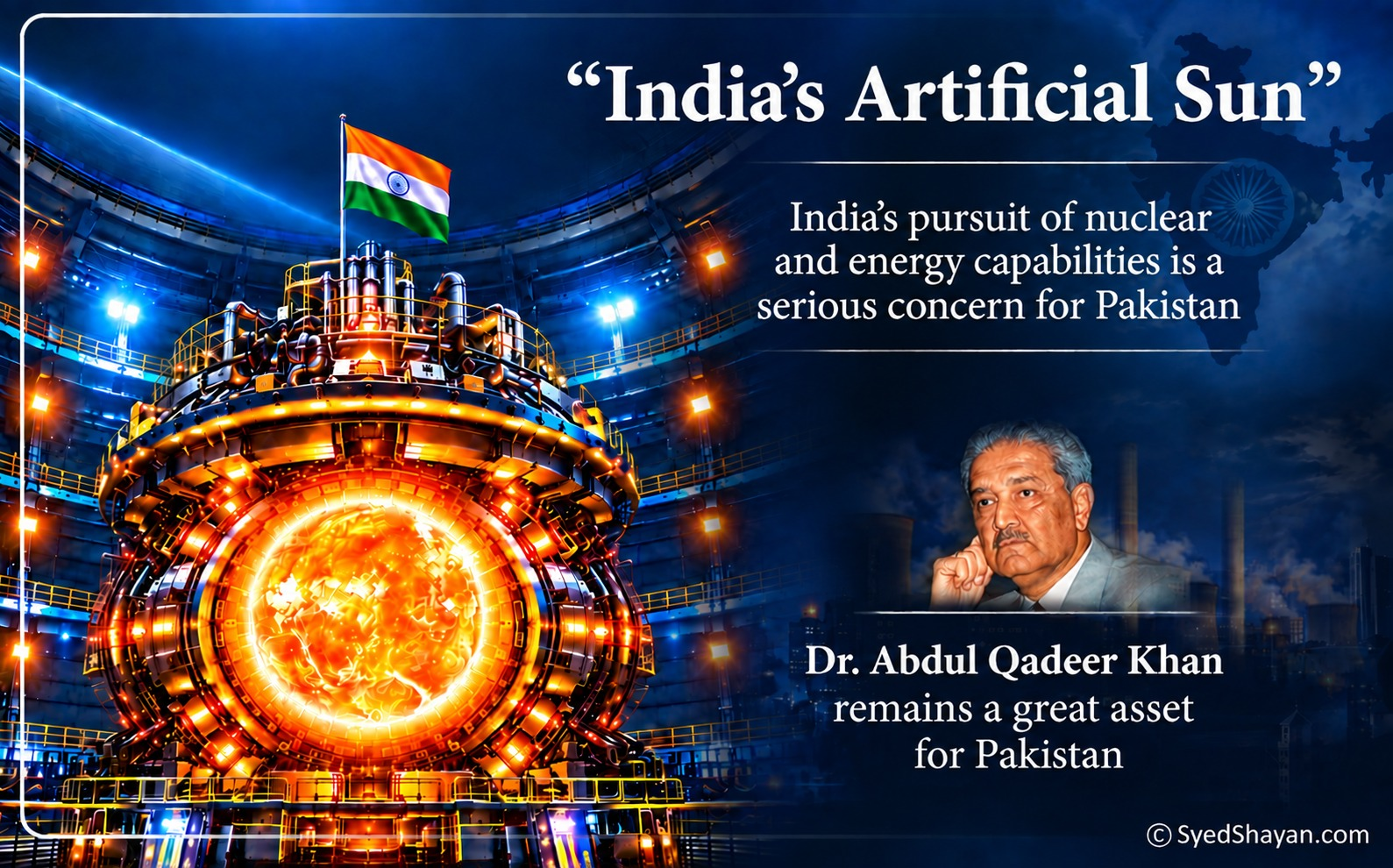
India, meanwhile, continued scientific research into the energy of the future while meeting its immediate needs through conventional sources. One outcome of that continuing journey is the SST-1 Tokamak, sometimes described as an “artificial sun.” It is currently an experimental facility for nuclear fusion research, rather than a commercial power plant. Its broader purpose is to help scientists develop a way to generate energy on Earth through the process that powers the Sun.
▫
After 1998, Dr Abdul Qadeer Khan’s thinking extended beyond nuclear defence. He wanted to advance serious work on fission, fusion and other sources of energy. According to Dr Khan, he wrote five letters to Prime Minister Nawaz Sharif offering his advice and services, but received no reply. Pakistan failed to benefit from this prominent scientist’s knowledge and experience in ways that might have changed the course of its energy crisis.Public Investigative Series | Episode 51Subject: How Can Pakistan’s Electricity System Be Fixed?Title: Why Did Pakistan Fail to Pursue a Lasting Solution to Its Electricity Crisis?Where Did Dr Abdul Qadeer Khan Want to Take Pakistan’s Energy Sector After the Atomic Bomb?If only we had continued to benefit from Dr Abdul Qadeer Khan’s abilities after the development of the atomic bomb.Written and researched by Syed ShayanIn the second week of September 2026, a report emerged from India that perhaps did not receive the attention it deserved in Pakistan. At the Institute for Plasma Research in Gujarat, Indian scientists reportedly installed and successfully operated a new, powerful gyrotron in their SST-1 Tokamak. It represents a step in a much longer journey whose ultimate ambition is to generate energy on Earth through nuclear fusion, the process that powers the Sun.The basic idea is straightforward. The Sun has provided light and heat for billions of years. Scientists sought to understand what happens inside it that allows such enormous amounts of energy to be released continuously.They discovered that the Sun is powered by a process called nuclear fusion. In simple terms, under conditions of extreme heat and pressure, light atomic nuclei combine and release vast amounts of energy. This is the fundamental source of the Sun’s power.Scientists then asked: if this process occurs naturally inside the Sun, could we reproduce it inside a machine on Earth?After decades of research and experimentation, scientists succeeded in producing fusion reactions on Earth, reproducing the underlying process through which the Sun and other stars release energy.The central challenge now is to confine the extremely hot matter known as plasma for long enough, and to obtain sufficient usable energy from the process, to eventually operate practical power plants.In pursuit of this goal, countries joined forces to establish a major international project known as ITER, originally an abbreviation for International Thermonuclear Experimental Reactor.Located in southern France, the project brings together the European Union, the United States, Russia, China, India, Japan and South Korea.The global scientific race is now focused on a crucial question: how can nuclear fusion move from the laboratory to the power station?China has set an ambition to demonstrate electricity generation from nuclear fusion around 2030 through its next “artificial sun,” known as BEST. If successful, this would represent a historic step towards translating experimental fusion research into practical electricity generation.Meanwhile, India has reported an important development in the same global effort. In the second week of September 2026, a new, powerful gyrotron was reportedly installed and successfully operated in the SST-1 Tokamak at the Institute for Plasma Research in Gujarat.Indian scientists reportedly say this technology will support their efforts to raise plasma temperatures towards 200 million degrees Celsius.Consider the scale of that ambition. The temperature at the Sun’s core is approximately 15 million degrees Celsius, while Indian scientists are discussing plasma temperatures of 200 million degrees in their “artificial sun.”If they achieve that target and also maintain stable plasma for the required duration, it could strengthen India’s position in the global pursuit of nuclear fusion.Reading about India’s progress brings Pakistan’s nuclear scientist, Dr Abdul Qadeer Khan, strongly to mind.In 2003, Dr Khan announced plans to begin formal research into solar energy development. There was discussion of advancing several research projects, including solar energy, in collaboration with Sir Syed University of Engineering and Technology in Karachi.The following year, however, circumstances changed dramatically. In 2004, the nuclear proliferation controversy emerged. Dr Khan was removed from his government position, accepted responsibility and apologised to the nation on state television. He subsequently spent years under house arrest, with strict restrictions on his movements and meetings.Dr Khan later maintained that the televised confession had not been a statement made of his own free will. According to his subsequent account, he had been given a prepared text, which he read in what he understood to be the national interest and in view of promises made to him.Time passed and restrictions on Dr Khan were lifted, but Pakistan’s electricity crisis continued to deepen.As a nuclear scientist, Dr Khan understood the importance of energy and the scale of Pakistan’s growing electricity shortage. He repeatedly argued that Pakistan should use its own resources and scientific capabilities instead of relying on others to meet its energy needs.Against this background, while addressing a gathering at Allama Iqbal Medical College in Lahore in June 2012, Dr Khan said Pakistan possessed substantial energy resources. He claimed that, if given the opportunity, he could generate 4,500 megawatts of electricity through nuclear reactors within just three months. He maintained that Pakistan could overcome its electricity crisis by using its own resources.In an interview shortly after Pakistan’s nuclear tests in 1998, Dr Khan stated that the country had tested boosted fission devices. He also said Pakistan was conducting research into nuclear fusion and thermonuclear technology.His interests extended beyond Pakistan’s nuclear defence capability. He also continued to reflect on the country’s energy needs. In subsequent years, he repeatedly advocated electricity generation through solar and nuclear energy, alongside the use of Pakistan’s own resources.The sadness and disappointment evident in some of Dr Khan’s interviews during his final years were painful to witness. A man who had played a central role in giving Pakistan nuclear capability appeared to spend the closing chapter of his life feeling that there was a profound gap between his contribution to the country and the treatment he had received.Dr Khan offered his services without payment to help address Pakistan’s energy crisis and other national problems. According to his own account, he wrote to Prime Minister Nawaz Sharif five times, offering advice and assistance, but received no response to any of those letters.It is difficult to accept that Pakistan had a scientist familiar with fission, thermonuclear and fusion research, and energy issues, yet failed to establish how his knowledge could best contribute to a sustained programme of peaceful energy research. To what extent did the government make use of that expertise? Can any of us provide a satisfactory answer?During the 1990s, both Pakistan and India possessed basic nuclear infrastructure and significant scientific talent. Their subsequent paths diverged. India continued to support institutions such as the Institute for Plasma Research and secured a place in major international research projects. Pakistan, meanwhile, became increasingly burdened by domestic crises, political instability and insufficient attention to scientific research, while its energy problems grew more severe.We came to regard the atomic bomb as our ultimate destination. Yet it should have marked the beginning of a new scientific chapter for Pakistan, with many more milestones to pursue in technology, energy, medicine and industry through the contributions of Dr Abdul Qadeer Khan and other scientists.Dr Khan continued to advocate energy development based on Pakistan’s own resources and scientific capabilities. Yet we did not draw on his knowledge and experience in ways that might have helped reshape the country’s economic and energy future.Today, India is advancing its research towards the ambition of a nuclear fusion “artificial sun,” while we continue to struggle with expensive electricity, circular debt and a persistent energy crisis.Perhaps remembering Dr Khan’s name is no longer enough. We must also ask ourselves: what have we done since then with our scientists, our knowledge and our scientific potential?To be continued in the next episode.