▫
The government is losing billions of rupees every day due to electricity theft and payments to Independent Power Producers (IPPs). The latest development is that the Ministry of Energy has announced a prize of Rs150,000 for anyone who can find a solution to the electricity crisis.
▫
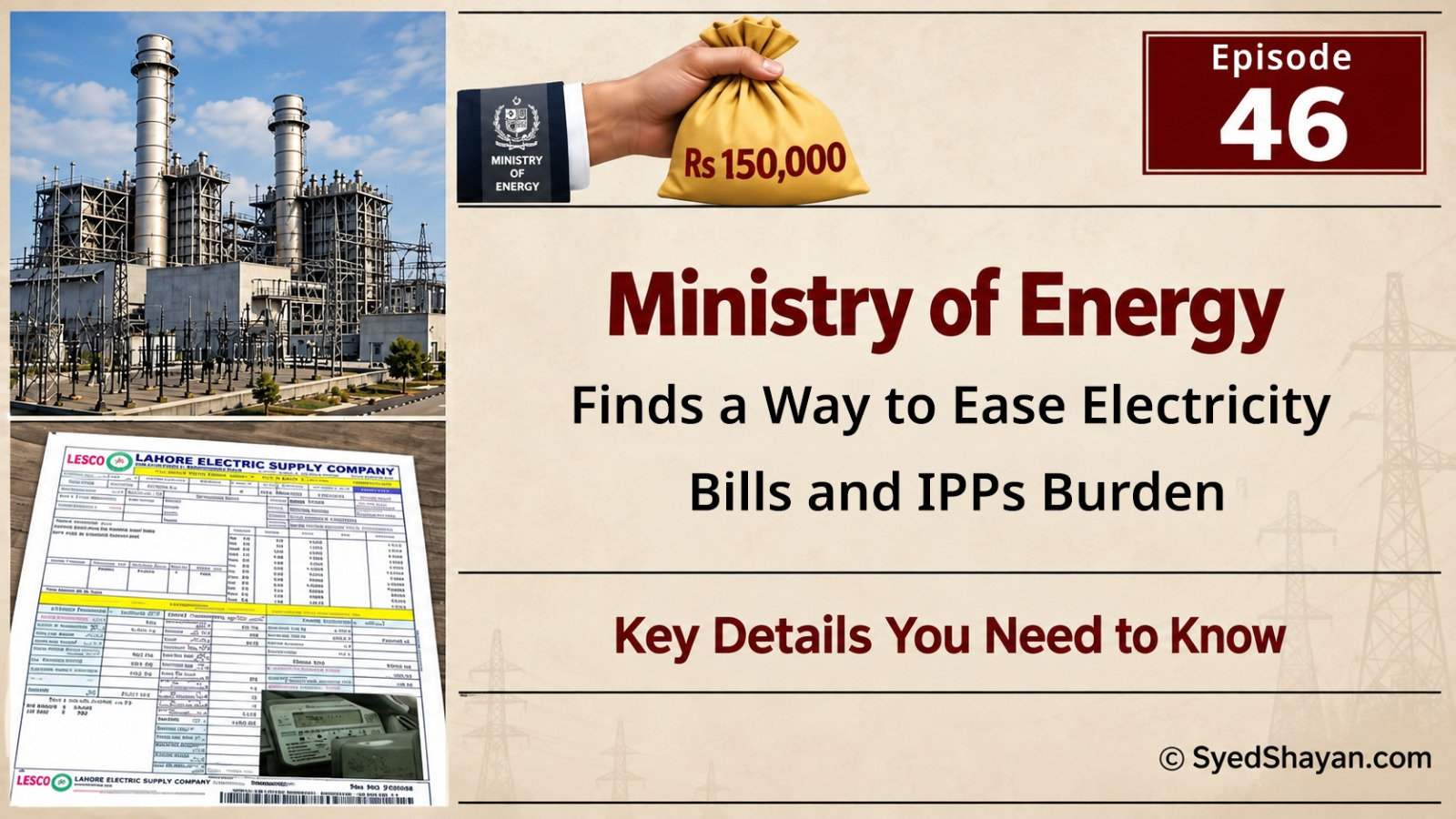
The Ministry of Energy does not need new ideas. It needs to improve its intentions and performance.🔲 Public Research Series | Episode 46Topic: How Can Pakistan’s Electricity System Be Fixed?Title: Public Invited to Suggest Solutions to the Electricity Crisis🔺 When institutions avoid providing the facts, it becomes the public’s responsibility to uncover the truth.Written and Researched by: Syed ShayanSo far, I have published 45 episodes on Pakistan’s electricity system and Independent Power Producers.When the issue of creating new provinces became part of the national debate, I temporarily paused the electricity series. I presented several years of research conducted by my think tank on provinces and the federal system through 11 episodes, maps and a nationwide online survey.Once the survey is completed, the research, public opinion and my recommendations will be compiled into a comprehensive report and submitted to the federal government and the relevant committees of the National Assembly and Senate.Our main work on the issue of new provinces has also been completed. All related episodes are available on our web portal, SyedShayan.com.In addition, our nationwide online survey about the creation of new provinces in Pakistan is currently underway. Pakistanis living in the country and abroad are sharing their opinions and recommendations. The survey will remain open until its scheduled closing date. Our e-book based on this research has also been completed and will be available on the website within the next few days.During this period, readers repeatedly reminded me not to leave the work on electricity and IPPs unfinished. Therefore, after a short break, we have returned to our original subject.After returning, I found that the fundamental problems of circular debt, electricity theft, transmission and distribution losses, and expensive electricity remain largely unchanged. However, one important development has taken place during this period, which I believe must be shared with you.You may have read on the thumbnail of this episode: “The Ministry of Energy Has Found a Solution to Expensive Electricity Bills and IPPs.”The details of the Ministry’s supposed solution are explained below. After reading them, you may also feel like mourning the system and the limited wisdom of those running it and asking what will become of this country.The Ministry of Energy has launched a new programme called the Power Sector Innovation Hub. Through this programme, the general public, experts, researchers, universities and institutions have been invited to submit new ideas for improving Pakistan’s electricity system.Applicants must identify the main problem in the electricity system, propose a possible solution, estimate its cost, explain its benefits and describe how it could be implemented in practice.A committee will evaluate the submitted ideas. For a new idea that has not previously been tested anywhere, the first prize is Rs150,000, the second prize is Rs100,000 and the third prize is Rs50,000. Winners may also receive an official certificate, and their ideas may be considered for practical testing.A separate prize of Rs500,000 has also been announced, but it is not for a new idea. It will only be awarded for a solution that has already been tested elsewhere and produced positive results.The question, however, is this: Pakistan’s electricity system is suffering losses and circular debt amounting to billions and trillions of rupees. The country’s brightest minds are being asked to propose solutions, yet the prizes for the best new ideas are only Rs150,000, Rs100,000 and Rs50,000.In other words, the problem is worth billions and trillions of rupees, but the proposed value of its solution is just Rs150,000.“Yet you feel no shame.”Compared with Pakistan’s electricity problems and circular debt worth trillions of rupees, this kind of “prize competition” is nothing less than a joke. In a country where the power sector is losing billions of rupees every day, asking serious thinkers and economists to solve the crisis for prizes of Rs150,000, Rs100,000 and Rs50,000 clearly exposes the seriousness and intellectual capacity of the policymakers.If the government is genuinely so helpless and financially weak that it can offer only the “substantial amount” of Rs150,000 to the person presenting the best solution to an electricity crisis worth trillions of rupees, I am prepared to donate that amount to the Ministry of Energy instead of claiming the prize. The only condition is that the Ministry must demonstrate the intention and courage to implement the research-based recommendations that already exist.It is like organising a prize competition among children using water pistols to save a burning city instead of calling the fire brigade. The self-proclaimed experts at the Ministry of Energy may then believe that they have launched a national plan to extinguish the fire.During the eighteenth century, France also faced severe hunger, famine and food shortages. Following the food shortages of 1769 and 1770, a well-known academic society in the French city of Besançon organised a competition in 1771. People were asked to identify a food that could compensate for shortages of common foods during a famine.A French pharmacist named Antoine Parmentier also participated in the competition. He argued that potatoes could play an important role in solving the problem.This may sound strange to many of us today because potatoes are now part of our everyday diet. At that time, however, people in France were reluctant to eat them. Some considered potatoes to be animal feed, while others believed they could cause disease. Many people did not consider them fit for human consumption.Parmentier did not simply say, “Eat potatoes and the problem will be solved.” He conducted proper research and tried to prove that potatoes were safe and nutritious for humans and could help compensate for shortages of grain and other foods during difficult times.His research won an award. Parmentier later launched a proper campaign to popularise potatoes in France. He cultivated potatoes, served potato-based dishes to people and involved influential individuals in the campaign. The initiative eventually reached King Louis XVI of France.According to a well-known account, King Louis XVI wore a potato flower on his clothing, while Queen Marie Antoinette decorated her hair with one. The purpose was to show the royal family’s acceptance of potatoes so that public fear and misconceptions about them would gradually decline.That is what eventually happened. People’s attitudes towards potatoes began to change, and they gradually became part of the everyday French diet.The important point is that Parmentier’s research did not end after he won the award. He continued working to promote his proposal and secure its practical acceptance. As a result, potatoes, which many people in France had once considered unfit for human consumption, later became an important part of their daily diet.The purpose of presenting this example from eighteenth-century France is to show that asking the public and experts to propose solutions to major problems is not a new practice. It has been done before.The prize money is not the main issue. The real question is what the government does after receiving a good solution.When Parmentier’s research won the competition in France, the matter did not end there. His proposed solution was tested, it reached the king and queen, and proper efforts were made to persuade the public to eat potatoes. An idea was requested, and when it was found valuable, it was implemented.In Pakistan, the real test is not the Rs150,000 prize. The real test is whether the Ministry of Energy will have the courage to implement a genuinely practical solution if one is presented.Let us first compare the French example with the competition organised by Pakistan’s Ministry of Energy.France faced a problem for which no clear solution was available. The public was invited to propose solutions, one person presented a research-based answer, it was found to be valid, and the state implemented it.Pakistan’s electricity system, however, does not suffer because nobody knows the solution. Hundreds of reports have already been prepared on the subject. The National Electric Power Regulatory Authority, the Ministry of Energy, international organisations, experts and numerous committees have repeatedly identified the problems and explained how they can be addressed.The problem is not a shortage of new ideas. The problem is the failure to implement solutions that already exist.Solar energy is the clearest example. Despite spending billions and trillions of rupees over many years, the government has failed to provide the public with sufficient and affordable electricity. Meanwhile, people have installed solar systems using their own money, without receiving a single rupee from the government, and have started meeting a significant portion of their daytime electricity needs themselves.This has reduced pressure on the national grid, decreased the need for expensive imported fuel and helped ease the electricity shortage to some extent.The government should have thanked these people, made solar installation easier and adapted the electricity system to the changing circumstances.Instead, the opposite happened. Federal Minister for Energy Sardar Awais Ahmad Khan Leghari began describing solar users as a burden on the system. People who spent their own money to solve their personal electricity problems and, to some extent, the country’s problem were blamed for allegedly increasing the financial burden on the national grid and other consumers.The reality is that solar users have not become a burden on the system. They have reduced the government’s burden.The actual burden comes from expensive power agreements, capacity payments, electricity theft, transmission and distribution losses, incompetence and years of poor management. Every government remains afraid of addressing these fundamental issues.The Ministry of Energy is now asking people to propose a solution to the electricity crisis and win a “platinum prize” of Rs150,000 for the best recommendation.The question remains: when the government is not implementing solutions that have already been identified and tested, what is the benefit of asking for new ideas?These new proposals may eventually meet the same fate as hundreds of earlier reports. They will attract attention for a few days, then be placed in a file, stored in a cabinet and forgotten, while the electricity system continues operating in the same way.To be continued in the next episode…