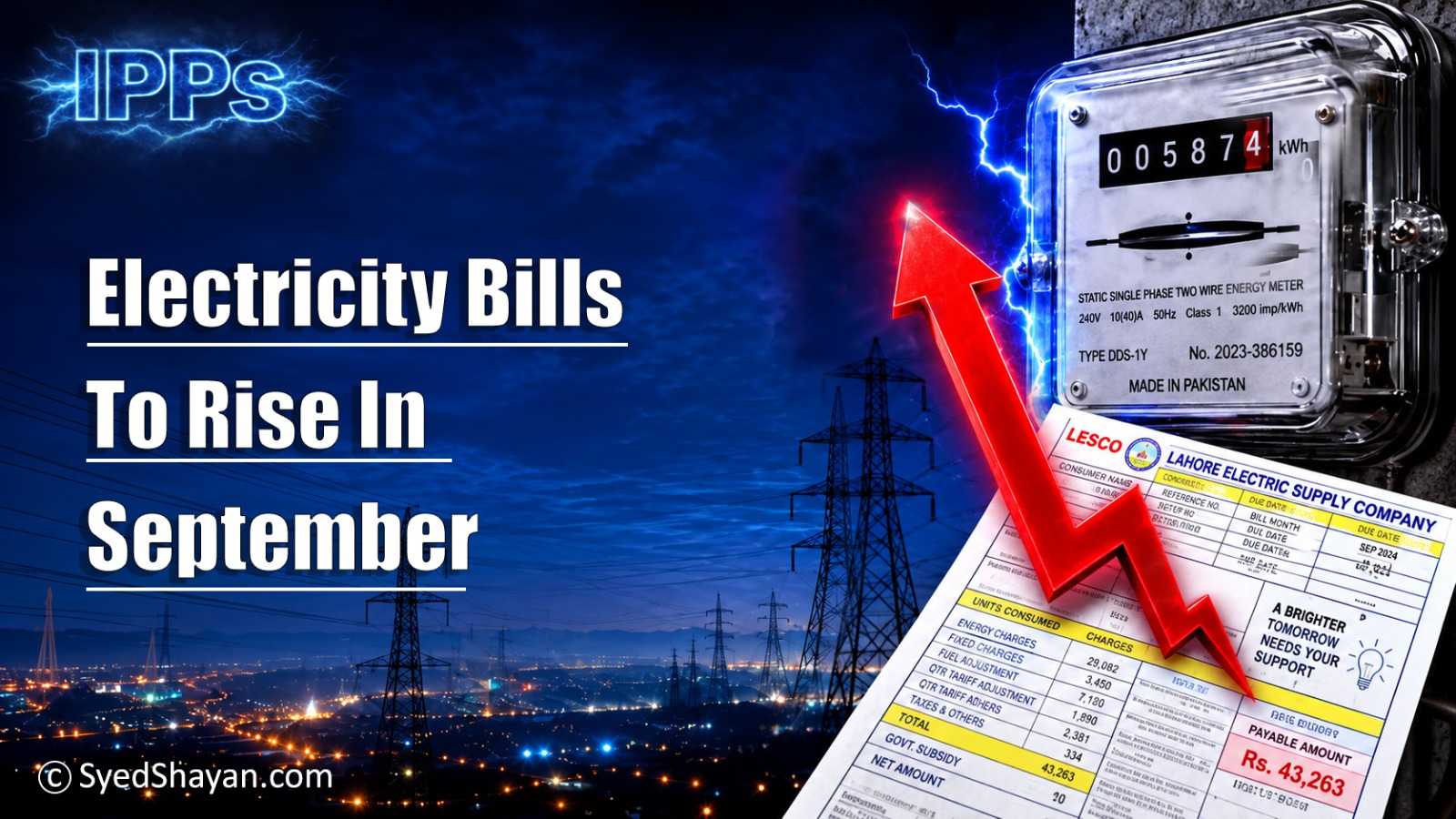
🔳 Congratulations! The country’s 11 electricity distribution companies have submitted their three-month financial accounts to the National Electric Power Regulatory Authority (NEPRA). Eight of these companies claim that their expenses exceeded earlier estimates and have requested permission to recover the additional amount through consumers’ future electricity bills.According to NEPRA, the amount is approximately Rs33.78 billion. If NEPRA approves the request in full, electricity bills for the September 2026 billing month may be approximately Rs3.33 per unit higher than those issued in August. This includes the expiry of an earlier relief of nearly Rs2 per unit and a possible new recovery of Rs1.34 per unit.
▫
A regulator’s fundamental responsibility is to protect public interests and hold electricity companies accountable for their performance. However, NEPRA’s current approach gives the impression that whatever figures the power distribution companies and the Central Power Purchasing Agency (CPPA) submit, NEPRA eventually finds a way to transfer those expenses to consumers’ bills after lengthy official proceedings and hearings.
▫
In the accounts for April, May and June 2026, the expenses of TESCO, QESCO and HESCO were lower than initially estimated. If the tariff of each electricity company in Pakistan were calculated separately, consumers in the former tribal districts, Quetta and other parts of Balochistan, and the Hyderabad region could have received considerable relief in their bills. Instead, these companies’ savings were included in the national calculation and offset against the additional expenses claimed by other companies.🔲 Public Research Series | Episode 47Topic: How Can Pakistan’s Electricity System Be Fixed?Title: Recovery of Rs33 Billion from Consumers: Why Do NEPRA’s Documents Contain Three Different Amounts?🔺 When institutions fail to provide facts clearly, it becomes the public’s responsibility to uncover the truth.Written and Researched by: Syed ShayanThe country’s 11 state-owned electricity distribution companies (DISCOs) have submitted their three-month accounts, known as the Quarterly Tariff Adjustment (QTA), to NEPRA. Eight companies claim that their expenses during these three months exceeded the original estimates. They have therefore requested permission to recover the additional amount through consumers’ future electricity bills.The total amount stated on NEPRA’s website is approximately Rs33.78 billion. If NEPRA permits this recovery, consumers may face a new burden of approximately Rs1.34 per unit.However, electricity bills in September will not become more expensive by only Rs1.34 per unit. The quarterly relief of approximately Rs1.99 per unit that consumers received in their June, July and August bills has also expired. Consequently, September’s electricity bill could be approximately Rs3.33 per unit higher than August’s bill.If 18 percent sales tax is added to this possible increase of Rs3.33 per unit, the estimated additional burden on consumers will be:A household consuming 200 units may face an increase of approximately Rs785.A household consuming 300 units may face an increase of approximately Rs1,177.A household consuming 500 units may face an increase of approximately Rs1,962.These calculations may vary according to each consumer’s category and the other taxes included in the bill. The monthly Fuel Price Adjustment will be calculated separately and may either increase or decrease the final bill.NEPRA held a public hearing on this request on August 12, 2026, but has not yet issued its final decision. Therefore, the possible increase of Rs3.33 per unit is currently only an estimate. The actual position will become clear after NEPRA issues its final decision, which may be announced at any time this month.For the convenience of my readers, I would also like to explain how electricity prices are determined in Pakistan and how NEPRA calculates the amounts recovered through consumers’ bills.At the beginning of the year, estimates are prepared for the total annual cost of purchasing electricity, paying capacity charges to power producers, operating the transmission system and covering other related expenses. Electricity tariffs are determined based on these estimates, and consumers are billed accordingly.After every three months, the actual expenses are compared with the original estimates. If the actual cost is higher, the electricity companies seek permission to recover the difference through consumers’ future bills. If the actual cost is lower, consumers’ bills should be reduced by the corresponding amount. This difference between estimated and actual expenditure is called the Quarterly Tariff Adjustment.Let us now examine the latest accounts for April, May and June 2026. The country’s 11 electricity distribution companies submitted their respective accounts to NEPRA. Eight companies stated that their expenses during these three months exceeded the original estimates and requested permission to recover the additional amount through consumers’ future electricity bills.According to the petitions available on NEPRA’s official website, the eight companies seeking permission to recover additional amounts from consumers submitted the following claims:1. Lahore Electric Supply Company (LESCO)Region: Lahore, Kasur, Sheikhupura, Nankana Sahib and OkaraAmount claimed: Rs2.953 billion2. Faisalabad Electric Supply Company (FESCO)Region: Faisalabad, Sargodha, Jhang, Toba Tek Singh, Mianwali, Bhakkar, Khushab and ChiniotAmount claimed: Rs5.358 billion3. Gujranwala Electric Power Company (GEPCO)Region: Gujranwala, Sialkot, Gujrat, Narowal, Hafizabad and Mandi BahauddinAmount claimed: Rs4.992 billion4. Islamabad Electric Supply Company (IESCO)Region: Islamabad, Rawalpindi, Attock, Chakwal and JhelumAmount claimed: Rs4.872 billion5. Multan Electric Power Company (MEPCO)Region: Multan, Bahawalpur, Rahim Yar Khan, Dera Ghazi Khan, Muzaffargarh, Vehari, Sahiwal, Bahawalnagar, Khanewal, Lodhran, Layyah, Rajanpur and other areas of southern PunjabAmount claimed: Rs5.09 billion6. Peshawar Electric Supply Company (PESCO)Region: Peshawar, Mardan, Swabi, Nowshera, Charsadda, Swat, Bannu, Kohat and most other parts of Khyber PakhtunkhwaAmount claimed: Rs6.294 billion7. Sukkur Electric Power Company (SEPCO)Region: Sukkur, Larkana, Khairpur, Ghotki, Shikarpur, Jacobabad, Kashmore and other parts of upper SindhAmount claimed: Rs13.724 billion8. Hazara Electric Supply Company (HAZECO)Region: Abbottabad, Haripur, Mansehra, Battagram, Torghar and other parts of the Hazara regionAmount claimed: Rs1.239 billionThe quarterly accounts of the remaining three companies showed savings rather than additional recoveries:1. Tribal Areas Electric Supply Company (TESCO)Region: The former tribal districts of Khyber, Kurram, Orakzai, Mohmand, Bajaur, North Waziristan and South WaziristanReduction in expenditure: Rs4.394 billion2. Quetta Electric Supply Company (QESCO)Region: Quetta and most other districts of BalochistanReduction in expenditure: Rs3.647 billion3. Hyderabad Electric Supply Company (HESCO)Region: Hyderabad, Mirpurkhas, Badin, Thatta, Sujawal, Tharparkar, Umerkot, Sanghar and other parts of lower SindhReduction in expenditure: Rs2.083 billionThe eight companies seeking additional recoveries claim that their actual expenses for electricity purchases and other costs during the previous quarter exceeded the original estimates. They are now requesting permission to recover the difference through consumers’ electricity bills.According to their submitted calculations:
▫
Rs46.38 billion has been claimed under capacity charges.
▫
Rs4.974 billion has been claimed for the operation and maintenance of power plants.
▫
Rs3.08 billion has been claimed for electricity transmission and distribution losses.
▫
Rs14.231 billion has been included as previously unrecovered costs associated with smaller and industrial power plants.If these four categories of expenditure claimed by the eight electricity companies are added together, the total comes to Rs68.665 billion.Surprisingly, however, the companies report combined expenses of Rs68.665 billion, while the total of the individual amounts claimed by the same eight companies comes to Rs44.522 billion.More surprisingly, NEPRA has stated on its website that the electricity distribution companies’ total claim is Rs33.778 billion. It is unclear how NEPRA calculated this amount.Even if we assume that TESCO, QESCO and HESCO are not seeking additional recoveries because their combined expenses were Rs10.124 billion below the estimates, and we subtract that amount from the Rs44.522 billion claimed by the other eight companies, the remaining amount is Rs34.398 billion.There is still a difference of Rs620 million between this calculation and the amount reported by NEPRA.It is difficult to understand why the companies presented one figure for their expenses, requested a different amount and NEPRA published yet another total. If any reader understands the reason behind these three different figures, we request their guidance.The actual expenses of TESCO, QESCO and HESCO during April, May and June 2026 were lower than initially estimated. If each company’s tariff were determined separately, consumers in these regions could have received a reduction in their electricity bills. However, the Uniform National Tariff system used their savings to offset the increased expenses of other companies, eliminating this possible relief.TESCO serves Bajaur, Mohmand, Khyber, Kurram, Orakzai, North Waziristan and South Waziristan.QESCO supplies electricity to Quetta, Pishin, Chaman, Zhob, Loralai, Sibi, Khuzdar, Turbat, Gwadar and most other parts of Balochistan.HESCO’s service area includes Hyderabad, Jamshoro, Matiari, Tando Allahyar, Tando Muhammad Khan, Badin, Thatta, Sujawal, Mirpurkhas, Umerkot, Tharparkar and several other areas of interior Sindh.In principle, the expenses of these three companies were lower than estimated, so consumers in their respective regions should have benefited from those savings. Under the Uniform National Tariff, however, their savings were deducted from the additional expenses claimed by other companies.As a result, consumers in the former tribal districts, Balochistan and interior Sindh did not receive their possible share of the relief.The question is this: when every company has separate management, staff, expenses, line losses, electricity theft and recovery rates, why are their accounts treated as one?If one company controls its expenses while another allows its costs to increase, why should consumers in both regions pay the same price? How is that fair?How can electricity companies be held accountable under this system? If a company knows that its additional expenses will eventually be recovered from consumers across the country, why would it make serious efforts to reduce costs, improve recoveries and prevent electricity theft?The people living in an electricity company’s service area should directly benefit when that company reduces its expenses. If a company’s expenses increase, its officials should be required to explain where and why the additional money was spent.It is unjust for a company to make mistakes, increase its expenses and then transfer the entire burden to consumers through their electricity bills. Covering every loss from the public’s pockets is not a solution. It merely conceals the poor performance of electricity companies.To be continued in the next episode…