

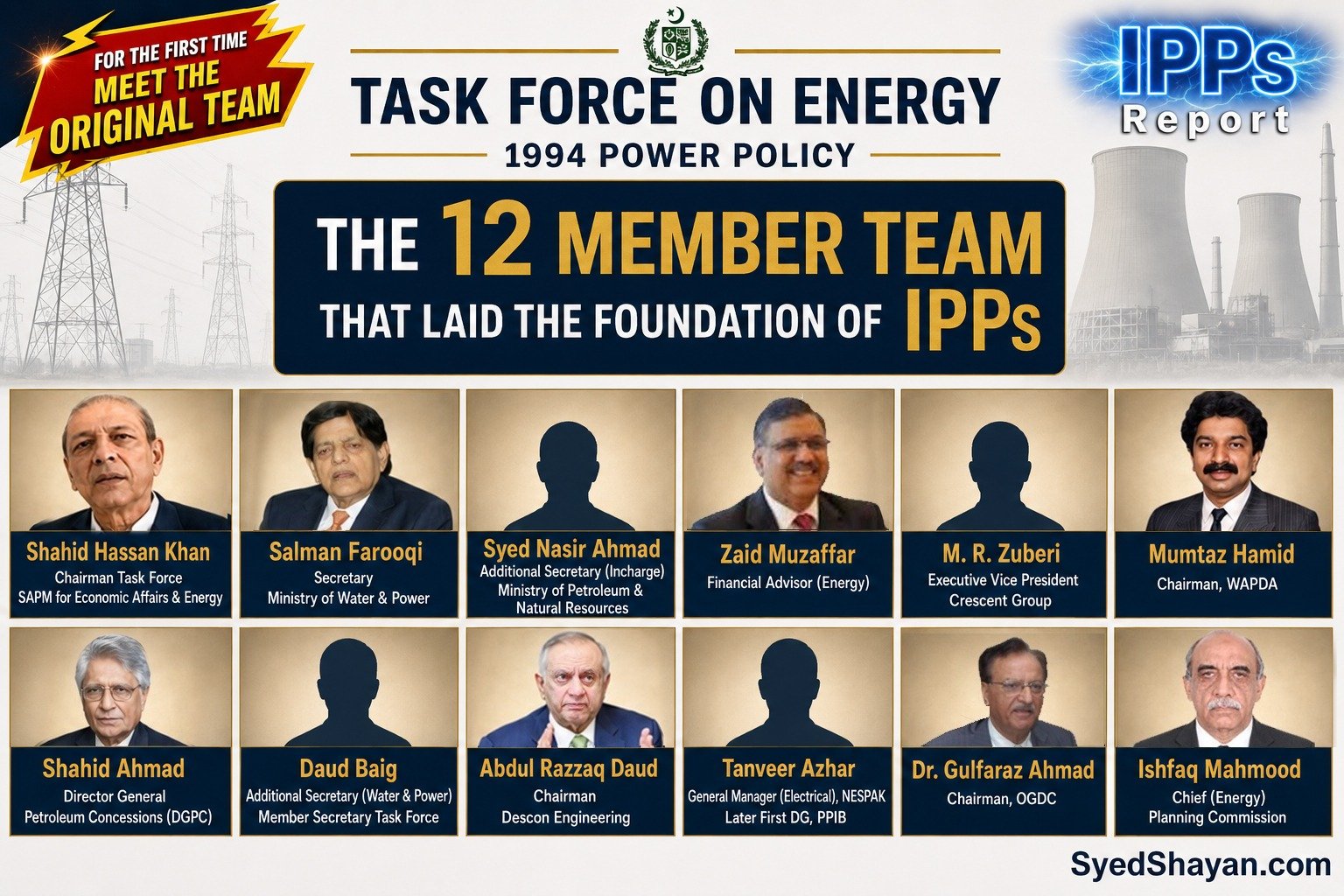
🔳 The members of the Task Force chaired by Shahid Hasan Khan laid the foundation for private sector power generation through Independent Power Producers (IPPs) in Pakistan, a model that would go on to reshape the country’s economic and energy landscape.These were the individuals who developed the original framework of Pakistan’s 1994 Power Policy. In this episode, we present a detailed introduction to the original team for the first time.Public Research Series | Episode 42Subject: How Can Pakistan’s Electricity System Be Fixed?Title: Members of the Task Force on Energy and Their Role in the 1994 Power Policy🔺 When institutions fail to provide the facts, the pursuit of truth becomes a public responsibility.Research and Writing: Syed ShayanIn the previous three episodes, readers followed my detailed discussions with Shahid Hasan Khan on the background to Pakistan’s 1994 Power Policy, the establishment of Independent Power Producers, the allegations surrounding the IPP model, and his response to those allegations.In this fourth episode, we introduce the full team that worked with Shahid Hasan Khan. We examine who served on former Prime Minister Benazir Bhutto’s Task Force on Energy, who sat on its various subcommittees, which experts were selected for particular responsibilities, and how each committee contributed to shaping the policy.Each committee will also be presented separately, with its members, responsibilities, and assigned mandate explained on the basis of the original official documents. The purpose is to show that the 1994 Power Policy was not the work of one individual. It was the product of an organised and collaborative process involving experts from government, industry, finance, engineering, planning, and the energy sector.🔘 The Task Force on Energy, chaired by Shahid Hasan Khan, initially consisted of 12 core members. Its formal notification was issued in October 1993. To broaden its scope and strengthen its technical work, another 23 members from different sectors were later co opted into various committees and working groups.However, these appointments did not necessarily represent 35 separate individuals because some members served on more than one committee or working group.The following were the 12 principal members of this high powered Task Force, which developed the financial and technical framework of Pakistan’s 1994 Power Policy.Key Members of the Task Force1. Shahid Hasan KhanChairmanSpecial Assistant to the Prime Minister on Economic Affairs and Energy
▫
Responsible for the policy’s overall vision, strategic direction, and political backing.2. Salman FaruquiSecretary GeneralMinistry of Water and PowerNote: The original notification mentions only the office and does not identify the individual by name.
▫
The principal bureaucrat responsible for the implementation of the policy. The administrative machinery and executive authority required for its implementation operated through his office.As Secretary of the Ministry of Water and Power, Salman Faruqui played the central administrative role in implementing the 1994 Power Policy. He is widely regarded as one of the most influential civil servants in Pakistan’s administrative history.3. Additional Secretary, Ministry of Petroleum and Natural ResourcesNote: The original notification records only the designation and does not mention a name.However, official records indicate that Syed Naseer Ahmad was serving as Additional Secretary in charge of the Ministry of Petroleum and Natural Resources when the Task Force was constituted in October 1993.His role was important in two areas. The first was ensuring the availability of furnace oil or natural gas for private power plants. The second was contributing to the development and approval of the fuel indexation mechanism used in electricity tariff calculations.4. Chairman, WAPDANote: The original notification also lists only the designation and does not identify the individual by name.However, Annexure 1.2 of the Task Force report identifies Mumtaz Hameed as Chairman of WAPDA.As Chairman of WAPDA, Mumtaz Hameed played an important role in developing the framework for Power Purchase Agreements (PPAs) with Independent Power Producers. He was also involved in evaluating the Take or Pay model and assessing the capacity of the national grid to absorb additional electricity generated by private power plants.5. Dr Gulfraz AhmadChairman, Oil and Gas Development Corporation (OGDC)As Chairman of OGDC, his primary responsibility was to provide technical advice on Pakistan’s indigenous oil and gas reserves, the availability of natural gas, and possible fuel supplies for private power plants. He was not directly responsible for electricity tariffs or Power Purchase Agreements.Dr Gulfraz Ahmad was later appointed the founding Chairman of the National Electric Power Regulatory Authority (NEPRA), where he played an important role in establishing Pakistan’s electricity regulatory framework.His appointment also shows that several members of the Task Force were later entrusted with senior positions responsible for implementing or regulating the policies they had helped formulate.6. Ashfaq MahmoodSenior Chief, Energy, Planning Commission
▫
Responsible for long term energy planning.
▫
Helped assess how much electricity Pakistan would require and which sources should be used to generate it.Ashfaq Mahmood was one of the most important technocrats on the Task Force. He later rose to the position of Secretary, Ministry of Water and Power.As Senior Chief, Energy, at the Planning Commission, his responsibility was to assess whether the incentives being offered to the private sector were consistent with Pakistan’s five year development plans for the water and power sectors.He also contributed to the planning framework used to estimate Pakistan’s electricity requirements over the following five to ten years and to determine the appropriate balance between Hydropower and Thermal Power generation.7. Director General, Petroleum ConcessionsAccording to contemporary industry records, this position was held by Shahid Ahmad in 1994, although the official policy documents mention only the designation and not the individual’s name.He played an important role in linking the legal framework governing petroleum concessions, gas supplies, furnace oil procurement, and fuel imports with the new policy for Independent Power Producers.This office was particularly significant because petroleum exploration and the allocation of exploration blocks to private companies fell within its jurisdiction.8. Zahid MuzaffarFinancial Expert
▫
Specialist in international investment.
▫
Issues such as dollar indexation and Return on Equity fell within his area of expertise.Zahid Muzaffar was an experienced financial expert and international business developer in Pakistan’s oil and gas sector. In later years, he served as Chairman of OGDCL and as an adviser to the Ministry of Petroleum.His inclusion in the Task Force was intended to support the development of an internationally acceptable project financing structure.He had extensive knowledge of financial modelling and international financial institutions, including OPEC and the International Finance Corporation. He is understood to have contributed to shaping the mechanisms for dollar indexation and investor returns in line with international investment standards.9. M. R. ZuberiExecutive Vice President, Crescent Group
▫
Represented the perspective of Pakistan’s private sector and advised on the terms under which domestic investors would participate in the new power model.Rather than relying entirely on the bureaucracy, Shahid Hasan Khan brought representatives of Pakistan’s leading business groups into the policy making process. Their role was to explain the expectations and concerns of local industrialists and investors.At the time, the Crescent Group was one of Pakistan’s leading business groups, with interests in textiles, finance, and energy.As a senior corporate executive, M. R. Zuberi highlighted the administrative and financial difficulties faced by local investors, including access to bank financing, debt to equity requirements, and the mobilisation of capital within Pakistan. Addressing these constraints was considered essential to the success of the policy.10. Dr Abdul Razak DawoodManaging Director, Descon Engineering Private LimitedAs the head of Descon Engineering, Dr Abdul Razak Dawood represented Pakistan’s private engineering and construction sector.He later served in different governments as a Federal Minister and as Adviser on Commerce and Investment.11. Tanveer AzharGeneral Manager, NESPAKTanveer Azhar later became the first head of the Private Power and Infrastructure Board (PPIB). This meant that after contributing to the design of the policy, he was also entrusted with overseeing its implementation.He was a distinguished electrical engineer and energy expert who rose to the position of General Manager at NESPAK.In 1991, he authored The Quest for Power: Pakistan Policy Options for the Nineties, an important book on Pakistan’s energy sector.Shahid Hasan Khan appointed him to the Task Force on Energy, where he played a significant role in developing Pakistan’s new private power policy.He was subsequently appointed the first Director General of the Private Power and Infrastructure Board.Shahid Hasan Khan regarded him as one of Pakistan’s most accomplished energy experts and personally recommended that I read his book, describing it as essential reading for anyone seeking to understand Pakistan’s energy challenges.12. Dawood BaigMember Secretary, Task Force on EnergyDawood Baig served as Additional Secretary, Power, in the Ministry of Water and Power.As Member Secretary of the Task Force, he played a central coordinating role. He organised meetings, facilitated communication among members and working groups, and brought together the various technical recommendations for inclusion in the final Task Force report.🔘 SubcommitteesTo complete its work within the six week deadline, the Task Force was divided into three major technical subcommittees:1. Power Subcommittee2. Private Sector Participation Subcommittee3. Oil and Gas SubcommitteeRepresentatives of the World Bank and the Asian Development Bank (ADB) also participated as observers and advisers. Their role was to help develop a financing structure that would be considered bankable by international lenders. This process ultimately contributed to the adoption of an imported fuel based power model.The principal members of each subcommittee were as follows:
▪
️Power Subcommittee• Tanveer Azhar• Dr Z. Fikri• M. R. Zuberi• Mumtaz Hameed• Salman Khaliq• A. Rashid Kakar• Ashfaq MahmoodThis subcommittee was primarily responsible for generation expansion, fuel mix planning, and the development of the framework for electricity tariffs and capacity payments.
▪
️Private Sector Participation Subcommittee• Dr Abdul Razak Dawood• Dawood Baig• M. R. Zuberi• Mian Azam Saigol• Mumtaz Hameed• Dr Shahid K. Haq• Shahid Hafeez Ahmad• Shahid SattarThis subcommittee developed the framework for private sector participation, including investment incentives, rates of return, sovereign guarantees, and payment security mechanisms.
▪
️Oil and Gas Subcommittee• Shahid Ahmad• Saleem Zulfiqar• Dr Gulfraz Ahmad• Dr Shahid K. Haq• Karim Mahmood• Ahmad Masood• Zahid MuzaffarThis subcommittee played a key role in developing the legal and commercial arrangements for fuel supplies to IPPs, including natural gas and imported furnace oil.In addition to the formal members of the Task Force, technical experts such as Shamsul Mulk, then Member Power and later Chairman of WAPDA, and Pervez Butt, former Chairman of KANUPP and the Pakistan Atomic Energy Commission (PAEC), provided advice on power sector matters.The Chairman of the Central Board of Revenue (CBR) worked on the framework for customs duty and income tax concessions for IPPs. Mian Mumtaz Abdullah, Chairman of the Corporate Law Authority (CLA), contributed to the legal arrangements for the registration of foreign companies and contracts incorporating dollar indexation.Taken together, these measures brought technical planning, financial structuring, taxation, and corporate regulation into a single investor friendly framework built largely around imported fuel based power generation.🔘 Government and Private Sector ParticipationThe composition of the Task Force shows that it brought together senior government officials, representatives of public sector institutions, and members of some of Pakistan’s largest private business groups. The government and the private sector were therefore both directly involved in formulating the 1994 Power Policy.This raises an important question because representatives of certain business groups involved in the policy making process were later associated with investments in power projects and Independent Power Producers (IPPs).When individuals involved in drafting a policy, or the business groups they represent, subsequently derive financial benefits from that policy, serious questions of potential conflict of interest may arise.The central issue is whether the policy was designed exclusively to address Pakistan’s national energy requirements or whether its structure also provided particular advantages to certain commercial interests. In economic and governance literature, such situations may be examined through the concepts of regulatory capture and the revolving door. However, whether either concept applies in this case can only be established through credible documentary evidence.The Private Sector Participation Sub Committee, for example, was chaired by Dr Abdul Razak Dawood, who was then Managing Director of Descon Engineering. Representatives of the Saigol Group and the Crescent Group also served on the same committee.One significant example is Mian Azam Saigol, who participated in the policy making process. His business group later established Kohinoor Energy, an IPP developed under the 1994 Power Policy. This raises a legitimate question as to whether some of those involved in shaping the policy subsequently became its commercial beneficiaries.Dr Abdul Razak Dawood was included in the Task Force as a representative of Pakistan’s private industrial and engineering sector. Descon’s core business, however, included the engineering, procurement, and construction of power plants and other industrial projects. In the years that followed, Descon secured engineering, procurement and construction (EPC), operation, and maintenance contracts in the power sector. In 2006, it also acquired Altern Energy, an IPP originally established under the 1994 Power Policy. These developments similarly raise questions about a potential conflict of interest.A related concern is the movement of public officials into private companies after leaving government service, commonly described as the revolving door phenomenon. It refers to situations in which individuals who were involved in formulating, regulating, or implementing a public policy later join private companies that benefit from that same policy.Several individuals associated with the Task Force were later linked to private power companies. For example, a study published by the Sustainable Development Policy Institute (SDPI) associates Shahid Hasan Khan, Chairman of the Task Force, with the US based energy company AES, and Salman Faruqui, a senior government official, with Uch Power.However, the exact nature, duration, and scope of these associations remain unclear. Before drawing any firm conclusions, I intend to seek Shahid Hasan Khan’s response on whether he, or any other individuals associated with the Task Force, subsequently held positions in or maintained professional relationships with private power companies and, if so, in what capacity.For context, AES was a US based energy company that developed two IPPs in Pakistan, Lal Pir Power and Pak Gen Power. In 2010, both plants were acquired by a Pakistani consortium led by Mian Muhammad Mansha’s Nishat Group and subsequently became part of the group’s power portfolio.[To be continued in the next episode.]






Very informative