

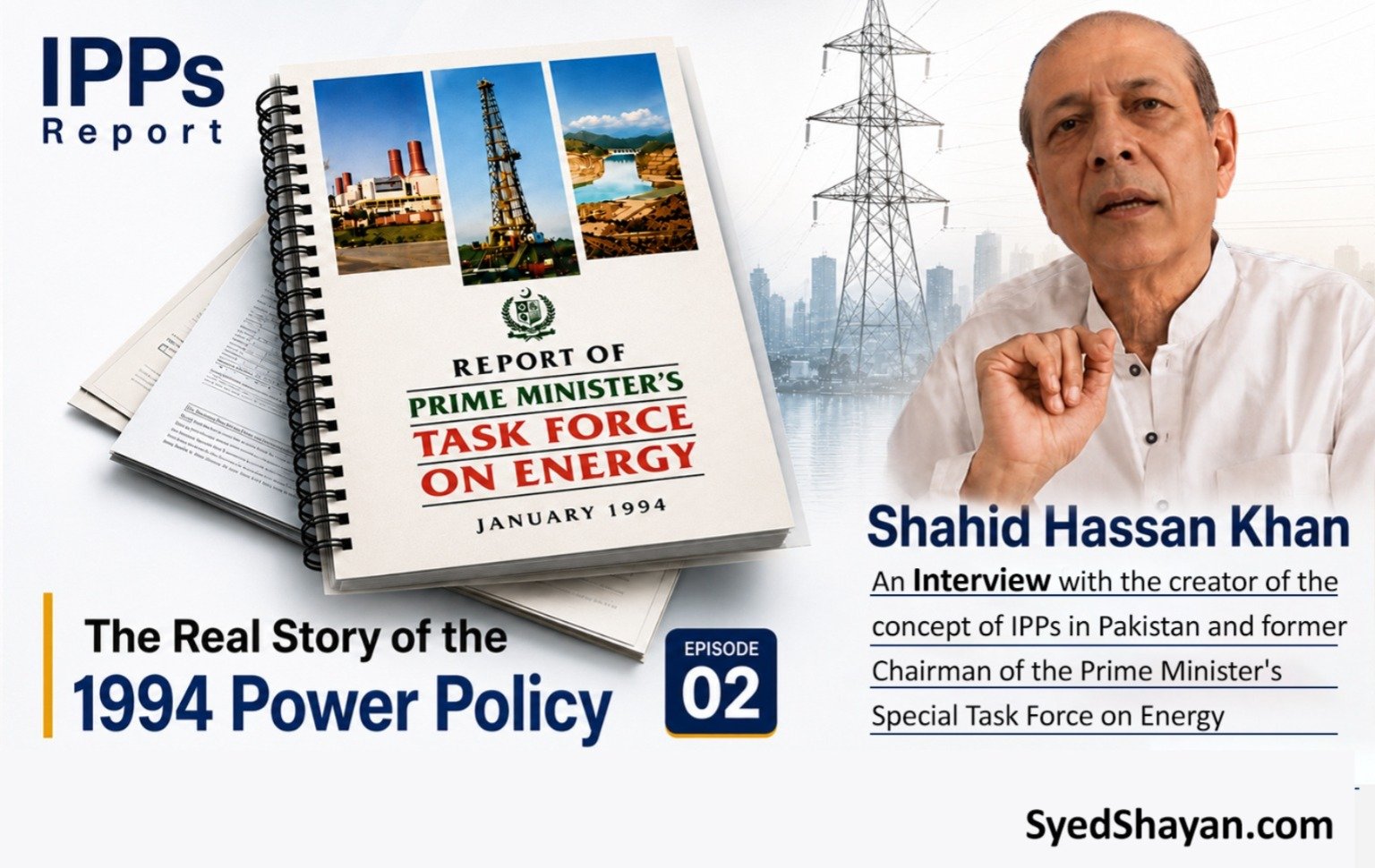
🔳 An Interview with Shahid Hasan Khan, the Architect of Pakistan’s 1994 Power Policy
Public Investigation Series | Episode 40
Topic: How Can Pakistan’s Power System Be Fixed?
Title: The 1994 Power Policy, the Imported Financing Model, and the Role of Technocrat Shahid Hasan Khan
🔺 When institutions fail to place facts before the public, the search for truth becomes a public responsibility.
Interview by: Syed Shayan
In 1993, facing a severe electricity shortage and prolonged load shedding, Benazir Bhutto’s government established the “Prime Minister’s Task Force on Energy” under the chairmanship of Shahid Hasan Khan. Based on the task force’s recommendations, the government approved the Power Generation Policy of 1994 on February 13, 1994, with the core aim of rapidly increasing electricity generation through private investment.
Under this policy, foreign investors were offered dollar indexation, capacity payments, Take or Pay terms, Fuel Pass Through, tax incentives, and other guarantees to encourage them to invest in Pakistan.
The policy brought substantial foreign investment into the country, and load shedding steadily declined over the following years. But in the years that followed, those very same terms, especially dollar indexation, capacity payments, dependence on imported fuel, and sovereign guarantees, became a major burden on Pakistan’s power sector and its economy, with the government recovering these costs from electricity consumers through their electricity bills before paying the IPPs.
Our thinking was simple: build enough new power plants to cover that shortfall and pull the country out of load shedding right away. After that, we planned to move to the next stage and gradually improve our energy mix, with a strong focus on hydropower and other domestic sources, to place the country’s power sector on a more sustainable footing.
He said:
“Bringing in IPPs was an emergency solution, like putting a critically ill patient on a ventilator for a short time. A ventilator has its own risks, but at that moment, saving the patient’s life is the immediate priority. In the same way, we knew that terms like capacity payments, dollar indexation, Take or Pay, return on equity, imported fuel, and sovereign guarantees could become a burden on the economy down the road. But at the time, the dollar was relatively stable, oil was cheap, and our immediate goal was simply to pull the country out of the dark.” That is why we recommended bringing in IPPs on a limited scale, on those terms, just enough to cover the roughly 3,000 megawatt shortfall and stabilize the system.
We never proposed building power plants on an unlimited scale, nor was that ever the purpose of our policy. Our proposal was only to generate enough additional electricity to get through the immediate national crisis. The next phase was meant to be strengthening the transmission network and gradually shifting toward cheaper domestic energy, especially hydropower. Shahid Hasan Khan added:
“Look, at that time we did not have an ideal option. The country did not have the capital required, WAPDA was in terrible shape, but the need for electricity was immediate. If we wanted to bring in private investment, we had no choice but to offer investors reasonable protections. That is why provisions like capacity payments, return on equity, dollar indexation, Take or Pay, imported fuel, and sovereign guarantees became part of the policy. They were included to attract investors, not to leave the country with a permanent financial burden.”
He said, “We drafted this policy in good faith, based on our professional experience. Its only purpose was to add around 3,000 megawatts of electricity within a limited period and pull the country out of the load shedding crisis. Fortunately, we succeeded, and in a relatively short time, the country emerged from widespread blackouts. We were confident that the next phase would focus on strengthening the transmission system and moving toward local energy sources, including hydropower.
But in the meantime, our government was dismissed. The governments that followed focused on the incentives in the policy rather than the limited purpose for which it had been designed. Perhaps they believed that if a few IPPs had brought good results, approving many more would bring even greater benefits. So, ignoring the country’s actual power needs, the limitations of our transmission system, and the financial burden it would create down the line, one project after another kept getting approved.”
He added, “That is why we chose thermal power to meet the immediate need. At that time, most new power plants around the world were being built on thermal technology too. Our goal was not to depend permanently on imported fuel, but to get through the immediate crisis. The energy mix was meant to be rebalanced in later stages.”
Shahid Hasan Khan added:
And as for capacity payments, you first need to understand what they are actually paying for. Capacity payments are tied to a physical asset whose machinery, debt, and investment are largely denominated in dollars. When the asset and its associated financial obligations are in dollars, the investor naturally wants to protect their principal and returns on the same basis. That is why, at the time, dollar indexation was not some unusual or novel idea to us. It was a recognized practice in international investment.
Shahid Hasan Khan said, “Let me repeat what I said at the start. We never thought this model would run forever. To us, it was a temporary, emergency arrangement, just like putting a patient on a ventilator for a short time. The only goal was for Pakistan to get through the immediate energy crisis. After that, once things improved, the energy sector was supposed to gradually shift onto a more sustainable footing. But unfortunately, Benazir Bhutto’s government itself was dismissed.”
(It should be noted that while this is Shahid Hasan Khan’s position, the facts on the ground tell a different story. The model that was introduced as a temporary, emergency arrangement later turned into a permanent policy. Governments changed, people came and went, but the system stayed in place. As a result, dollar indexation and capacity payments remain a heavy burden on Pakistan’s power sector to this day, a cost the economy and ordinary consumers are paying in the form of expensive electricity.)
“The principle of merit order was that to meet demand, the plant with the lowest production cost would be run first. Hydropower usually came first, then relatively cheap gas generated electricity, followed by furnace oil or other more expensive fuel based plants. As demand rose, the more expensive plants had to be brought online too. This kept the overall production cost of the system as low as possible.”
“Even today, the merit order principle has not gone away. Electricity generated from solar, wind, and hydropower has a very low fuel cost, so it is given priority in the grid. But the consumer is not billed just for the production cost of that particular electricity. The final tariff includes the average cost of electricity purchased from all sources, capacity payments, transmission and distribution costs, losses, surcharges, and taxes.”
“That is why the benefit of cheap solar or wind power does not show up separately for the consumer. That cheap electricity does bring down the overall cost of the energy mix somewhat, but at the same time, capacity payments still have to be made to expensive IPPs whether or not their electricity is actually used. When more plants are built than are actually needed, their fixed payments eat up most of the benefit that would otherwise come from cheap electricity.” “The real problem is not that solar, wind, or hydropower are as expensive to produce as coal or oil. The real problem is that the consumer ends up paying for the combined cost of the entire power system.”
After the IPP system came in, on top of the price of electricity, consumers were also saddled with capacity charges, various taxes, surcharges, and other additional costs, all so that this money could be collected from consumers and paid out to the IPPs. The result was that electricity bills moved further and further out of ordinary people’s reach, and this extra financial burden broke their backs.
The biggest question is this: people are paying for electricity, paying taxes, and bearing capacity charges, yet load shedding still hasn’t gone away, and in many areas the situation today is the same as before, or even worse.
If the public had to pay expensive electricity bills, extra taxes, and billions of rupees in capacity charges, and still had to endure load shedding, then what exactly did the country and its people gain from this entire IPP model?
What did Shahid Hasan Khan say in response to this question? Read that in the next episode.
(To be continued)



Thanks for sharing this informative article, I am waiting for the next article what did Shahid Hasan Khan says in the response.
Great work