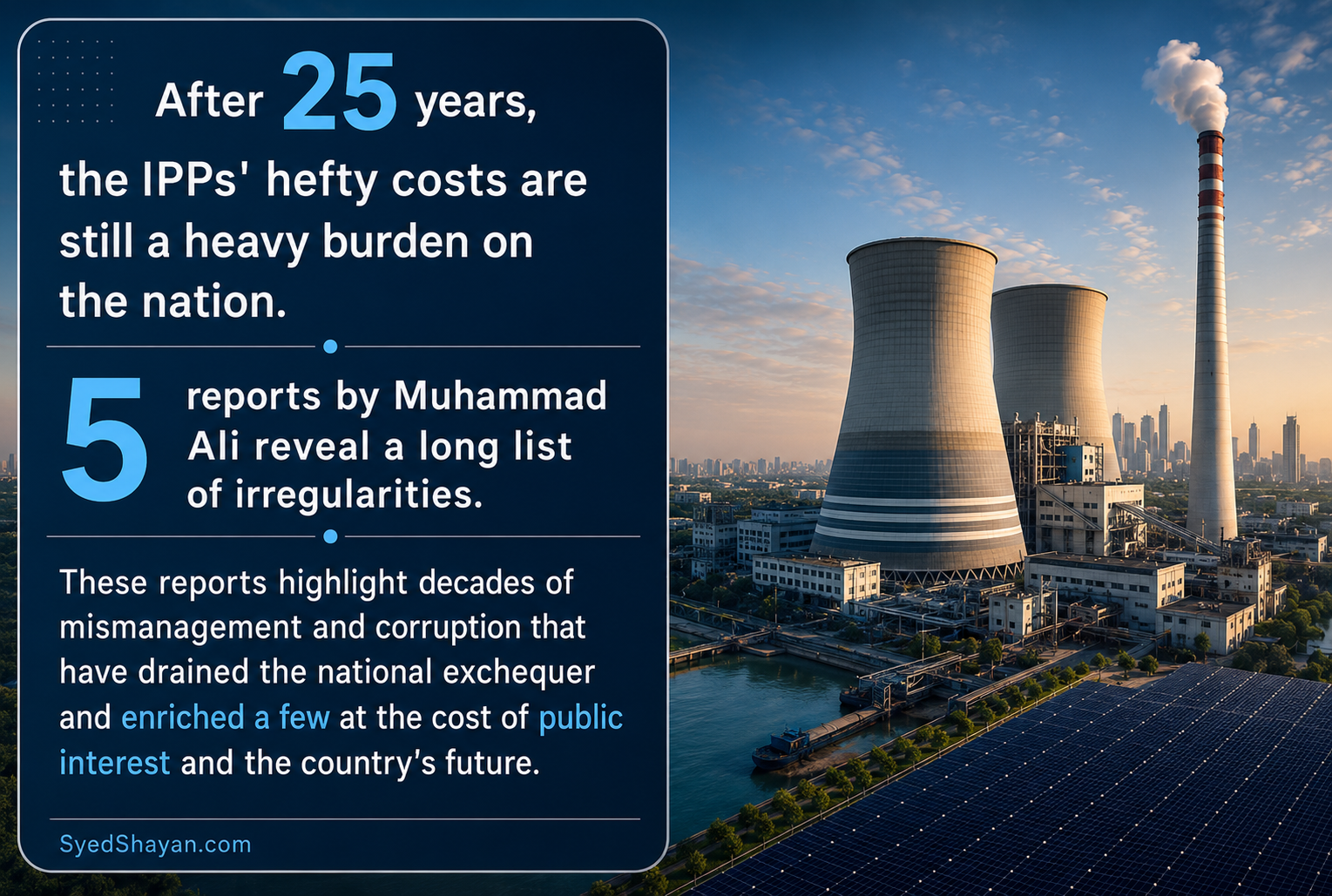
🔳 The true terms of Pakistan’s IPP agreements remained hidden from the public for nearly 25 years.
▫
The Muhammad Ali Report, released in April 2020, was the first to publicly reveal the hidden financial arrangements behind Pakistan’s Independent Power Producers (IPPs). It exposed the enormous financial cost that the national exchequer and the public had borne in the name of ending load shedding.
▫
The report identified 18 IPPs in which serious evidence of financial irregularities, over invoicing, and possible corruption had been found. It recommended the recovery of PKR 104.43 billion in alleged excess payments. This episode also identifies these IPPs and their owners.However, instead of conducting comprehensive forensic and legal investigations, the government chose to retain their contracts after obtaining a few concessions. In my view, this was the moment when the government should have stated that these companies had already earned around 30 years’ worth of profits and that their power plants would therefore be taken into public ownership. Had corruption been legally established, international arbitration tribunals would not have been expected to defend fraudulent conduct. In my assessment, successive governments allowed this opportunity to pass.Public Research Series | Episode 43Topic: How Can Pakistan’s Electricity System Be Fixed?Title: The Muhammad Ali Report and Financial Irregularities in Pakistan’s IPPs🔺 When institutions fail to provide the facts, the responsibility of seeking the truth falls upon the public.Research and Writing: Syed ShayanThe history of Pakistan’s agreements with Independent Power Producers (IPPs) revolves around three major power policies introduced in 1994 (Benazir Bhutto government), 2002 (Pervez Musharraf government), and 2015 (Nawaz Sharif government).Under these three power policies, a number of key contractual provisions agreed with IPPs, including US dollar indexation, returns on investment ranging from 15% to as high as 70%, and capacity payments even when no electricity was purchased, remained hidden from the public for almost 25 to 26 years, from 1994 to 2020.Successive governments never presented the full details of these agreements for public or parliamentary debate, consistently treating them as matters of Commercial Confidentiality.However, in April 2020, during the government of Prime Minister Imran Khan, the first comprehensive investigative report into the costs, profits, over-invoicing, and other financial aspects of the IPPs was made public. Commonly known as the Muhammad Ali Report, it was the first document to reveal to ordinary Pakistanis the enormous financial burden that certain IPP agreements had placed on the national exchequer and electricity consumers in the name of eliminating load shedding and improving the country’s power supply.The report identified alleged excess payments, extraordinary profits, and serious financial irregularities, triggering a nationwide debate over Pakistan’s IPP agreements.Prepared by a nine-member committee headed by Muhammad Ali, former Chairman of the Securities and Exchange Commission of Pakistan (SECP), the 288-page report disclosed for the first time that certain IPPs had earned billions of rupees in excess profits and that evidence of over-invoicing had been found in several projects.Among the major IPPs whose profits, project investments, and power generation costs were subjected to serious scrutiny in the report were:1. Hub Power Company (HUBCO)2. Kot Addu Power Company (KAPCO)3. Nishat Power Limited4. Nishat Chunian Power Limited5. Attock Gen Limited6. Rousch Pakistan Power Limited7. Liberty Power Tech Limited8. Uch II Power Limited9. Atlas Power Limited10. Engro Powergen Qadirpur Limited11. Foundation Power Company Daharki Limited12. Sapphire Electric Company Limited13. Saif Power Limited14. Orient Power Company Limited15. Saba Power Company Limited16. Kohinoor Energy Limited17. Sahiwal Coal Power Plant18. Port Qasim Electric Power Company🔘 The following is a list of the 18 IPPs identified in the report, together with their principal owners or controlling shareholders.
▫
Nishat Power Limited and Nishat Chunian Power Limited are affiliated with the Nishat Group, owned by Mian Muhammad Mansha.
▫
Hub Power Company (HUBCO) is a publicly listed company. Its Chairman is Habibullah Khan.
▫
Kot Addu Power Company (KAPCO) has WAPDA as its largest shareholder (approximately 40.25%), while the remaining shares are held by various banks, including MCB and UBL, as well as private institutions and individual investors.
▫
Attock Gen Limited is part of the Attock Group, whose ownership and management control rest with the Pharaon Investment Group.
▫
Rousch Pakistan Power Limited was, at the time of the Muhammad Ali Report, affiliated with Abdul Razak Dawood’s Descon Group, while the Crescent Group was also a major shareholder. The project was developed under the BOOT (Build, Own, Operate, Transfer) model. Accordingly, following the early termination of its Power Purchase Agreement (PPA) with the Government of Pakistan in 2024, ownership of the power plant was transferred to the government’s designated entity, the National Power Parks Management Company Limited (NPPMCL).
▫
Liberty Power Tech Limited belongs to Karachi’s Liberty Group, which is owned by the Mukaty family.
▫
Uch-II Power Limited is now jointly owned by Sapphire Fibres Limited and Mindbridge, each holding a 50% stake.
▫
Atlas Power Limited is part of the Atlas Group, controlled by the Shirazi family.
▫
Engro Powergen Qadirpur Limited is an Engro Group company, whose management control rests with the Dawood family through the Engro Group.
▫
Foundation Power Company Daharki Limited is owned by the Fauji Foundation.
▫
Sapphire Electric Company Limited is a project of the Sapphire Group, owned by the Abdullah family.
▫
Saif Power Limited belongs to the Saif Group of the Saifullah family of Peshawar.
▫
Orient Power Company Limited was, at the time of the Muhammad Ali Report, associated with Nadeem Babar, Mahmood Textile Mills, and other shareholders.
▫
Saba Power Company Limited was, at the time of the Muhammad Ali Report, owned by Nadeem Babar. However, its Power Purchase Agreement (PPA) was terminated in 2024. Since the project had been established under the BOO (Build, Own, Operate) model, ownership of the power plant remained with the company.
▫
Kohinoor Energy Limited is a joint venture between the Saigol family, led by Mian Naseem Saigol, and Japan’s Toyota Tsusho Corporation, with the Saigol family holding the majority stake.
▫
Sahiwal Coal Power Plant is a joint venture involving China’s Huaneng Shandong Ruyi, while Port Qasim Electric Power Company is jointly owned by China’s PowerChina and Qatar’s Al Mirqab Capital, with shareholdings of 51% and 49%, respectively.🔘 The Muhammad Ali Committee Report (2020) not only exposed the payments, incentives, and financial benefits extended to IPPs, but also revealed how decisions in Pakistan’s power sector were made, how payments were structured, and which contractual provisions ultimately increased the financial burden on electricity consumers.The report uncovered internal mechanisms of Pakistan’s power sector that had remained largely unknown not only to the general public but also to many economists, economic commentators, and policy analysts.🔘 The Five Most Shocking Findings of the Muhammad Ali Report1. Hidden Profits Through Fuel EfficiencyUnder the IPP agreements, power producers were paid according to a predetermined fuel efficiency benchmark, known as the Heat Rate Efficiency, for generating electricity using furnace oil or natural gas.The committee found that several power plants actually consumed less fuel than the benchmark allowed, yet continued to bill the government for the higher fuel cost through the official settlement mechanism.As a result, these plants allegedly earned billions of rupees in additional profits from the fuel they saved. According to the report, neither NEPRA nor the Central Power Purchasing Agency (CPPA-G) maintained records of these gains.2. Returns Far Above the Official RateThe common understanding was that IPPs were receiving a Return on Equity (ROE) of around 15% to 17%, a figure that was already considered generous by international standards.However, the report concluded that technical and financial irregularities in certain projects meant that some investors had contributed far less equity than officially declared, or in some cases had invested very little actual equity at all. Instead, they allegedly inflated capital costs and operational expenditures through over-invoicing.According to the committee’s findings, this accounting practice increased the effective dollar-based return on investment for some projects from the officially approved 15% to as much as 70% to 80% per year. In practical terms, some investors were able to recover their original investment within two or three years while continuing to receive substantial profits for the remainder of contracts lasting nearly three decades.This practice, whereby equity is overstated on paper while actual investment remains comparatively small, is commonly referred to as Equity Squeezing. The report suggests that this practice occurred in certain locally owned IPPs.3. Operation and Maintenance PaymentsGovernment policy provided every IPP with dollar-denominated allowances for Operation and Maintenance (O&M).The committee found that many IPPs awarded O&M contracts to their own subsidiaries or affiliated companies at significantly lower rates.According to the report, only around 30% to 40% of the O&M payments received from the government were actually spent on operating and maintaining the plants, while the remaining 60% was transferred to the owners’ holding companies as additional profit.In effect, consumers bore the full cost of operating and maintaining the plants, while any savings generated through lower actual expenses remained with the owners. In financial terminology, this practice resembles Double Dipping, whereby the same arrangement generates multiple streams of financial benefit for the same party.4. Commercial Operation Date (COD) CertificationThe committee reported that certain power plants allegedly obtained their Commercial Operation Date (COD) certificates despite incomplete testing or before demonstrating full generating capacity.As a consequence, the government began making capacity payments even though the plants had not fully satisfied the technical requirements that should have preceded commercial operation.According to the report, this resulted in billions of rupees in payments being made earlier than they otherwise should have been.5. Debt Restructuring Benefits Retained by InvestorsThe committee also found that several IPPs had initially obtained financing from domestic and international lenders at interest rates linked to KIBOR or LIBOR.Afterwards, many of these loans were reportedly restructured at lower interest rates.However, government payments continued to be calculated using the original, higher financing costs. Instead of passing these savings on to the public, the financial benefit from lower borrowing costs was allegedly retained by the project owners.The report concludes that several IPPs benefited both from cheaper financing and continued reimbursement based on higher historical financing costs.⸻🔘 The financial data, investment figures, construction costs, invoicing practices, and profitability analyses presented in the Muhammad Ali Report regarding 18 major IPPs raise serious questions about the role of several leading investor groups. If these findings were to be established through legal proceedings, they could rank among the most significant revelations in the history of Pakistan’s power sector.These power plants are owned by some of Pakistan’s largest and most influential business groups. If the report’s observations regarding construction costs, over-invoicing, investment levels, and profitability are ultimately proven to be correct, and if it is established that project costs were deliberately inflated or that unjustified financial benefits were obtained through contractual arrangements, an important question arises: what legal or moral justification would remain for granting further concessions to such projects?The report notes that matters relating to these companies were examined by NAB and other institutions, and investigations were conducted. However, instead of pursuing criminal prosecutions or seeking convictions, the government chose to resolve the matter primarily through negotiations.In effect, the government acknowledged that previous agreements had imposed an excessive burden on the public and sought revisions through renegotiation rather than litigation.In my assessment, a stronger course of action would have been for the government to argue that investors had already recovered the profits contemplated over the life of the agreements through alleged over-invoicing, inflated capital costs, and generous payment structures, and that the remaining assets should therefore be brought into public ownership subject to applicable law.Had fraud or corruption ultimately been established through proper legal proceedings, international tribunals would not necessarily have been expected to protect rights acquired through fraudulent conduct.Governments often hesitate to take such measures because of concerns about international arbitration. Nevertheless, international investment law also recognizes principles such as the Doctrine of Clean Hands and the rule that fraud or corruption can invalidate contractual rights. Where supported by credible evidence and a proper forensic audit, these principles may provide an important legal defence.This aspect of international law has received comparatively little attention in Pakistan. Whenever the cancellation or restructuring of IPP agreements is discussed, reference is usually made to the risks of arbitration before institutions such as ICSID, SIAC, or LCIA, as well as concerns arising from previous disputes such as Reko Diq. Much less attention is given to the legal doctrines that may invalidate contracts tainted by fraud or corruption.The Muhammad Ali Report expressly recommended comprehensive forensic audits. Those audits, however, were never undertaken. Why that recommendation was not implemented is a question that only the government of the time and the relevant public officials can fully answer.As a result, the legal route through which the report’s allegations could have been tested by forensic examination and judicial proceedings was never pursued. Instead, the government opted to renegotiate the contracts.Consequently, the major business groups involved remained owners of their power plants, avoided any significant legal consequences, and retained most of their contractual rights after granting limited concessions. This further reinforced the public perception that the law was unable to hold powerful interests fully accountable.From 1993 to 2026, a total of 33 years have passed. During this period, Pakistan witnessed seven to eight governments, including one period of military rule. Prime ministers came and went, and successive administrations promised reforms, yet the fundamental issues surrounding the country’s IPP framework remain unresolved.Even more troubling is the fact that during these three decades, no sustained national movement emerged to warn the public that Pakistan had embarked upon a course whose consequences might ultimately be borne by future generations.At times, I am reminded of a passage from Mukhtar Masood’s celebrated work Awaz-e-Dost, in the essay Qahat-ul-Rijal:“In famine, death becomes cheap; in a famine of leadership, life itself loses its value.”What has already happened cannot be changed.What remains, however, can still be changed.If Pakistan continues to avoid a serious national discussion about the causes of the IPP problem and fails to build a durable consensus on meaningful reforms, the costs for future generations may prove even greater than many of the country’s historic crises.The time has come to move beyond blame and toward genuine national reform and informed public dialogue.(To be continued in the next episode.)