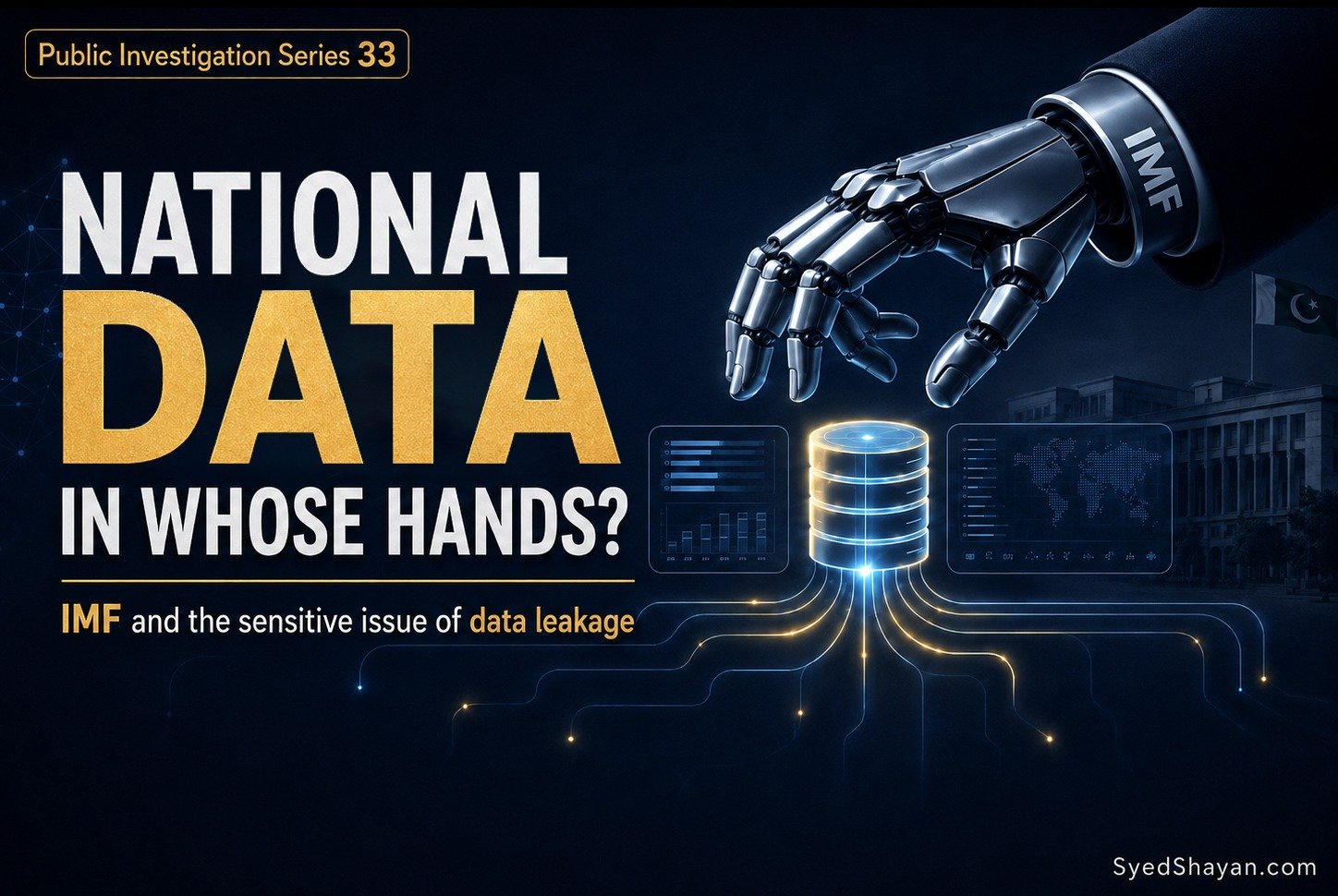
🔳 IMF’s New Conditions for Electricity Subsidies: A Decision to Hand Over Data of Millions of Pakistani Citizens to an External Firm, A New Question for National Security?
▫
The Governor of the State Bank and the Federal Minister for Finance must explain to the nation whether written permission was given to the IMF for access to, or analysis of, Pakistani citizens’ data after approval from Pakistan’s Parliament. Was this decision taken after formal consultation and written approval from the relevant national database custodians, security authorities and state institutions responsible for sensitive information?
▫
In the absence of Data Protection laws in Pakistan, external audits of this nature can make the private lives of our citizens even more insecure.
▫
This is not merely a matter of data transfer. It is a major bargain over the economic sovereignty of our people and the digital privacy of citizens.
▫
It is being said that the government is not directly transferring citizens’ data to the IMF. But the reality is that, by accepting an IMF condition for a loan tranche, a system is being created in which the sensitive data of entire families of 22 million of the poorest electricity consumers will come under the control of external firms in order to end their subsidy.
▫
If this data is hacked or falls into foreign hands, it could become the biggest security breach in Pakistan’s history. This is the kind of work a foreign intelligence agency would want to do.
▫
Legally, the IMF is a macroeconomic institution. It should have no personal interest in the individual information of ordinary citizens, such as identity card numbers, phone numbers or private biodata. Nor should it be able to demand that such data be transferred to its servers. The IMF’s focus is always on aggregate macroeconomic data, such as how much subsidy is being provided in which sector, how it will be phased out, and the timeline for withdrawing it.🔲 Public Investigative Series | Episode 33Topic: How Can Pakistan’s Electricity System Be Fixed?Title: Electricity Subsidy or a Deal Over National Data?🔺 When institutions avoid providing facts, reaching the truth becomes the responsibility of the people.Written and researched by Syed ShayanIn May 2026, during budget negotiations between Pakistan and the International Monetary Fund, or IMF, a written assurance was given by our Governor of the State Bank and the Federal Minister for Finance. This assurance has raised not only questions of economic reform, but also a highly serious question of national security.The government has assured the IMF in writing that from January 2027, the base electricity tariff will be increased, the existing subsidy for consumers using up to 200 units will be abolished, and it will be replaced with a targeted subsidy system linked to the data of the Benazir Income Support Programme, or BISP, and the National Socio-Economic Registry, or NSER.On the surface, this appears to be an economic reform measure. But if examined more deeply, it could prove to be perhaps the biggest Data Governance crisis in Pakistan’s history.What is going to happen? The real factsUnder the agreement reached with the IMF, a new base tariff will be implemented from January 15, 2027. This is a mandatory structural benchmark under the $7 billion Extended Fund Facility, or EFF.The protected consumer subsidy for users of up to 200 units will be abolished, and approximately 22 million consumers fall into this category.
▪
️ Data linkage in the name of subsidyThe new subsidy will be available only to those people who are present in the BISP database and whose electricity connection has been linked with the NSER database.This entire process is to be completed by November 2026 with technical assistance from the World Bank, and an external firm was to be hired by the end of May 2026. By the time this article is read, that firm may already have been appointed.
▪
️ The risk to the digital identity of every householdWhen electricity connections, the NSER database and BISP records are linked in one place, the following information will be gathered on a single platform:the citizen’s full name, identity card number, home address, number and ages of family members, monthly electricity consumption and time of use, income level and economic status, and whether the house is owned or rented.This is not merely a subsidy record. This is the complete digital identity of every Pakistani household.
▪
️ The risk of foreign accessAn external firm will also be involved in this database being prepared with the technical assistance of the World Bank.Which country does this firm belong to? Where are its servers located? How much access will its employees have to the data?These questions were neither raised in Parliament nor discussed in the media.If this firm belongs to a country that is a rival of Pakistan, the data of around 25 million of our citizens could come within the reach of an enemy without any war.
▪
️ The risk of intelligence profilingElectricity usage is not merely an economic statistic. It is a map of life.For a foreign institution to possess complete household details of people living near military cantonments, sensitive installations and border areas would be equivalent to an intelligence operation.Political opponents, journalists and civil society activists would also have their complete profiles present in this database.
▪
️ The cybersecurity problemThe cybersecurity of Pakistan’s digital systems has already not been satisfactory.Concerns related to NADRA data and the weak billing systems of DISCOs further increase this risk.Connecting such systems to a central platform can create a single point of failure, where one fault, leakage or unauthorised access could place the sensitive data of millions of citizens at risk.
▪
️ The risk of data misuseWhen the government has a complete system to know who lives where, how much they earn, how much electricity is consumed in each house, and which economic category each person belongs to, this information does not remain limited to subsidy decisions.Such data can also be used for political pressure, administrative surveillance, identification of economic vulnerabilities and influence over weaker sections of society.In Pakistan, there is neither a strong law nor a fully independent oversight mechanism to prevent the misuse of such sensitive data.
▪
️ Data without individual consent: a legal and ethical questionPakistan has still not enacted any Data Protection law. No Privacy law is in force. There is no national framework for cybersecurity audits.In this situation, placing the data of any individual among 260 million citizens into a special database without that person’s consent, without their awareness and without approval from Parliament is a direct violation of the constitutional right to privacy.
▫
These are some basic questions that the Federal Minister for Finance and the Governor of the State Bank must place before the nation.• What is the name of the external firm? Which country does it belong to? What are the details of the data-sharing agreement?• What is the extent of the World Bank’s access to the data? Can it use this data for its own purposes?• Will there be any independent cybersecurity audit of this database? Who will conduct it?• If citizens do not want their data to enter this system, what option will they have?• In which session of Parliament was this issue debated, and under which law was this assurance given?Electricity will become more expensive in January 2027. This has now been decided.The subsidy for 200-unit consumers will end. This too has been decided.But the much bigger question is where the data of millions of Pakistani citizens is going in this entire process, who will use it, and for what purpose.Economic compulsions are understandable. The pressure of IMF conditions is also understandable.But national security and citizens’ privacy are not things that can be quietly sacrificed during budget negotiations.Until parliamentary approval, an independent cybersecurity audit, a Data Protection law and a clear mechanism for citizens’ consent are placed before the public, this is not merely a question of electricity prices. It is a question of national sovereignty.[To be continued in the next episode.]