

The Debate on New Provinces in Pakistan Is a Valid Question Raised at the Wrong Time
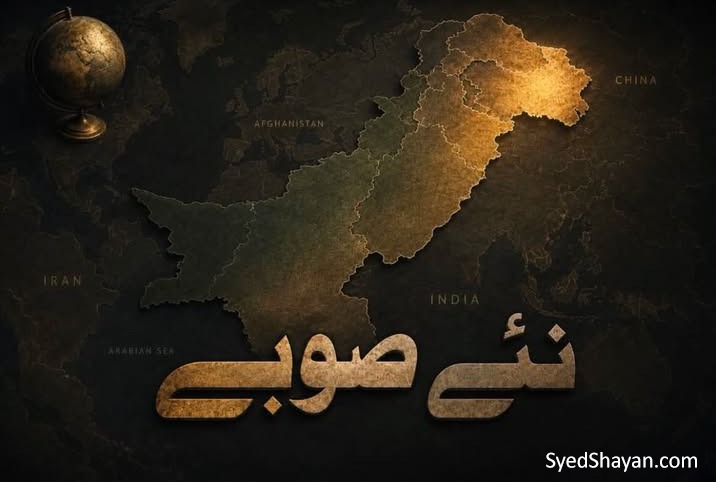
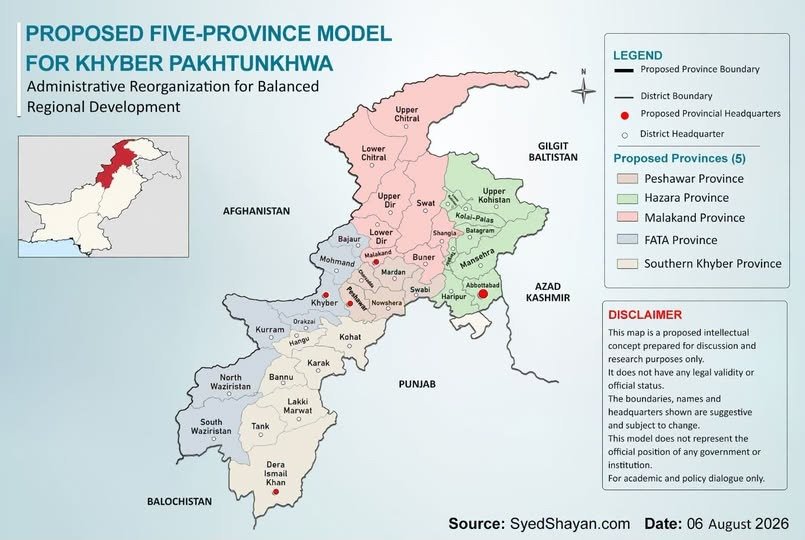
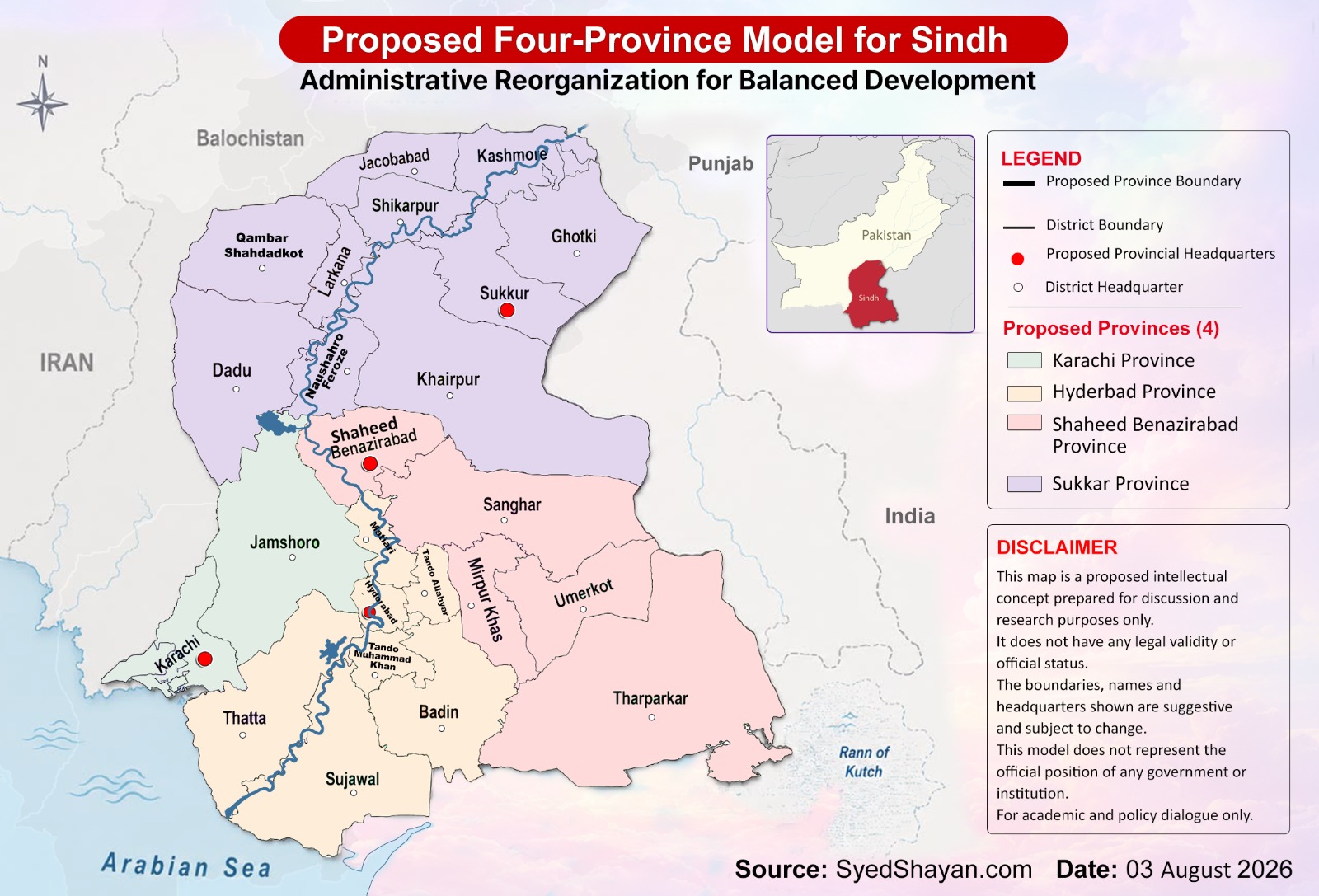
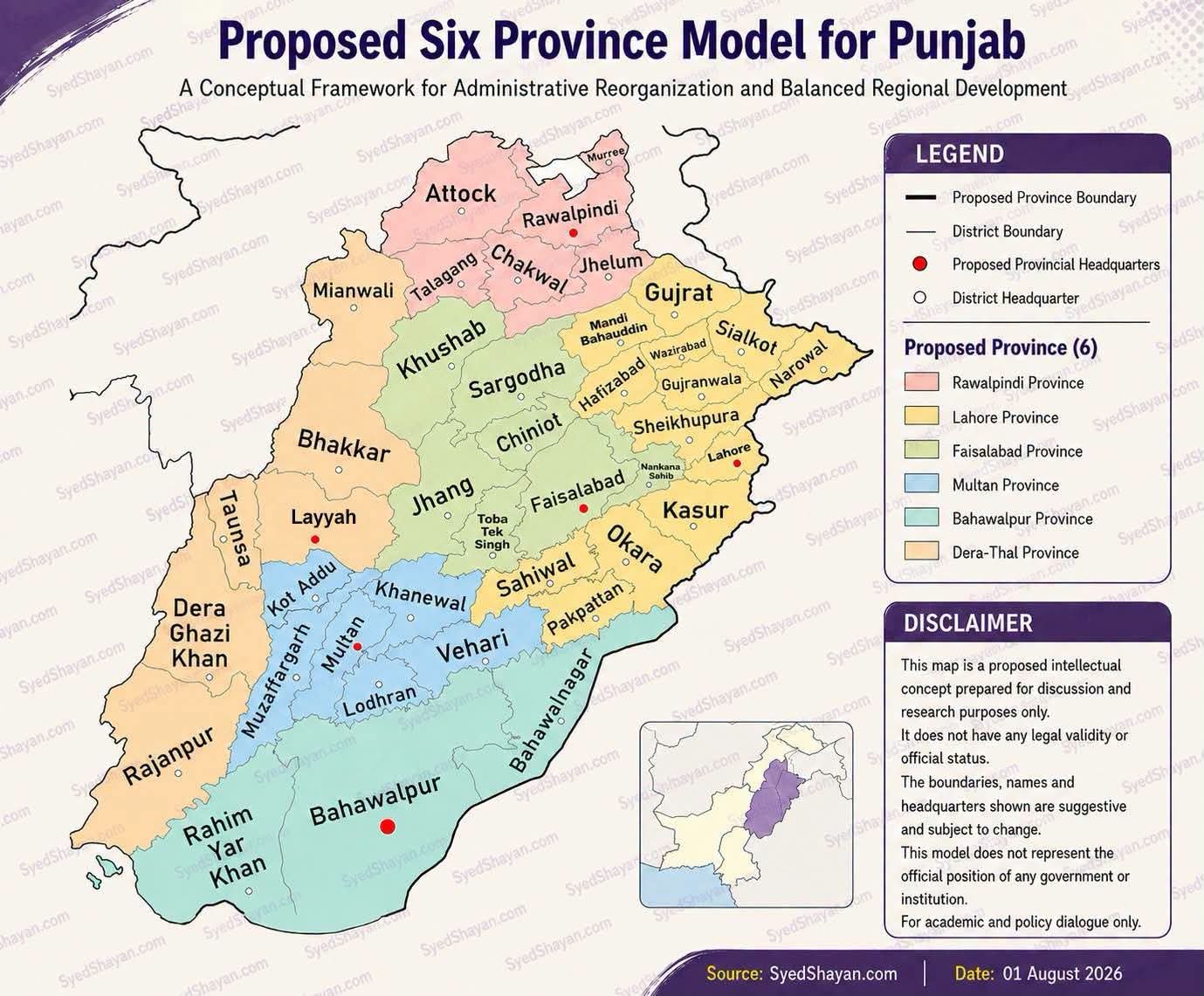
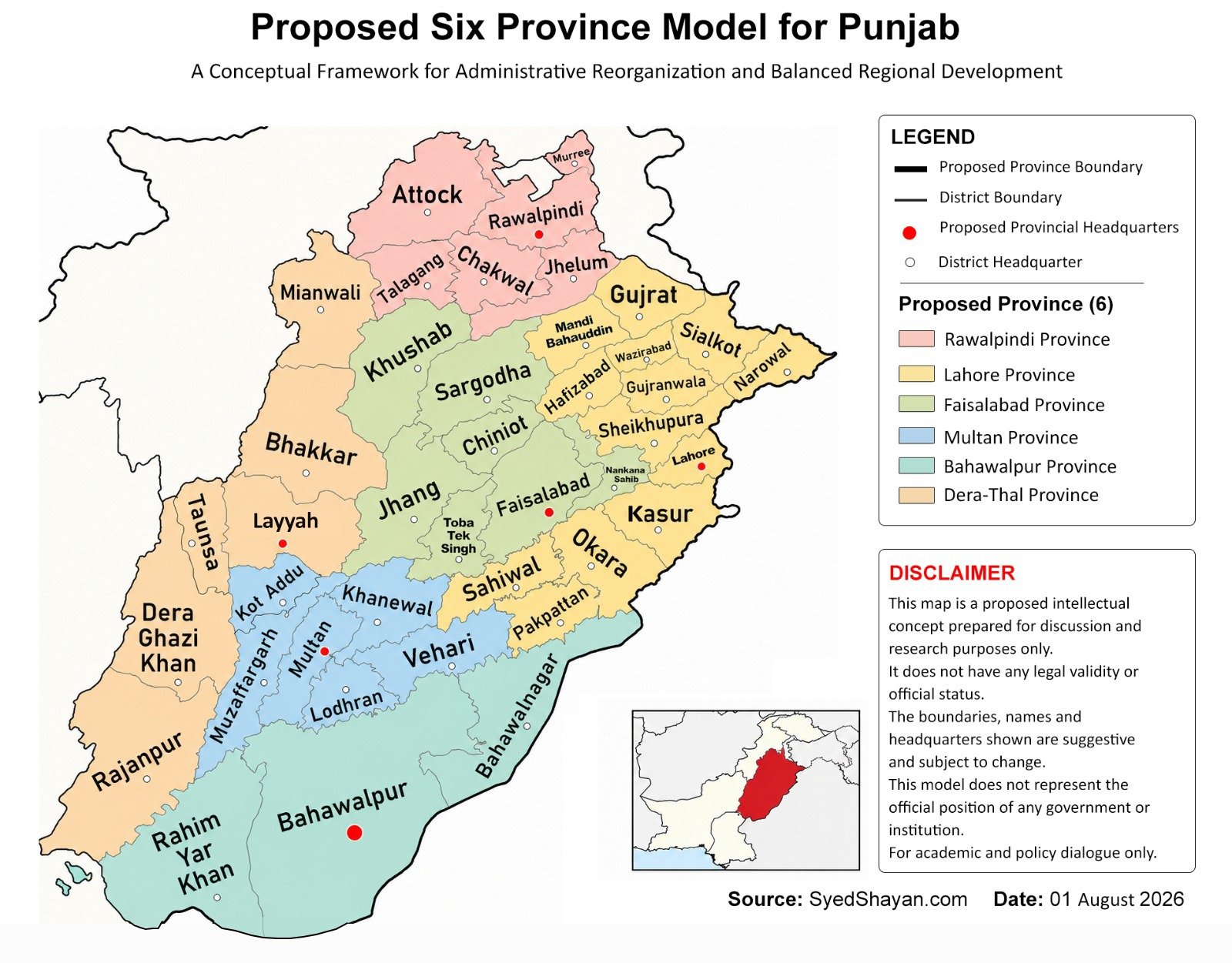
🔳 The debate on creating new provinces in Pakistan is undoubtedly a valid issue, but it has been raised at the wrong time.
Various international studies have shown that when new provinces or administrative units are created, people become less dependent on major cities for healthcare, employment and judicial matters, allowing economic activity to spread more widely across the country.
▫️ People in Pakistan need to understand that a province is not a separate state. It is an administrative unit through which the state governs.
▫️ Administrative division should not be confused with political division. Just as a large institution, bank or company creates different zones or branches in order to operate more efficiently, provinces are also a means of improving governance.
▫️ People strongly prefer that the taxes they pay should be spent in their own regions. The smaller and more accessible a province is, the easier it becomes to monitor the misuse of funds and corruption.
▫️ When administrative units are smaller and empowered, the burden on central and provincial governments is reduced and the federation becomes stronger because citizens are less dependent on the centre or a distant provincial capital for the protection of their rights.
▫️ In countries with ethnic, linguistic or geographical diversity, the creation of new provinces or the granting of regional autonomy has, in several cases, led to a noticeable reduction in rebellion against central authority and in feelings of deprivation.
▫️ International surveys and research reports examining public views on the creation of provinces and the distribution of powers have found that more than 70 percent of respondents in some studies believed that education, healthcare and policing function more effectively and more rapidly in smaller and empowered provinces than in large provinces governed from distant centres.
🔳 Subject: Does Pakistan Really Need New Provinces? | Episode 5
Title: A Province Is Not a State. It Is an Administrative Unit Through Which Government Functions
🔺 Differences of opinion on national issues are natural, but serious debate and national consensus are essential for finding sustainable solutions.
Written and Researched by Syed Shayan
The purpose of creating provinces is to make government more accessible to citizens and to enable legislation according to the circumstances and needs of each region.
There are seven major advantages:
1. Government Comes Closer to the People
Today, many people have to travel hundreds of kilometres to a provincial capital for official work, complaints or administrative problems. When a new province is created, the government, secretariat and major institutions become more accessible to the people of that region.
2. Decisions About a Region Are Made Within the Region
Mountainous areas, agricultural regions, industrial cities and desert territories do not have identical needs. When each region has its own government, decisions can be made according to its actual requirements.
3. The Budget Is Not Confined to Major Cities
In large provinces, much of the public expenditure is concentrated in the provincial capital and a few major cities. When a new province is created, the region has its own budget and funds can be directed towards local roads, hospitals, schools and employment opportunities.
4. Decisions Are Made More Quickly
When one government has to manage a very large population and a vast territory, decision making becomes slower. A smaller and better organised province can understand its problems more quickly and resolve them more efficiently.
5. Responsibility Becomes Easier to Identify
When government is distant, institutions often shift responsibility from one department to another. When government is closer to citizens, people know who is responsible for roads, water, schools, hospitals and law and order.
6. Development Is Not Confined to One City
The creation of new provinces can lead to the development of new capitals, universities, hospitals, courts, government offices, industries and employment centres. In this way, development can spread across the country instead of remaining concentrated in two or four major cities.
7. National Unity and a Stronger Federation
When people in smaller or neglected regions are given meaningful authority over their own affairs and greater control over the use of local resources, feelings of deprivation are reduced. This can reduce resentment towards the centre, strengthen national unity and reinforce the federation.
After reading these arguments, many people may reasonably think that most of the benefits attributed to new provinces could also be achieved through an empowered and effective local government system.
Development projects and municipal services fundamentally fall within the domain of local government. In that case, how far is it correct to present these services as advantages of creating new provinces, when establishing a strong and empowered Local Government system may be a simpler and less costly solution?
The distinction can be explained as follows:
Local governments deal with lower level services and administrative matters such as streets, drainage and sanitation. They do not possess broad legislative and administrative powers because key areas such as policing, revenue administration, provincial taxation and policymaking remain under provincial control.
The second major difference is Financial Autonomy. Local government institutions depend on provincial governments for funding, whereas a province constitutionally receives its share under the NFC framework.
Most importantly, local government institutions remain dependent on provincial governments and may, under the law, be dissolved, suspended or have their powers restricted. A province, by contrast, provides its region with Constitutional Protection and meaningful Power and Authority.
This raises another question. If new provinces make life easier for ordinary citizens, why do people oppose them?
The reality is that ordinary citizens often benefit the most from the creation of new provinces. They no longer have to approach an MNA or MPA for every minor or major issue because many matters begin to be handled directly through institutions.
This is one reason why some political figures may feel that their personal importance and influence could decline. Opposition is then often amplified by those politicians or their supporters, whereas for the ordinary citizen, bringing administration closer is not a disadvantage but a major convenience.
The purpose of creating provinces is to make government more accessible to citizens and to enable legislation according to the circumstances of each region.
🔘 Let us examine why, despite the many economic and administrative advantages associated with new provinces, political parties and citizens often oppose the idea or show limited interest in it. The main reasons are as follows:
▫️ Fear of Losing Political Influence:
Governing parties and major regional political groups may fear that dividing a province will divide their vote bank and weaken their political power. The creation of new provinces may also threaten established political monopolies.
▫️ Disputes over Resources and Fiscal Transfers:
Conflicts may arise between existing and newly created regions over natural resources such as water, minerals and gas, as well as financial allocations, particularly under the NFC Award. No region is easily willing to surrender what it considers its existing share.
▫️ Concerns About Linguistic and Cultural Unity:
Provinces are often associated with language or geography. When a province is divided, local populations may fear that their historical, cultural and linguistic identity will be weakened or fragmented.
▫️ High Administrative Costs:
Creating a new province requires a new Provincial Assembly, Governor House, Chief Minister House, secretariat and administrative structure. These arrangements may require billions of rupees in additional expenditure and could place a further burden on the national economy.
▫️ Centralisation of Power:
Political elites and bureaucracies are generally reluctant to transfer authority to lower levels because the creation of new provinces may reduce their central control.
▫️ A Complex Constitutional and Legislative Process:
Creating a new province is an extremely complex and lengthy constitutional process requiring a two thirds majority in Parliament and in the relevant Provincial Assembly. Building consensus among all political groups can therefore be extremely difficult.
These are the principal reasons why debates over new provinces often move away from administrative necessity and become political controversies.
In Pakistan’s present debate, there is an additional problem: the timing.
The discussion about creating new provinces began at a time when the government’s public standing and the broader national situation were themselves under serious scrutiny. As a result, an important national issue became unnecessarily controversial.
However, now that the debate has begun, it should proceed through reasoned argument and research.
Before taking the discussion further, one fundamental distinction must be understood. People in Pakistan need to clearly understand the difference between a province and a state.
A province is not a separate state. It is an administrative unit through which the state governs.
For example, if a family consists of five people, one house, one kitchen, one drawing room and one dining room may be sufficient.
But if that same family grows over time to fifty members, one house will obviously no longer be enough. Some members may then build a second house and others a third.
Does this mean that the family has broken apart? Certainly not.
It simply means that the family has grown, and its administrative arrangements must also expand.
The same principle applies to a state.
As population grows, administrative structures must also expand so that government remains close to citizens, decisions reflect local needs and people do not have to repeatedly travel to distant capitals for their work.
When a family grows, the number of houses may increase. When a country grows, its administrative structure must also expand. Neither the family nor the country is divided merely because its administration has expanded.
Another important point is that people often treat Local Government, districts, divisions and provinces as though they were the same thing, although each performs a different function.
Local Government deals with local issues. Districts and divisions primarily provide administrative convenience. A province, however, operates at the level where the secretariat, Chief Minister, cabinet, High Court, police, healthcare, education, budget and major administrative decisions are located.
This is why, when citizens face significant problems relating to health, education or major legal and administrative matters, they often have to approach provincial level institutions rather than a Union Council or division. In some cases, they may even have to travel to Islamabad.
To understand the debate over the creation of new provinces, some important examples from Islamic history are also relevant.
As the State of Madinah expanded and Makkah, Taif, Yemen, Bahrain, Khaybar and other regions became part of the Islamic state, the Prophet Muhammad ﷺ did not administer every matter exclusively from Madinah. Governors, administrators and other officials were appointed in different regions.
The purpose of this arrangement was to ensure that local matters could be resolved locally, that people could obtain justice and government services closer to where they lived, and that they would not need to travel to Madinah for every minor or major issue.
This illustrates an important principle: as the territory and population of a state expand, administrative responsibilities must also be distributed so that governance remains effective and the distance between rulers and citizens is reduced.
Later, during the period of Hazrat Umar Farooq رضی اللہ عنہ, when the Islamic state expanded into Iraq, Syria, Egypt and Persia, the same principle was developed in a more organised form.
Separate governors, judges, treasury officials and other administrators were appointed for different regions. New administrative centres such as Kufa, Basra and Fustat were also established so that people did not have to travel to Madinah whenever they required justice, administration or government services.
The development of Wilayat, meaning provinces, Jund, meaning military garrisons, Diwan, meaning financial and administrative offices, and systems of accountability during the period of Hazrat Umar Farooq رضی اللہ عنہ demonstrates that the principles of state administration are not static. As population and geographical reach expand, administrative systems must also be expanded and reformed.
Wilayat is an Arabic term referring to a territory under administration, while Wali refers to its administrator or governor. In contemporary administrative terms, these concepts may broadly be understood as corresponding to a province and its governor.
This demonstrates that within the Islamic tradition of governance as well, administrative structures expanded as the state and population grew, with the objective of providing better public services and more timely justice.
(To be continued in the next instalment)
No comments yet.