

How Many Provinces Should Sindh Be Divided Into?
🔳 Whenever the idea of making Karachi, or any other part of Sindh, a separate province or administrative unit is raised, it is often perceived at the public level as a threat to Sindh’s historical unity, regardless of how much an ordinary citizen might benefit from such an arrangement. This is where politically motivated leaders can exploit the public’s limited awareness of history. The historical reality, however, is that ancient Sindh itself was administratively divided into three major administrative regions centuries ago: Upper Sindh was known as Siro, Central Sindh as Vicholo, and Lower Sindh as Lar.
▫️ In Sindh, land is not merely a geographical territory. It is also connected with the deeply emotional and almost sacred concept of “Sindhu Dharti.” This is why the people’s relationship with their land is not merely political or economic, but deeply existential in nature.
Topic: How Can Pakistan Be Administratively Reorganized? | Episode 3
Title: How Many Provinces Should Sindh Be Divided Into?
🔺 Differences of opinion on national issues are natural, but meaningful solutions can only emerge through serious debate and a broader national consensus.
Written and Researched by: Syed Shayan
Before discussing the division of Sindh or the creation of new provinces, it is important to understand the following historical context.
🔳 On 23 July 1948, under a decision associated with Quaid e Azam Muhammad Ali Jinnah and the central Constituent Assembly, an area of approximately 812 square miles of Karachi was separated from Sindh and placed under the Federal Government.
It became Pakistan’s federal capital and was designated the Federal Capital Territory.
Even after the creation of the One Unit system in 1955, Karachi retained its separate federal status.
During the presidency of Ayub Khan, the national capital was first temporarily shifted to Rawalpindi and was later permanently moved to Islamabad.
In July 1970, when General Yahya Khan abolished the One Unit system and restored the provinces, Karachi’s separate federal status came to an end. It was reintegrated into Sindh and became the provincial capital once again.
However, long before Pakistan came into existence, Sindh itself had undergone several major changes in its administrative status.
In 1847, for administrative and financial reasons, Sindh was incorporated into the Bombay Presidency. It was given the status of a Commissionership and placed under the Governor of Bombay.
If we examine Sindh’s history before the creation of Pakistan and before the One Unit era, an important turning point came in 1839, when the East India Company captured Karachi.
In 1843, under the leadership of Sir Charles Napier, the East India Company conquered the whole of Sindh. In 1847, Sindh was incorporated into the Bombay Presidency as a Commissionership under the Governor of Bombay, and its administrative affairs began to be managed from Bombay.
One of the earliest voices demanding Sindh’s separation from Bombay came from Seth Harchandrai Vishandas in 1913.
Later, leaders including Ghulam Muhammad Bhurgri, Sheikh Abdul Majid Sindhi, Sir Abdullah Haroon, Shahnawaz Bhutto, and others transformed this demand into a significant political movement.
Quaid e Azam Muhammad Ali Jinnah also explicitly demanded the separation of Sindh from the Bombay Presidency in Point 9 of his famous Fourteen Points of 1929.
After a long political struggle, Sindh was separated from the Bombay Presidency on 1 April 1936 and established as a separate province with its own legislative assembly.
History therefore shows that the administrative status of Sindh and Karachi has changed at different times in response to state and administrative requirements.
For this reason, discussing new provinces or administrative reorganization within Sindh today is neither an extraordinary nor inherently unconstitutional idea. Nor can it reasonably be argued that the province’s existing boundaries can never be reconsidered.
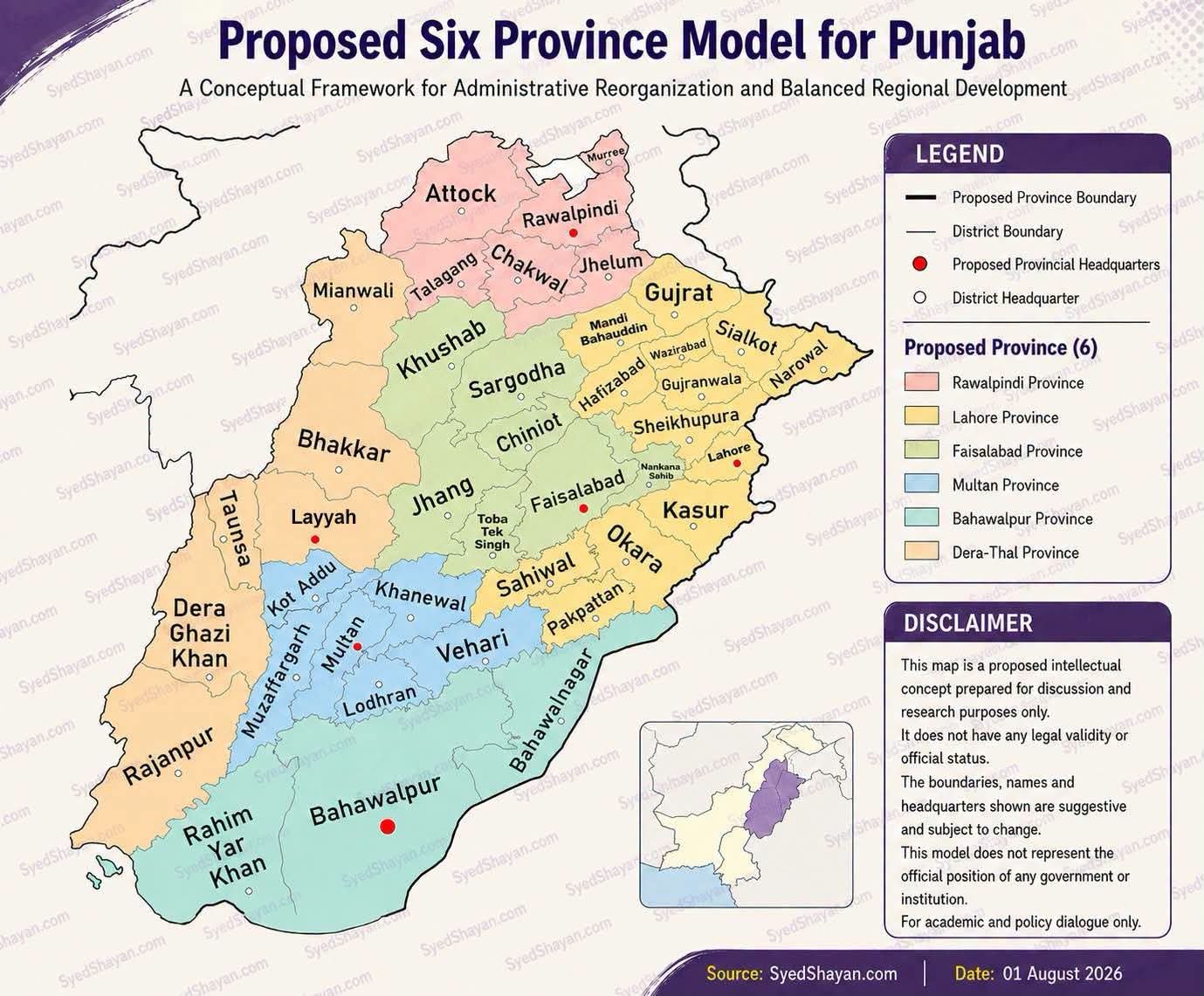
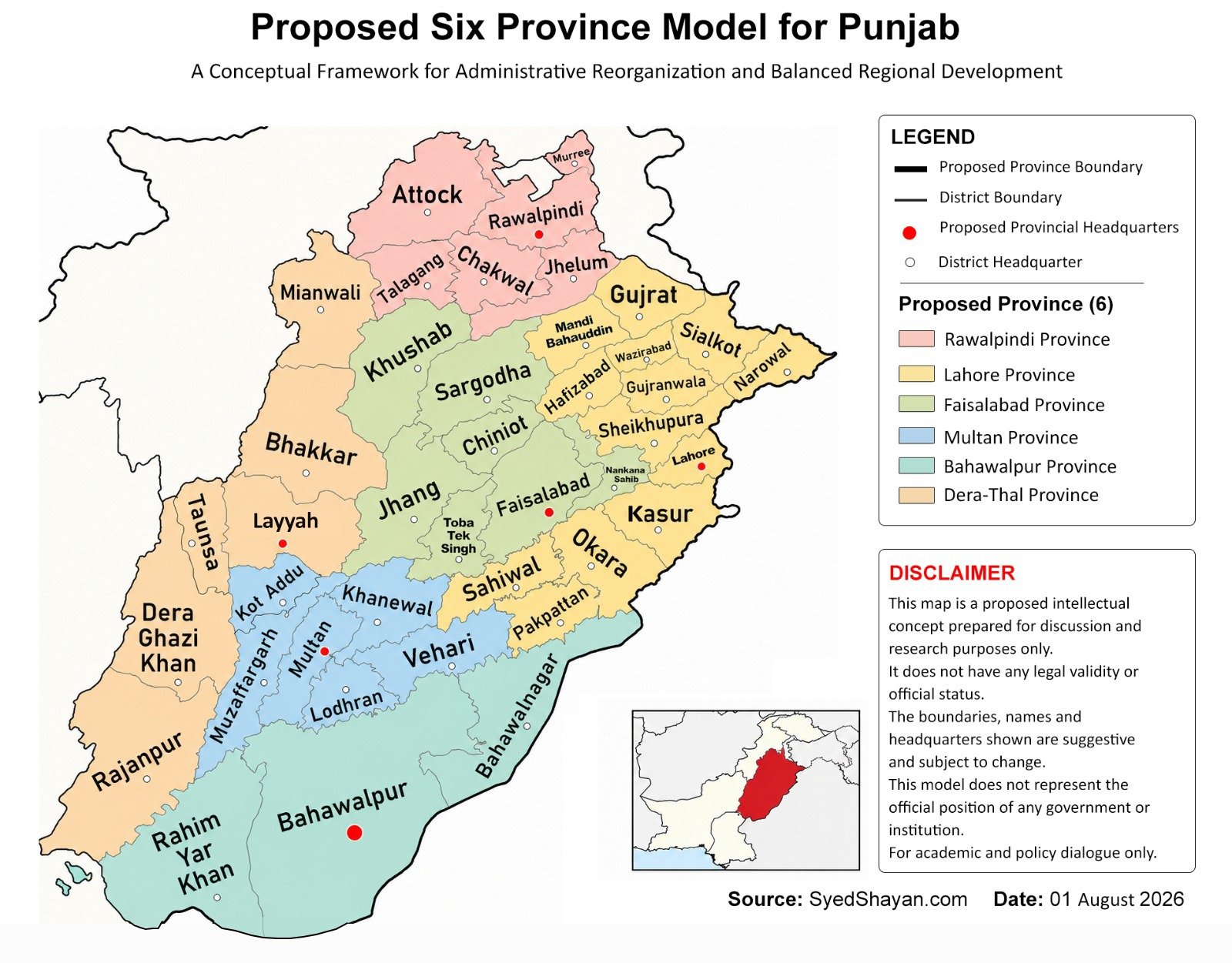
In the previous episode, we presented a proposed model for dividing Punjab into 6 provinces, based on population, geographical area, economic potential and administrative requirements.
If administrative reform is genuinely to become a national agenda, the same principles should be applied equally to Sindh and Pakistan’s other administrative units.
Sindh’s Population and the Governance Question
The 2023 Census raises an important question about Sindh’s current administrative structure.
Out of a total provincial population of more than 55.6 million, even if Karachi Division, with approximately 20.3 million people, is considered separately, the population of the rest of Sindh still exceeds 35.3 million.
A population of more than 35 million is, by itself, large enough to constitute a major and densely populated region.
This reality forces us to ask:
Can the existing system, administered primarily from a single provincial capital, effectively address the needs of such a large and diverse population?
Or has the time come to transfer powers closer to the people through stronger local institutions and new administrative units, so that essential public services become more accessible?
But How?
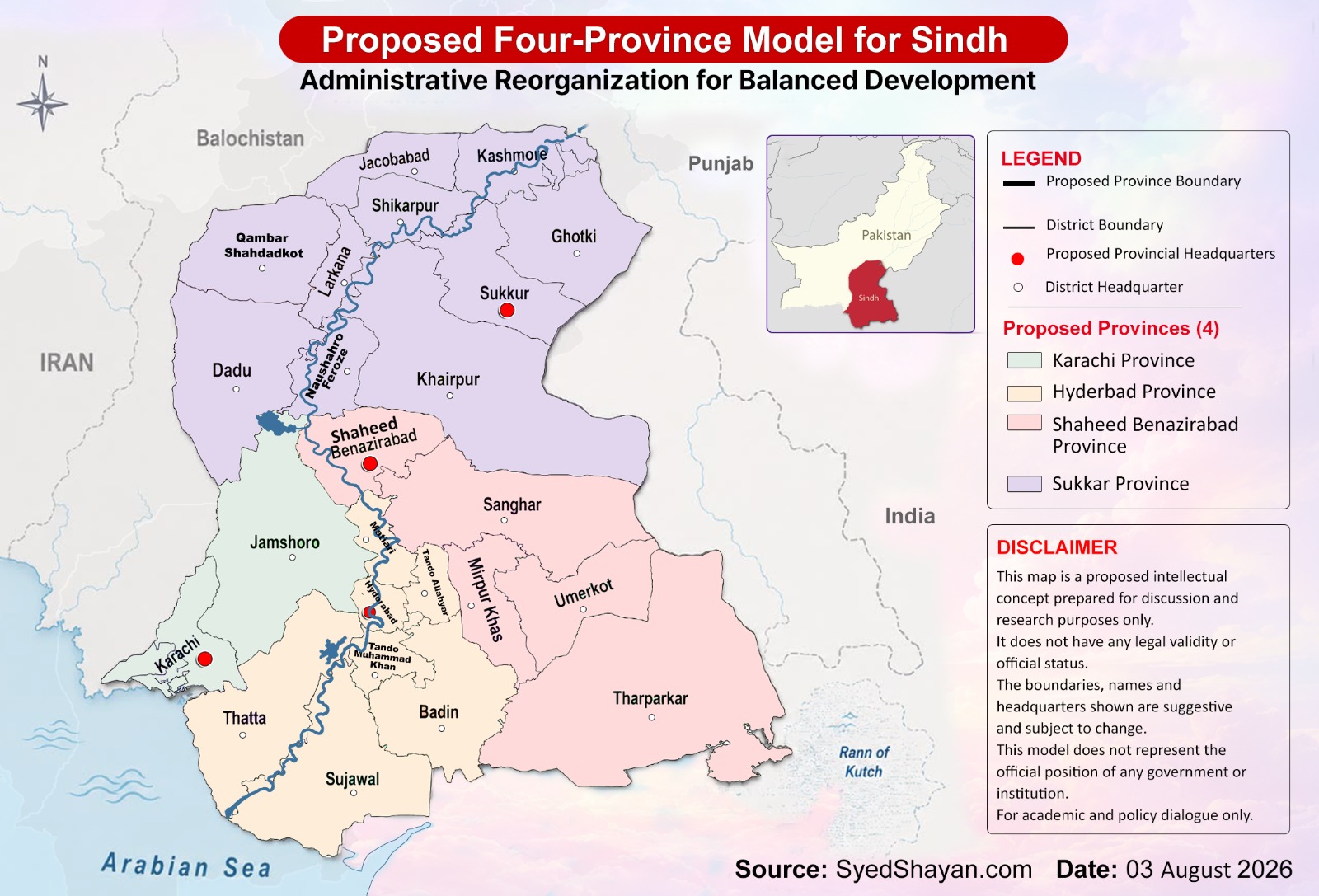
Considering Sindh’s population, long geographical distances, economic connections and existing administrative boundaries, organizing the province into 4 provincial units appears to offer a more balanced model.
Simply making Karachi a separate province might address some of Karachi’s governance challenges, but it would not resolve the continued concentration of authority, long distances and administrative difficulties faced by the rest of Sindh.
Sindh currently consists of 6 divisions and 30 districts.
Our proposed model therefore does not require splitting any existing district. Instead, it reorganizes the existing districts into 4 provincial units.
The 4 Proposed Provinces of Sindh
1. Karachi Province
Karachi Division’s existing 7 districts, along with Jamshoro District.
Including Jamshoro would provide additional space for Karachi’s future expansion and would bring the industrial and economic connections between Karachi, Nooriabad, Kotri and Jamshoro under a single administrative framework.
This could help create a more integrated metropolitan and industrial region.
2. Hyderabad Province
Districts: Hyderabad, Matiari, Tando Allahyar, Tando Muhammad Khan, Badin, Thatta and Sujawal.
These districts have close geographical, agricultural, water related and transport connections with Hyderabad.
For this reason, Hyderabad could serve as their natural administrative centre.
3. Shaheed Benazir Province
or Central and Eastern Sindh
Districts: Shaheed Benazirabad, Sanghar, Mirpurkhas, Umerkot and Tharparkar.
This proposed unit would connect the agricultural regions of central Sindh with eastern Sindh and the Thar region.
Making Shaheed Benazirabad the administrative centre could provide a relatively balanced location between the different parts of the proposed province.
4. Sukkur Province
or Upper Sindh
Districts: Sukkur, Khairpur, Ghotki, Naushahro Feroze, Larkana, Qambar Shahdadkot, Shikarpur, Jacobabad, Kashmore and Dadu.
Naushahro Feroze has strong transport and economic connections with Sukkur and Upper Sindh.
Similarly, Dadu’s geographical and transport connections along the western bank of the Indus River link it with several upper districts.
For these reasons, including both districts within this proposed province may provide a more coherent administrative arrangement.
Under this model, all 30 districts of Sindh are included.
No district is divided, and all existing district boundaries remain intact.
Each proposed provincial unit would therefore have a clearly identifiable administrative centre as well as its own economic base.
This Is Not an Entirely New Geographic Concept
An important point to consider is that this geographical organization of Sindh is neither entirely new nor artificial.
A study of Sindh during the Mughal and Tarkhan periods shows that, for administrative purposes, the region was historically understood through three natural and administrative regions.
1. Siro — Upper Sindh
The upper region around Shikarpur, Sukkur and Jacobabad.
2. Vicholo — Middle Sindh
The central region around Hyderabad, Nawabshah and Dadu.
3. Lar — Lower Sindh
The coastal and lower regions around Thatta, Badin and Karachi.
These regions developed their own administrative characteristics, local speech patterns and geographical identities.
Their regional dialects included Siroli or Siroki, Vicholi and Lari.
Successive rulers, whether the Soomras, Kalhoras or Talpurs, recognized the importance of these regional distinctions for administrative control.
During the Talpur period from 1783 to 1843, this administrative decentralization became even more clearly reflected in governance.
Regional and district level administrators were appointed to manage different territories. They were known by titles such as Kardar or Nawab, and performed administrative functions that, in some respects, can be compared with the role of regional governors in modern systems.
Because governing such a vast territory from a single central point was considered impractical in earlier periods of Sindh’s history, an important principle behind governance was decentralization.
Sindh’s History Should Be Part of the Modern Debate
▫️ Throughout this article, my purpose has simply been to explain that if Pakistan is now having a serious debate about the creation of new provinces, then Sindh should also be examined in the light of its own ancient history, civilization and geographical structure.
Historical Sindh was not always administered from a single central point.
Instead, it was understood and administered through natural and geographical regions such as Siro, Vicholo and Lar, because even the rulers of earlier periods understood that such a large territory could not be governed effectively without strong regional administration.
This leads to an important question:
If three administrative provinces were established in Sindh today on the basis of these historical regions and were even named Siro, Vicholo and Lar, why should this necessarily be described as the division of Sindh?
It could instead be viewed as adapting an older regional administrative concept of Sindh to the requirements of the modern era.
Karachi, however, presents an exceptional case because of its extraordinary population, economic scale and continuous urban expansion.
For this reason, it has been proposed as a fourth administrative unit together with Jamshoro.
Under such a model, Sindh would neither be separated from its history nor lose its cultural identity.
To be continued in the next episode.
No comments yet.