

How Many Provinces Should Punjab Be Divided Into?
🔳 Did you know that the area of Pakistan’s Punjab province is almost equal to the total area of Great Britain, comprising England, Scotland and Wales, while Punjab’s population is nearly twice as large?
▫️ Punjab has a larger population than more than 180 countries in the world. With an official population of 127.7 million, it is more populous than major countries including the United Kingdom, France, Italy, Spain, Canada, Saudi Arabia, Australia, Japan, the Philippines, Egypt, Vietnam and Iran.
▫️ Punjab’s population has now reached around 135 million, almost equal to that of Mexico, the world’s tenth most populous country, which also has a population of approximately 135 million. Mexico is administered through 31 separate states and one federal district, while the entire administrative system of Punjab remains centred around a single provincial capital, Lahore.
▫️ Since 1947, India has created 17 new states at different times, or granted full statehood to certain territories, in response to administrative needs and public demands. Gujarat, Haryana, Nagaland, Meghalaya, Chhattisgarh, Jharkhand, Uttarakhand and Telangana are among the prominent examples. Today, India consists of 28 states and 8 Union Territories, while Pakistan still remains primarily divided into only 4 provinces and 3 federally administered units.
Topic: How Can Pakistan Be Administratively Reorganized Today? | Episode 2
Title: How Many Provinces Should Punjab Be Divided Into?
🔺 Differences of opinion on national issues are natural, but permanent division and disorder cannot solve any problem. Citizens, political parties and state institutions share a responsibility to engage in serious and transparent debate and eventually reach a clear national consensus.
Written and Researched by: Syed Shayan
In the previous episode, we raised a fundamental question: Is a strong local government system alone sufficient to make public institutions more accessible to citizens, or are new provinces also necessary?
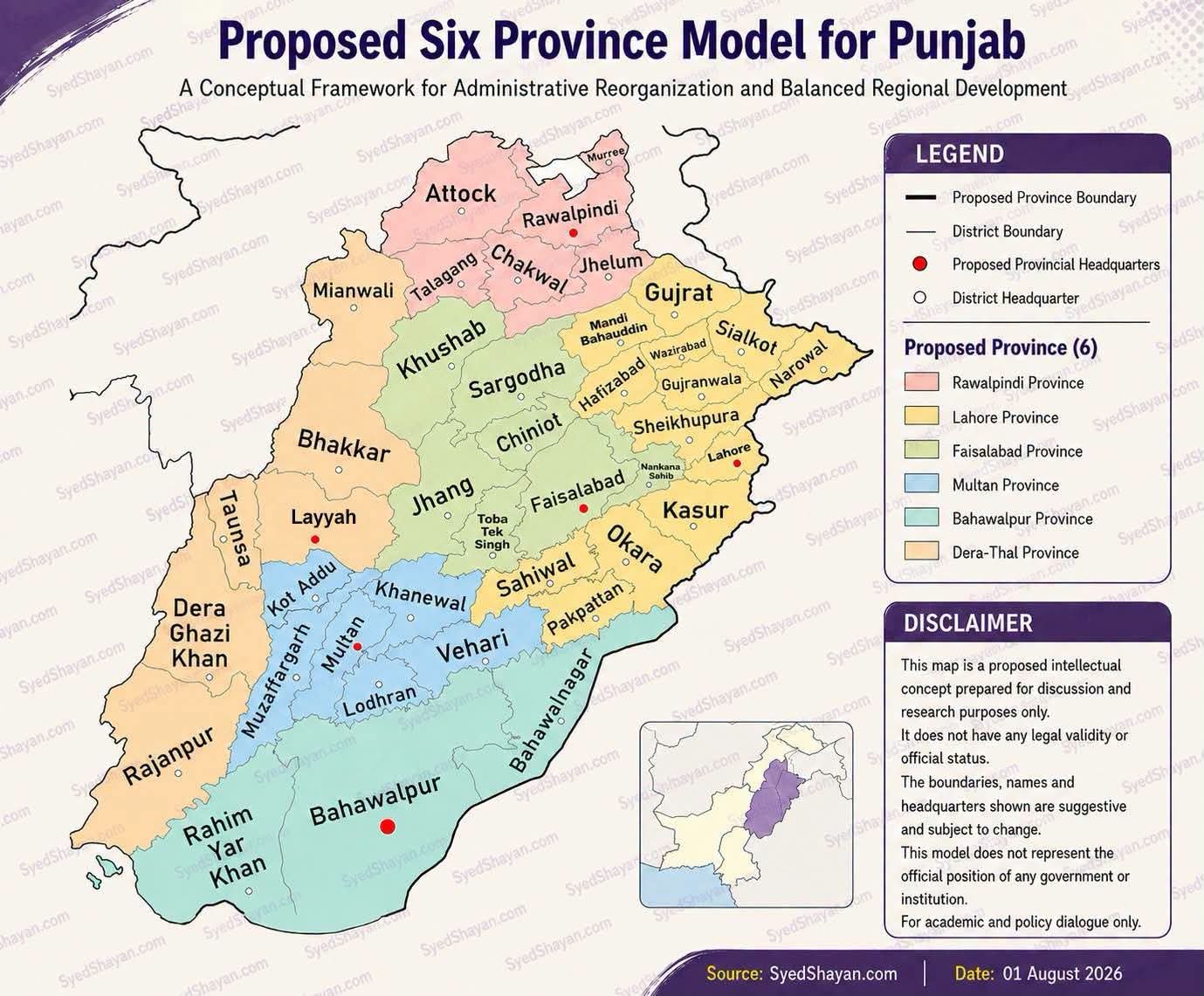
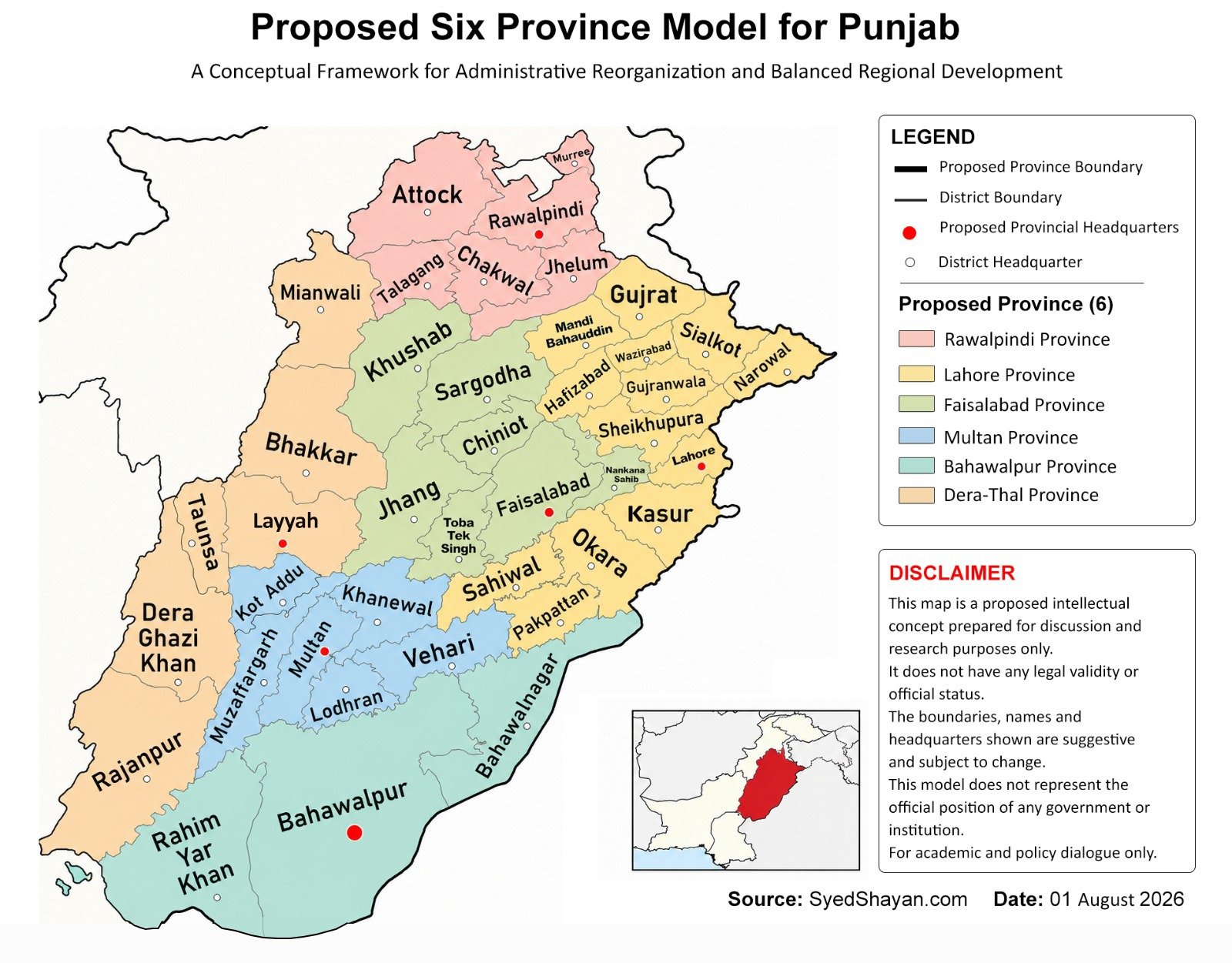
Today, we take that discussion forward by examining our proposed model for dividing Punjab into 6 new provinces, along with the intellectual and practical rationale behind the proposal.
This episode also considers a broader question. In a large and diverse federation such as Pakistan, which model could provide more effective governance?
1. Should the existing large provinces be retained?
2. Should the existing divisions be transformed into Empowered Administrative Units?
3. Should new provinces be given the formal constitutional status of Federating Units?
4. Or should authority be transferred to the grassroots through a strong Local Government System?
The Scale of Punjab
If we look at the ground realities, Punjab currently covers an area of 205,344 square kilometres, while its population has risen beyond approximately 135 million. According to the official 2023 Census, Punjab had a population of 127.7 million.
In terms of land area, Punjab is almost equal to Great Britain, yet its population is nearly twice as large.
Punjab is also larger in area than more than 110 countries, including countries such as South Korea, Greece and Portugal.
In population terms, Punjab surpasses more than 190 countries and has significantly more people than the United Kingdom, France, Italy, Spain, Canada, Saudi Arabia and Australia. Even Germany, the most populous country in Europe, has a considerably smaller population.
When we think of Britain, we often imagine a very large country. Yet the combined area of Great Britain, meaning England, Scotland and Wales, is approximately 209,000 square kilometres, while Punjab alone covers approximately 205,000 square kilometres.
In other words, Punjab is equivalent to almost 98 percent of the total area of Great Britain.
The difference is that Great Britain, with a population of around 67 million, has used better governance, science, technology, industry and strong institutions to establish itself among the world’s major economic powers. Punjab, with approximately 135 million people, continues to struggle with poor administration, weak planning and serious economic challenges despite its fertile land, extensive canal system and enormous human and natural resources.
This raises an important question.
If Punjab is almost equal to the entire area of Great Britain and has a population larger than many major countries, how can a single provincial capital effectively administer justice, healthcare, education, public safety and other essential services for such a vast territory and such a large population?
Now that the enormous geographical and demographic scale of Punjab is evident, dividing it into different provinces or Federating Units should at least be seriously considered as an important administrative reform.
If such a debate continues to be avoided, it may further strengthen the perception that political interests are being given priority over the national interest.
But this brings us to the real question:
How Many Provinces Should Punjab Be Divided Into?
One of the oldest and most prominent demands has been the creation of a Saraiki province centred around Multan and its surrounding areas, the restoration of the former State of Bahawalpur as a separate province, and the continuation of the remaining Punjab as another province.
Under this formula, the existing Punjab would be divided into 3 provinces.
However, any new administrative division should not be based solely on historic demands or regional identities.
Population, geographical area, administrative requirements, economic capacity, transport connections, available resources and the likely future expansion of population should all be given fundamental importance.
It is therefore necessary to examine whether a three province model would genuinely provide a sustainable and successful long term solution, or whether Punjab needs to be divided into a greater number of provinces.
3, 6 or 10 Provinces?
The fundamental question today is whether Punjab should be divided into 3, 6 or 10 provinces.
The proposal for three provinces has remained under discussion for many years.
Our think tank, however, is proposing a six province model, based on Punjab’s population, distances between different regions, administrative requirements and economic considerations.
A third proposal would be to transform Punjab’s existing 10 divisions into separate provinces.
Our proposal has not been developed merely through assumptions or theoretical discussion. Our team has spent considerable time studying different cities and rural areas of Punjab, along with their economies, commercial activities and regional connections.
The objective was to understand which cities and regions could be grouped together to form provinces that would not only be administratively manageable, but could also sustain their economies more independently.
For this purpose, we also examined China’s model of industrial and economic clusters.
What Can Be Learned from China’s Economic Clusters?
One of the important factors behind China’s extraordinary economic development is the way different cities and regions have been organised around specialised industries, creating complete industrial ecosystems.
For example, Changchun, Shanghai, Guangzhou, Wuhan and Chongqing are major centres of the automobile industry.
Changchun does not simply manufacture vehicles. An entire ecosystem of auto parts, batteries, engineering, research, skilled labour and supply networks has developed around the automobile sector. This is why the city is regarded as one of China’s major automotive clusters.
Similarly, Chenghai District in Shantou is known for toy manufacturing, packaging and exports.
Shenzhen and Dongguan are major centres for electronics, mobile phones, drones and semiconductors, while the Shanghai Chemical Industry Park specialises in petrochemical and chemical industries.
Under this model, each city develops expertise in particular industries instead of attempting to produce everything.
This allows a region to establish a distinct economic identity. Investors can find infrastructure, skilled workers, suppliers and markets within the same economic region. As a result, production costs can fall, quality can improve and export capacity can increase.
It was after studying and observing such models that our proposal for dividing Punjab into six provinces was developed.
Our proposed six provinces are therefore not intended to represent a simple administrative division.
The objective is to create Economic Regions capable of developing sustainably through their own resources, industries, agriculture, trade and investment.
In developing this concept, regional economic models from China and several other countries were also studied.
The 6 Proposed Provinces of Punjab
1. Rawalpindi Province
This proposed province would largely comprise the Potohar region, which has a distinct economic identity because of its geography, services sector, defence establishments, oil and gas resources, minerals and tourism.
Making Rawalpindi the provincial capital would make access to provincial institutions considerably easier and faster for people living across the region.
Districts: Rawalpindi, Murree, Attock, Chakwal, Talagang and Jhelum
Capital: Rawalpindi
Economic Base: Services, defence, tourism, rain fed agriculture, oil, gas and minerals
Total Area: Approximately 22,255 square kilometres
Population: Approximately 11.4 million, according to the 2023 Census
Note: In the 2023 Census, Murree’s population was included in the figures for Rawalpindi District, while Talagang’s population was included in the figures for Chakwal District.
2. Lahore Province
This proposed province would bring together Punjab’s largest industrial, commercial and technology centres.
Lahore’s information technology industry, financial activities, higher education and services sector would be linked with Gujranwala’s light engineering, Sialkot’s surgical instruments and sports industries, Gujrat’s fan and furniture industries, agriculture in Hafizabad and Mandi Bahauddin, and the dairy, livestock and food processing sectors of Kasur, Okara, Sahiwal and Pakpattan.
Together, these areas could potentially form Pakistan’s largest industrial, export and technology based Economic Cluster.
Districts: Lahore, Kasur, Sheikhupura, Okara, Sahiwal, Pakpattan, Gujranwala, Gujrat, Sialkot, Narowal, Hafizabad, Mandi Bahauddin and Wazirabad
Capital: Lahore
Economic Base: Information technology, finance, education, services, light engineering, surgical instruments, sports goods, fans, furniture, agriculture, dairy, livestock, food processing and exports
Total Area: Approximately 37,020 square kilometres
Population: Approximately 48.5 million, according to the 2023 Census
3. Faisalabad Province
This proposed province would consist of one of central Punjab’s major industrial and agricultural regions.
Faisalabad’s textile industry, Sargodha’s citrus production, Khushab’s mineral resources, Chiniot’s furniture industry, and the agriculture and livestock sectors of Jhang, Toba Tek Singh and Nankana Sahib could together provide the region with a balanced industrial and agricultural economy.
By combining industry, agriculture, food processing and exports within a single region, it could become one of Punjab’s most important economic clusters.
Districts: Faisalabad, Nankana Sahib, Jhang, Toba Tek Singh, Chiniot, Sargodha and Khushab
Capital: Faisalabad
Economic Base: Textiles, furniture, agriculture, citrus, wheat, livestock, food processing, minerals, industry and exports
Total Area: 32,501 square kilometres
Population: Approximately 23.7 million, according to the 2023 Census
4. Multan Province
This proposed province would comprise a major agricultural, commercial and industrial region of southern Punjab.
Multan’s trade, education, healthcare and services, cotton and wheat production in Khanewal and Vehari, agriculture in Lodhran, and the agricultural production, energy and industrial activities of Muzaffargarh and Kot Addu could provide the region with a strong economic foundation.
By integrating agriculture, textiles, food processing, trade and energy within the same region, it could become a major economic cluster of southern Punjab.
Districts: Multan, Khanewal, Vehari, Lodhran, Muzaffargarh and Kot Addu
Capital: Multan
Economic Base: Cotton, wheat, agriculture, textiles, food processing, livestock, trade, services, industry and energy
Total Area: 23,460 square kilometres
Population: Approximately 19.1 million, according to the 2023 Census
Note: In the 2023 Census, the population and area of Kot Addu and Chowk Sarwar Shaheed were included within the overall figures for Muzaffargarh District.
5. Bahawalpur Province
This proposed province would comprise the historic and administrative region of the former State of Bahawalpur.
Bahawalpur, Bahawalnagar and Rahim Yar Khan are closely connected through agriculture, industry, trade and energy.
Cotton, wheat, sugarcane, food processing, livestock and the industrial and commercial activities of Rahim Yar Khan, combined with the land, mineral resources and solar energy potential of Cholistan, could provide this region with a strong economic foundation.
The former State of Bahawalpur once had its own system of government, educational institutions, a strong canal based irrigation network and an effective administrative structure for development.
Even today, the region possesses significant potential in agriculture, industry and trade, as well as the vast lands of Cholistan, livestock, mineral resources and solar energy.
The Quaid e Azam Solar Park in Bahawalpur is one practical example of this potential, while Lal Suhanra National Park gives the region a distinct identity in tourism, wildlife and environmental conservation.
The objective of this proposal is not to recreate the past. Rather, it is to use the region’s historical experience and local resources in accordance with the requirements of the modern era.
With proper planning and investment, Bahawalpur could develop into a strong economic centre for agriculture, food processing, industry, tourism and solar energy.
Districts: Bahawalpur, Bahawalnagar and Rahim Yar Khan
Capital: Bahawalpur
Economic Base: Agriculture, cotton, wheat, sugarcane, sugar, food processing, livestock, industry, trade, minerals, Cholistan and solar energy
Total Area: 45,588 square kilometres
Population: Approximately 13.4 million, according to the 2023 Census
6. Dera Thal Province
This proposed province would comprise the historic and geographical regions of Dera Jat and Thal.
The mineral resources, Sulaiman Mountains, energy resources and livestock sectors of Dera Ghazi Khan, Rajanpur and Taunsa could be connected with the agriculture of Layyah, Bhakkar and Mianwali, along with the Indus River and the vast plains of Thal, to create an integrated regional economy.
Based on agriculture, minerals, energy, livestock, the Indus River and tourism, this region could develop into a strong economic cluster of western Punjab.
Districts: Dera Ghazi Khan, Rajanpur, Taunsa, Layyah, Bhakkar and Mianwali
Capital: Layyah
Economic Base: Agriculture, the Indus River, livestock, minerals, oil and gas, energy, the Sulaiman Mountains, Thal and tourism
Total Area: Approximately 57,400 square kilometres
Population: Approximately 13.8 million, according to the 2023 Census
To be continued in the next episode.
Very Informative