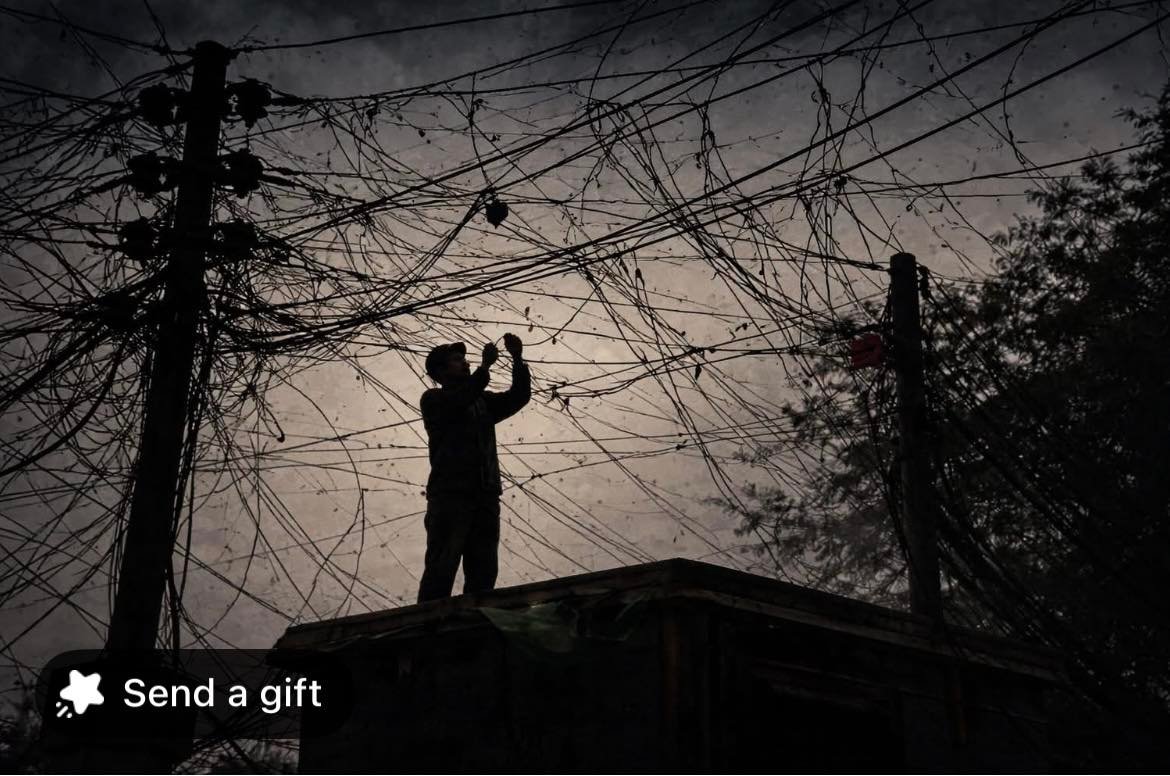
🔲 Public Inquiry Series | Episode 17Topic: How Can Pakistan’s Electricity System Be Fixed(Electricity Theft and Kunda Culture)🔺 When institutions withhold facts, the responsibility to uncover the truth rests with the public.Research & Writing: Syed Shayan🔳 “Kunda Culture” (Electricity Theft through Direct Hooking)If, in a neighbourhood, two out of ten households steal electricity, the remaining eight may still disapprove. But when six out of ten begin doing the same, the remaining four start to feel disadvantaged. And when a society reaches a point where wrongdoing becomes the norm, the distinction between right and wrong begins to fade, and the very ability to recognise wrongdoing begins to disappear. In such an environment, even language starts to lose its meaning.Bribery is rebranded as “speed money” or “facilitation.” Electricity theft is relabelled as “line losses.” Elite level corruption is normalised under structured arrangements such as IPPs, while the honest, law abiding citizen is labelled as naïve.In such societies, reform does not come through policing and legal enforcement alone. It requires the support of technology and systemic correction.
▫
At the household level, electricity theft is quietly producing “silent accomplices.” When elders engage in such practices, they unintentionally teach their children that laws can be bypassed for personal benefit. What begins as the theft of a few units gradually turns into the moral conditioning of an entire generation.
▫
Pakistan’s current slab based tariff system has, in many ways, contributed to the spread of electricity theft by placing the burden of inefficiency and wrongdoing on those who actually comply with the law.A deeply rooted mindset has taken hold in Pakistan: that the state is not providing value, but is instead extracting from citizens through heavy taxation and expensive electricity. As a result, when someone installs a kunda or slows down their meter, they do not perceive it as theft, but as reclaiming a right they believe has been denied to them.This reflects a form of social rebelliousness in which breaking the law begins to be seen as an act of defiance, even courage.When an ordinary citizen observes that powerful segments of society, whether politicians, influential officials, or large industrialists, operate beyond the reach of accountability, while engaging in large scale financial manipulation under the cover of electricity generation, and at the same time benefit from privileges such as free or subsidised electricity, a silent reaction begins to take shape.The individual understands that they cannot hold these actors accountable. However, within their limited sphere, they begin to replicate similar behaviour. In doing so, they create small “clusters” where the same violations seen at higher levels are mirrored on a smaller scale.This behaviour is often justified as a “balancing act,” a way to restore perceived fairness within an unequal system.The concept of anomie, introduced by the French sociologist Émile Durkheim, offers a powerful framework to understand this condition. Anomie describes a state in which social norms weaken, and the boundary between right and wrong becomes blurred.When the social contract deteriorates and individuals feel that justice and fair distribution no longer exist, society shifts from a state of order into one of disorientation. Individuals no longer see themselves as part of a collective system, but instead focus solely on survival.According to Durkheim, in such conditions, deviance is no longer merely an individual act but becomes a “social fact,” meaning the problem lies not in individuals alone but within the structure of society itself.Pakistan’s “kunda culture” is a manifestation of this broader social breakdown. The electricity system cannot be reformed unless the billing structure itself is corrected, as it has contributed to pushing ordinary citizens towards defiance. If this condition of anomie is not addressed, the consequences will not remain confined to electricity theft alone. The resulting disorder can spread across all aspects of national life.This raises a critical question: how did electricity theft, or “kunda culture,” emerge in the first place, and when did it evolve into a widespread social phenomenon?In my view, this culture began to take root when WAPDA was unbundled and the power sector was opened to private interests. The public was led to believe that the introduction of distribution companies and independent power producers would ensure abundant and affordable electricity, eliminate load shedding, and improve efficiency. In practice, the opposite occurred.When electricity was managed under WAPDA, it was perceived as a public service. However, with the introduction of private power producers and agreements based on “take or pay” models, electricity was transformed into a commercial commodity. People began to observe that while supply remained constrained, financial obligations towards private entities continued to rise.When consumers realised that they were required to pay even for electricity they did not use, particularly to support power plants owned by influential groups, a sense of resistance began to develop. The reasoning became simple: if companies could be paid without producing electricity, why should consumers not take electricity without paying?At the same time, electricity bills became layered with multiple taxes and charges that had little direct connection to actual consumption. As income tax, fixed charges, fuel price adjustments, financing cost surcharges, and other levies began to dominate the bill, the system increasingly lost its legitimacy in the eyes of ordinary citizens.When the law appears to define electricity theft strictly for the poor, while legitimising large scale financial advantages for the powerful under categories such as capacity payments or subsidies, people begin to reinterpret theft as a form of self defence.This culture did not emerge in isolation. It is a reaction to a system perceived as unjust, where promises of reform through privatisation failed to deliver relief, and instead deepened the financial burden on the average citizen.(To be continued in the next episode)