

By: Syed Shayan
English Version Stats: 1 hr 20 min total reading time by 31 readers
[Urdu version metrics tracked separately]
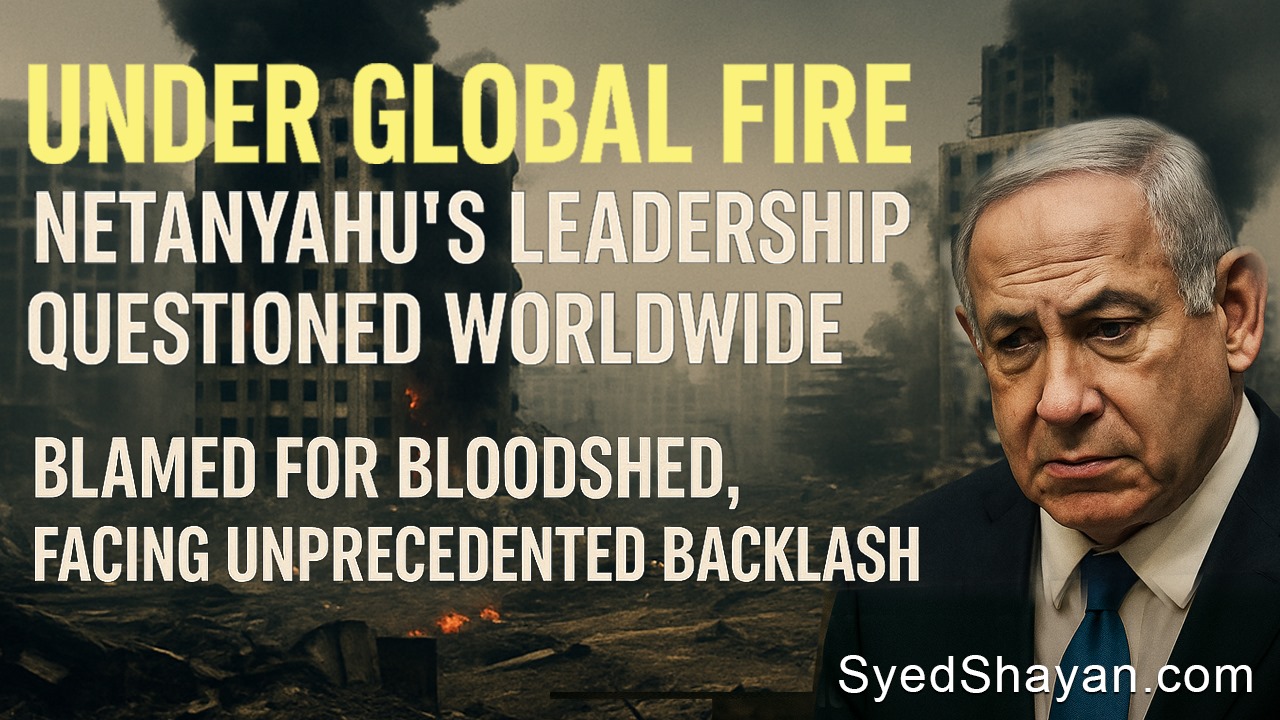
Netanyahu on Trial: War Crimes, Global Isolation, and the Fall of Israel’s Longest Serving Prime Minister
Israeli Prime Minister Benjamin Netanyahu has emerged as one of the most controversial and widely disliked political leaders in recent years. Comparisons to German dictator Adolf Hitler have surfaced, not merely as public sentiment but backed by surveys from international organizations like the Pew Research Center and the Israel Democracy Institute, which confirm a sharp decline in trust in his leadership, both globally and within Israel itself.
Netanyahu has served as Israel’s Prime Minister for a total of approximately 17 years, making him the longest-serving leader in the country’s history. His first term was from 1996 to 1999, followed by a prolonged tenure from 2009 to 2021, and his current term began in December 2022. Before the Hamas attack in October 2023, he was regarded as Israel’s foremost security expert. Today, however, many Israeli citizens view him as the nation’s greatest security risk.
When the Israeli government launched retaliatory operations against Hamas in Gaza, the United Nations and global human rights organizations labeled them excessively violent and in violation of international law. These actions resulted in thousands of civilian deaths, the destruction of Gaza’s infrastructure, and a severe lack of access to basic necessities like food and water. The UN Secretary-General called these measures unnecessary and regrettable, while Human Rights Watch and Amnesty International described them as tantamount to collective punishment.
Although the majority Jewish population initially supported the government’s actions, several Jewish citizens and left-wing groups fiercely criticized these policies. Organizations like Peace Now, Standing Together, and other Jewish human rights groups held protests in Tel Aviv, Haifa, and Beit Shemesh, raising voices against the humanitarian crisis in Gaza. According to a recent survey by the Israel Democracy Institute, 73% of left-wing Jewish Israelis support a two-state solution and recognize the basic human rights of Palestinians.
A 2025 global survey conducted by the Pew Research Center polled opinions on Netanyahu in 24 countries, including the United States, Turkey, France, Germany, Indonesia, South Africa, and Brazil. Most respondents stated that Netanyahu is incapable of making sound decisions in global affairs. In Turkey, this figure reached 93%. In the U.S., 53% of adults viewed Israel unfavorably, with many deeming Netanyahu an untrustworthy leader.
Within Israel, public discontent is even more pronounced. A March 2025 national survey by the Israel Democracy Institute (IDI) revealed that 70% of Israeli citizens believe Netanyahu should resign as Prime Minister. The same survey found 87% holding him directly responsible for the security failure of October 7, 2023, with only 15% wanting him to remain in office post-war.
According to Reuters, Netanyahu’s popularity has steadily declined over the past year. From mid-2024, his approval rating ranged between 20% and 35%, while disapproval rates soared between 61% and 71%. This public backlash stems from multiple factors: the thousands of Palestinian deaths in Gaza, international condemnation from the UN, Amnesty International, and Human Rights Watch for human rights violations, internal attempts to weaken the judiciary, corruption allegations, and a persistent belligerent stance.
These statistics highlight that Netanyahu’s tarnished image is not confined to the Muslim world but is equally evident within Israel, where his actions face intense scrutiny.
A pivotal moment in international politics occurred on November 21, 2024, when the International Criminal Court (ICC) issued arrest warrants for Netanyahu and former Defense Minister Yoav Gallant over alleged actions during the Gaza war, including war crimes and crimes against humanity. The charges include using starvation as a weapon, targeting civilian populations, mass killings of unarmed individuals, and inhumane treatment based on ethnicity. This marks the first time a leader of a Western-backed democratic state has faced such charges at the ICC, a historic development as such actions were previously limited to African or weaker states.
These warrants bar Netanyahu from traveling to the 124 ICC member states, including the UK, France, Germany, Canada, Japan, and Brazil, where authorities are legally obligated to arrest him. However, since the U.S., China, Russia, and Israel are not ICC members, the warrants are unenforceable in those countries, granting Netanyahu legal protection within Israel for now.
The decision sparked global reactions. Human rights organizations and international media hailed it as a step toward justice, while the U.S., UK, and some European nations expressed reservations, viewing it as potentially biased against Israel.
While international law has not yet classified Netanyahu’s actions as genocide, the deaths of thousands of children and civilians in Gaza, the blockade of water and food, and the destruction of healthcare systems are, morally, no less than genocide. What Hitler did to Jews was legally recognized as genocide, and if the world remains silent on Netanyahu’s atrocities, history will judge that genocide is not only defined by courts but by the cries of the oppressed.
Netanyahu’s political strategy and policies have fueled intense global debate and controversy, particularly over actions in Palestine, Gaza, and the West Bank. Human rights organizations label his policies as oppressive, unjust, and in violation of international law. Critics see him as a leader prioritizing power, occupation, and nationalism over peace and human welfare, while supporters view him as a steadfast guardian of Israel’s security.
In recent years, comparisons between Netanyahu and Hitler have surfaced, though their contexts differ. Hitler orchestrated systematic genocide based on racial ideology, killing over six million Jews and other minorities. Netanyahu faces criticism for Gaza attacks, military sieges, and human rights violations, with the ICC issuing warrants for war crimes. However, he has not been legally convicted of genocide due to prolonged delays in the trial process.
In April 2025, Iran launched an unprecedented retaliatory strike against Israel, not merely a military response but a strategic message: “We will not sit idly by.” Using “Fattah” hypersonic missiles, “Khorramshahr” ballistic missiles, and dozens of advanced drones, Iran targeted key Israeli cities like Tel Aviv, Haifa, and Ashkelon, damaging military installations and civilian infrastructure. Power grids collapsed, airports were shut down, and daily life was paralyzed. Notably, several senior Israeli leaders and policy think tanks had repeatedly warned that unwarranted confrontation with Iran could prove catastrophic. Their stance was clear: “Neither can we destroy Iran, nor can they destroy us, so what is the point of this war?” Yet, when Iran struck with unexpected ferocity after a period of silence, Israeli leadership not only misjudged the attack’s intensity but also suffered a severe blow to its public credibility.