

Pakistan with 23 Provinces:
A Proposed Administrative Framework
▫️ New provinces should not be created on the basis of language or political considerations. Their formation should instead take into account population, geography, administrative distance, and financial viability, with the aim of improving governance and supporting the country’s broader development.
▫️ In our view, the debate over new provinces is not simply about how many administrative units Pakistan should have. The more important question is how each province can develop a complete economic ecosystem capable of providing employment, business opportunities, and a better standard of living for its people. If new provinces are created merely on the basis of language, culture, rivers, or agricultural patterns, without developing a viable economic ecosystem within them, we may change the map without changing Pakistan.
▫️ Administrative experiments undertaken without public acceptance, political consensus, and serious research tend to disappear with the governments that introduce them.
▫️ The distribution of powers and resources between the federation and its constituent units should be guided by internationally recognised principles.
▫️ It would be incorrect to assume that the creation of new provinces alone will resolve Pakistan’s administrative problems. New provinces must also be accompanied by an empowered system of Local Government or City District Government so that authority and resources are genuinely devolved to the local level.
▫️ To promote public and parliamentary debate, our think tank intends to present this research before the National Assembly, the Senate Standing Committee on Inter-Provincial Coordination, and through seminars at various press clubs and universities. We therefore seek the views of our readers.
Subject: Does Pakistan Need New Provinces? | Final Episode
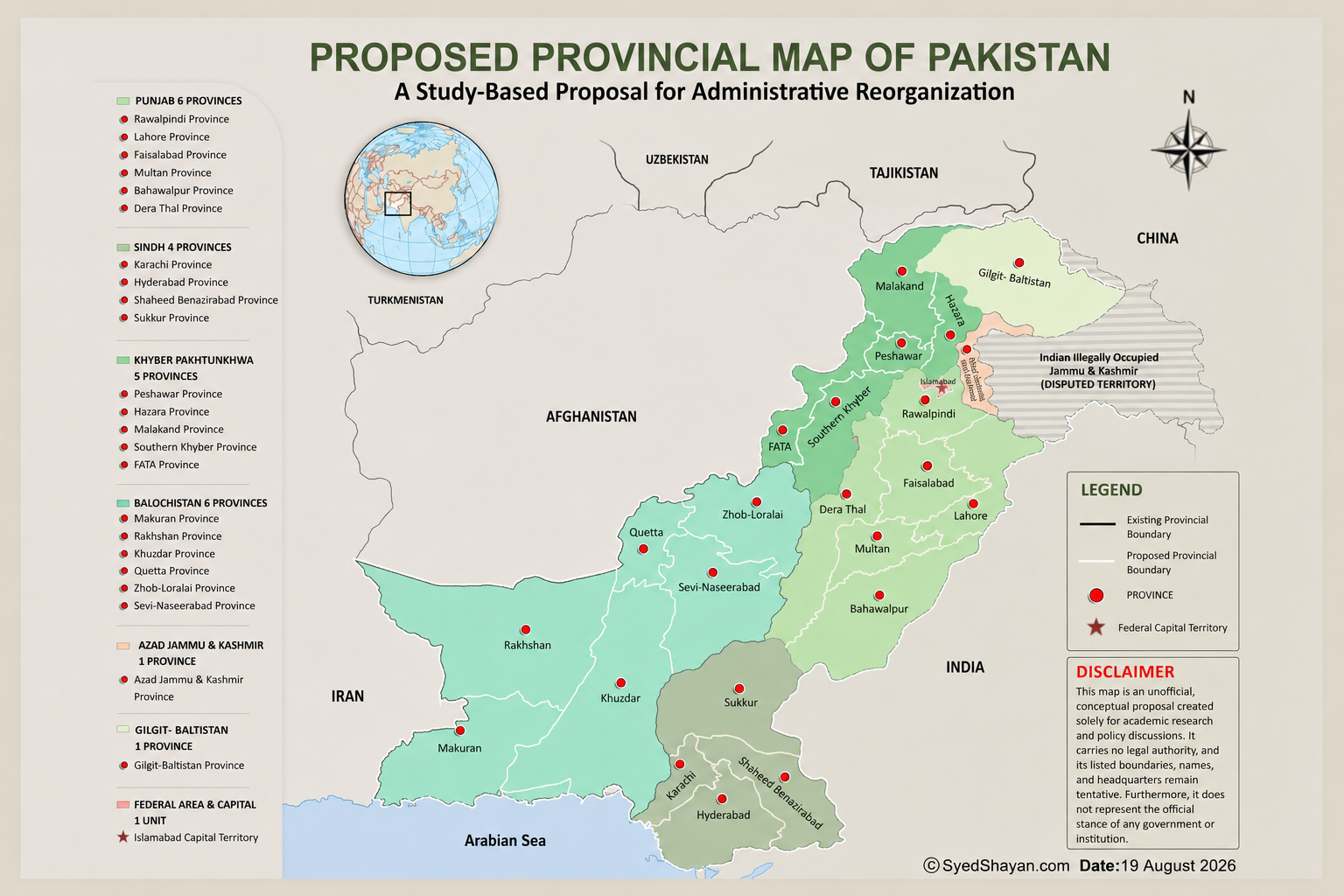
Title: The Proposed 23 Provinces of Pakistan
This is the final instalment of my research series on the creation of new provinces.
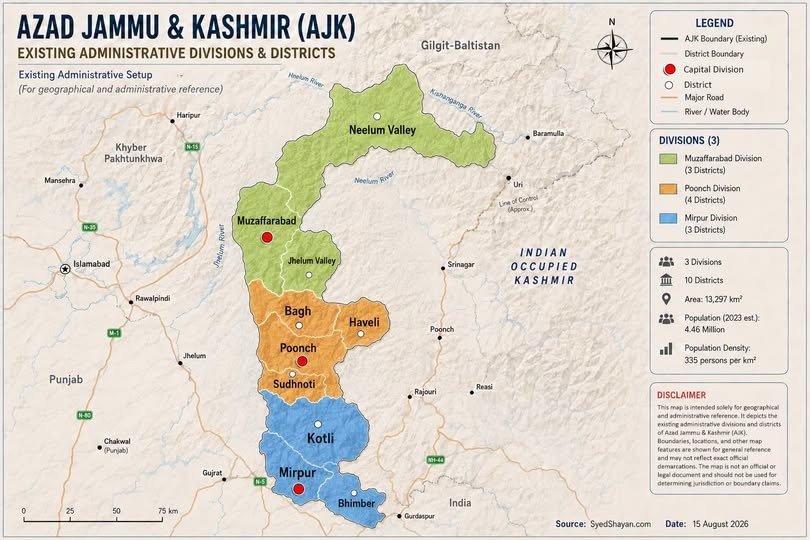
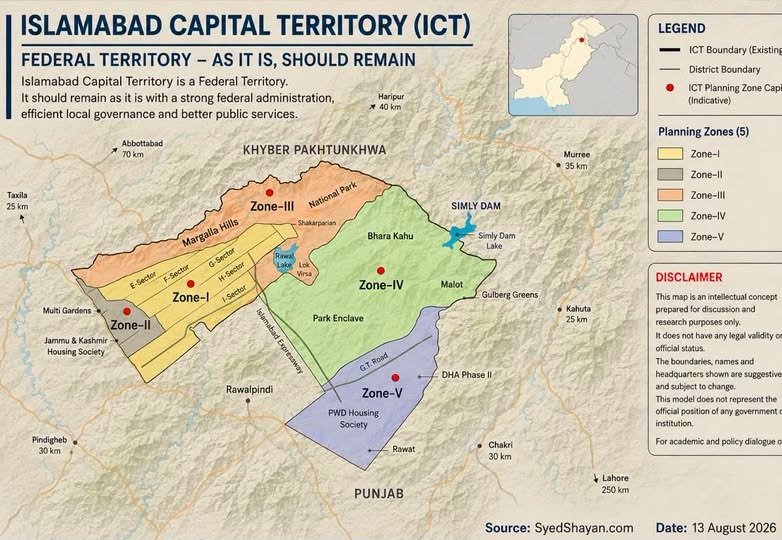
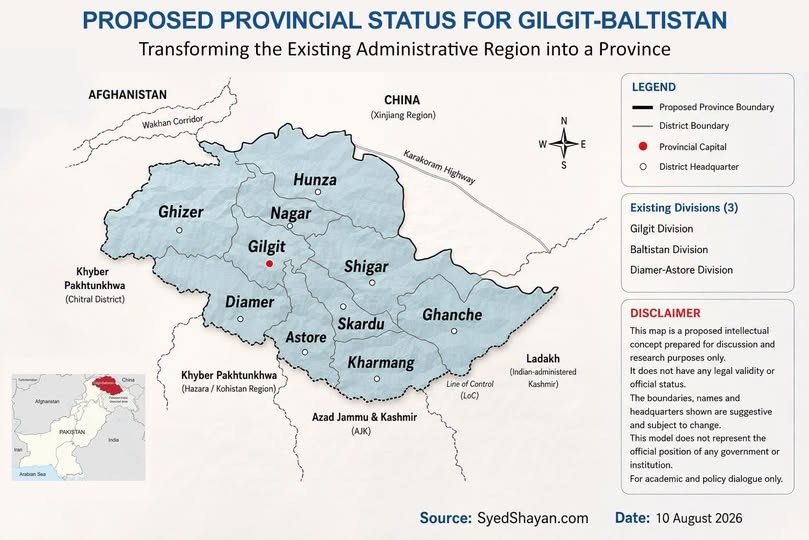
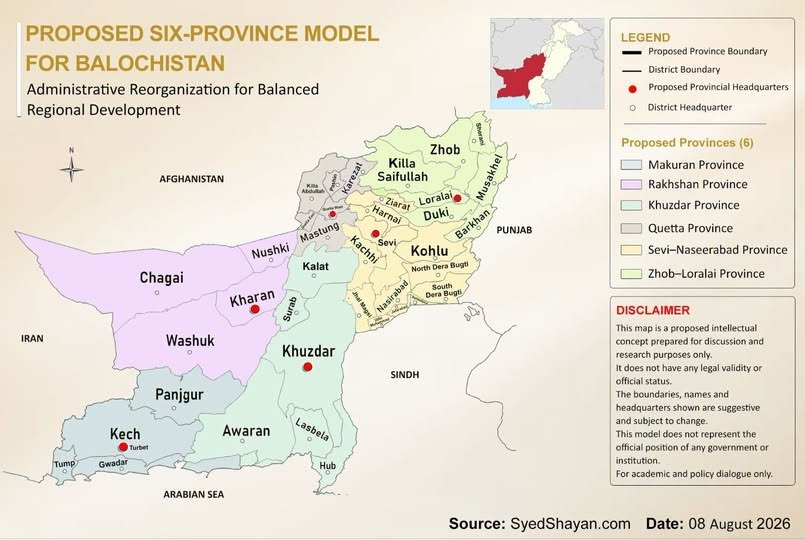
Over the previous ten instalments, we examined different parts of Pakistan separately and proposed new provinces and administrative units in light of administrative, geographical, and economic realities.
When all these proposals are brought together, they produce the proposed administrative map of Pakistan presented in this article, comprising 23 provinces and one Federal Capital Territory.
This is a proposal based on our research and study. It is now for policymakers and those in positions of authority to determine the extent to which they consider this research practicable and whether it can contribute to future administrative reforms.
Throughout this research series, we have attempted to examine Pakistan from a new and different perspective, drawing upon research conducted by our think tank, our own experience and observations, and the available data.
Our purpose was neither to support linguistic or regional divisions nor to present our proposals as a final solution. We sought only to explore whether, if Pakistan is to create new provinces, they could be considered on the basis of geography, population, distance, resources, economic capacity, and administrative need rather than language and politics.
Our research has attracted disagreement, criticism, and considerable encouragement. This is entirely natural. No idea can command universal agreement. We raised questions in good faith, prepared maps, examined data, and placed before our readers whatever we believed deserved consideration in the national interest.
Another entirely new experience for us during this project was cartography, or formal map-making. Our UI/UX and Art team worked extensively on these maps using the Britannica Atlas, various credible sources, geographical information, and digital tools. With each instalment, the team continued to improve the clarity, accuracy, and overall quality of the maps. We are pleased that this exercise proved successful and demonstrated that, with proper research and sustained effort, our team is also capable of producing high-quality cartographic design.
Throughout this work, we remained conscious that Pakistan’s official political map is a sensitive matter with legal significance. We therefore made every effort to avoid unnecessary deviation from the official map issued by the Survey of Pakistan and from the basic position reflected in it.
In the age of Artificial Intelligence, map-making may appear relatively easy, but serious cartography cannot be undertaken through AI alone. Our maps were not AI-generated. They were prepared by our UI/UX and Art team using credible sources, graphic-design methods, and other digital tools, while AI was used only as a supporting tool.
In this final instalment, I want to bring the entire discussion together and consider what overall picture emerges from all the previous episodes.
We have therefore decided to publish our decades of research and work in book form. Through these instalments, we shared selected glimpses of that research in order to encourage informed public discussion and greater awareness on an important issue such as the creation of new provinces.
As this discussion comes to a close, however, it is also important to understand the basic principles that guide the creation of new provinces or federal units in other parts of the world.
No single book comprehensively addresses all four questions: how a new province should be created, how its boundaries should be determined, which areas should be grouped together, and how powers should be divided between the federation and the provinces. However, the well-known author W. Elliot Bulmer, in Federalism: Constitution-Building Primer 12, published by International IDEA, provides particularly comprehensive guidance on these issues.
The book explains the principles upon which the boundaries of provinces or regions within a federation may be determined, the nature and extent of the powers they may exercise, the distribution of revenues and resources, and the manner in which different powers may be assigned to particular regions where necessary.
For anyone seeking to understand the considerations involved in creating new provinces, this publication provides direct and useful guidance.
The example of India is also particularly relevant in this context. Only six years after independence, in 1953, the government of Prime Minister Jawaharlal Nehru established the States Reorganisation Commission under the chairmanship of Justice Fazl Ali. Its task was to determine the principles upon which the boundaries of India’s states should be reorganised.
The Commission conducted approximately two years of research and submitted its report in 1955. It recognised that language, culture, and local identity were important, but maintained that these considerations alone could not provide a sufficient basis for creating a new state. Administrative viability, economic conditions, geography, connectivity between different regions, and the wishes of the people also had to be considered. Particular importance was attached to whether a proposed state would be financially capable of meeting its own expenditures.
Following this report, the States Reorganisation Act 1956 was enacted, and the Seventh Amendment to the Constitution introduced major changes to India’s internal state structure.
As a result of this reorganisation, Kerala emerged as a new state, Mysore was reconstituted through the integration of different territories, while the boundaries of Bombay and several other states were also redrawn. In other words, no single criterion was applied uniformly. The circumstances of each region were considered separately.
The report remains part of the official record of India’s Ministry of Home Affairs and is regarded as one of the principal historical references on the reorganisation of Indian states. (Ministry of Home Affairs)
The purpose of referring to the Justice Fazl Ali Commission is not to suggest that Pakistan should copy India. The point is to demonstrate that changing a country’s administrative map requires research, clearly defined criteria, and systematic planning. India established a commission in 1953, deliberated for approximately two years, and reorganised its states in 1956. The question is: if Pakistan is considering the creation of new provinces, where is our equivalent research?
I raised the same question in an earlier instalment through an open letter addressed to Interior Minister Mohsin Naqvi, in which I presented 15 questions. These were not complex academic questions, but basic questions that anyone advocating new provinces should first ask. On what basis will boundaries be drawn? What will the financial system be? How will powers be distributed? How will the new units finance their expenditures? And where is the process of public consultation?
If the government cannot place answers to these basic questions before the nation, then on what foundation will the entire project stand?
Pakistan’s history repeatedly demonstrates that major systems imposed primarily through the authority of a government rarely survive for long. Whether one considers Ayub Khan’s system, some of the major administrative changes introduced during the Bhutto era, the system under Zia-ul-Haq, or Pervez Musharraf’s local-government reforms, any reform that fails to develop a public and political foundation tends to weaken or disappear when the government changes.
New provinces therefore cannot be created and sustained through a government announcement alone. They require research, national consensus, political continuity, and public acceptance. Otherwise, there remains a genuine risk that when the present government leaves office, the proposal may leave with it.
It must also be remembered that the creation of new provinces alone will not resolve Pakistan’s administrative problems. Meaningful reform requires two measures to proceed together: the creation of new provinces and the establishment of an empowered Local Government or City District Government system within every province.
Just as a province requires a constitutional and administrative structure, local government should also be treated as an essential part of that structure. If powers and resources do not move beyond provincial capitals to districts, cities, and union councils, increasing the number of provinces alone will not bring fundamental change to the lives of ordinary citizens.
A final consideration is that people today are increasingly less inclined to read lengthy texts and are more attracted to maps, images, videos, and graphics. For this reason, we did not confine the subject of new provinces to written discussion alone. We also used maps and data to explain complex issues in a more accessible way.
Research, however, also indicates that reading remains highly important for understanding and retaining serious material. In the widely cited meta-analysis “Don’t Throw Away Your Printed Books”, Pablo Delgado and his colleagues reviewed research conducted between 2000 and 2017 and found that, in a number of circumstances, comprehension was better when material was read on paper rather than on a screen. (ScienceDirect)
Similarly, “Picture This: A Review of Research Relating to Narrative Processing by Moving Image versus Language” explains that when we read written material, the mind constructs its own imagery and develops understanding through that process, whereas video presents much of the imagery directly to the viewer. (Frontiers)
Visuals are therefore highly effective for attracting attention and communicating an idea quickly, but for a deeper understanding of a subject, sustained reading and books remain essential.
Our purpose in raising the issue on Facebook was also to bring an important national question such as the creation of new provinces before a wider audience in an accessible form and to encourage serious discussion.
In keeping with this approach, a book based on these instalments is currently being prepared for publication in Urdu and English and will soon be presented to readers.
We also intend to make this research available in E-Book form so that students, policymakers, members of the civil bureaucracy, legal professionals, international researchers and think tanks, and others in Pakistan and abroad with an interest in the subject can access it more easily.
God willing, the book will be available soon. All information concerning its publication and availability will be announced on our website, SyedShayan.com.
With this, our ten-part research series on the creation of new provinces comes to an end.
(Conclusion)

No comments yet.