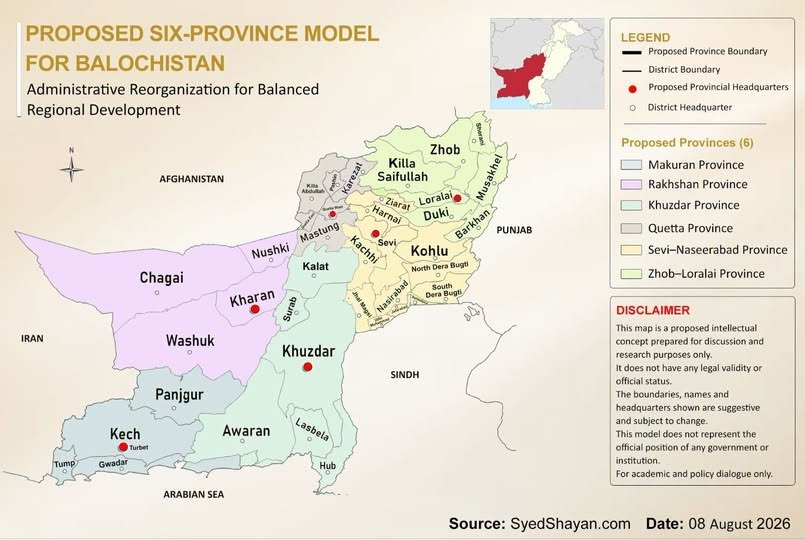
Balochistan: When the Provincial Capital Is 900 Kilometres Away If a resident of Balochistan has to travel from a distant area such as Gwadar, Turbat or Khuzdar to Quetta for official work, the journey may cover as much as 900 kilometres one way. A return trip can therefore extend to approximately 1,800 kilometres, with two or three days consumed largely by travel. The question is simple: should a provincial capital be this far from its citizens? Subject: Does Pakistan Need New Provinces? | Episode 6 How Many Provinces Could Be Created in Balochistan? 🔺 Pakistan’s problem is not simply the number of provinces. It is also the growing distance between government and the people. A central conclusion of my research is that provinces should not be so large that, for an ordinary citizen, reaching the provincial capital feels like entering an entirely different world. Written and Researched by Syed Shayan The demand for new provinces in Balochistan is not new. In the past, proposals have been made for a separate province for Pashtun majority areas, while in more recent years the idea of creating a separate province in southern Balochistan has also emerged. The model presented in this article, however, proposes six provinces across Balochistan. It is a new administrative concept developed by our think tank after considering historical demands, geography, population, distances and economic potential. Following a notification issued by the Revenue Department of the Government of Balochistan on 8 July 2026, the province now consists of 11 divisions and 41 districts. Quetta has been divided into East Quetta and West Quetta, Mastung has been included in Quetta Division, and four new divisions, Pishin, Khuzdar, Lasbela and Koh e Suleman, have been created. The new structure is as follows. 1. Quetta Division: 3 Districts East Quetta, West Quetta, Mastung 2. Pishin Division: 4 Districts Pishin, Killa Abdullah, Chaman, Barshore 3. Khuzdar Division: 4 Districts Khuzdar, Kalat, Surab, Wadh 4. Lasbela Division: 3 Districts Lasbela, Hub, Awaran 5. Rakhshan Division: 4 Districts Chagai, Kharan, Nushki, Washuk 6. Makran Division: 4 Districts Kech, Gwadar, Panjgur, Tump 7. Naseerabad Division: 5 Districts Naseerabad, Jaffarabad, Jhal Magsi, Sohbatpur, Usta Muhammad 8. Sevi Division, formerly Sibi: 3 Districts Sevi, Kachhi, South Dera Bugti 9. Zhob Division: 3 Districts Zhob, Killa Saifullah, Sherani 10. Loralai Division: 5 Districts Loralai, Duki, Musakhail, Ziarat, Harnai 11. Koh e Suleman Division: 3 Districts Kohlu, Barkhan, North Dera Bugti Total: 11 divisions and 41 districts. Under this new arrangement, Quetta has been divided into two districts, the former Kalat Division has been replaced by Khuzdar and Lasbela Divisions, and several new districts have been created with newly defined boundaries. 🔘 Balochistan is Pakistan’s largest province by area, covering 347,190 square kilometres. According to the 2023 Census, its population is 14,894,402. In terms of population density, Balochistan differs dramatically from the other provinces. It has only about 43 people per square kilometre, compared with approximately 622 in Punjab, 402 in Khyber Pakhtunkhwa and 395 in Sindh. This contrast makes it clear that Balochistan’s administrative challenges cannot be assessed on population alone. Its vast area, long distances and dispersed population must also be taken into account. How far does a citizen living in a remote part of Balochistan have to travel if provincial level official work requires a visit to Quetta? For example, the road distance from Gwadar to Quetta is approximately 900 kilometres, and the journey can take between 12 and 14 hours. Turbat is around 750 kilometres from Quetta, while Zhob is approximately 330 kilometres away. For residents of some parts of the province, therefore, reaching their own provincial capital can require almost a full day of travel. In large and sparsely populated regions around the world, the solution is not to force citizens to travel to government. The objective is to bring government closer to citizens. The United States, Australia, India and China have each developed different systems for devolving authority and administrative services closer to local populations. Australia even measures how far communities are located from essential services. The same principle raises a fundamental question for Balochistan: how far should government be from the people? This is where the question of Balochistan’s administrative restructuring begins. If the objective is to bring government closer to citizens, will the creation of new districts alone be sufficient, or does a province of this size also require additional provincial centres? And if new provinces are to be created, how many should there be, where should their boundaries lie, and where should their capitals be located? The answer cannot be found through population figures alone. Area, distance, travel time, economic resources, and regional and cultural realities must all be considered. Before considering a new administrative structure for Balochistan, it is also necessary to understand its linguistic and cultural composition. The 2023 Census records mother tongue rather than ethnicity. According to the census, Balochi, Pashto and Brahui speakers constitute the major linguistic groups in the province, while Sindhi, Saraiki, Urdu and other languages are also spoken. Balochi speaking populations are concentrated primarily in Makran, Rakhshan and southwestern Balochistan. Pashto speaking populations are more prominent in Quetta, Pishin, Chaman, Zhob, Killa Saifullah and northern areas, while Brahui speaking populations are more concentrated in Kalat, Khuzdar, Mastung and central Balochistan. In many areas, however, these communities are also intermixed. For this reason, we believe that new provinces cannot be designed solely on the basis of area and distance. Linguistic sensitivity, regional identity and social cohesion must also be considered so that administrative reform does not create a new sense of deprivation or separation among any major community. With these considerations in mind, we examined Balochistan’s regions, existing divisions, demographic linkages, distances, employment opportunities and sources of income, and developed the following model of six proposed provinces. The objective is to make government more accessible while avoiding unnecessary division of regions or communities. 1. Proposed Province of Makran Existing Division: Makran Division Districts: Gwadar, Kech, Panjgur, Tump Proposed Capital: Turbat Population 2023: approximately 1.876 million Area: 52,067 square kilometres Population Density: approximately 36 persons per square kilometre Languages and Culture: Balochi speaking communities are predominant in this region, although other local languages and dialects are also spoken in different areas. Makran is one of Balochistan’s most distinctive regions in terms of Balochi language, culture, coastal traditions and historical regional identity. Prominent Tribes and Communities: Gichki, Buledi, Bizenjo, Dashti, Hot, Rind and other local Baloch tribes and communities. Rationale for the Proposed Province: Makran forms a naturally connected coastal and southwestern region whose districts already share historical, linguistic, cultural and economic links. Gwadar, because of its port, coastal economy and international commercial importance, could become the principal economic centre of the proposed province, while Kech, Panjgur and Tump are important for agriculture, border trade and the local economy. Turbat has been proposed as the capital instead of Gwadar primarily because of administrative accessibility and geographical balance. Gwadar is the region’s most important port, economic and commercial centre, but Turbat occupies a relatively more central location within Makran and offers more balanced access between Panjgur, Kech, Tump and Gwadar. This would allow Gwadar to function as the economic centre while Turbat serves as the administrative capital. Note: Tump was part of Kech District at the time of the 2023 Census and became a separate district later. For this reason, the total population and area calculations for 2023 include the complete figures of the former Kech District. 2. Proposed Province of Rakhshan Existing Division: Rakhshan Division Districts: Chagai, Nushki, Kharan, Washuk Proposed Capital: Kharan Population 2023: approximately 1.040 million Area: 98,596 square kilometres Population Density: approximately 11 persons per square kilometre Languages and Culture: Balochi speaking populations are predominant in this region, while Brahui and other languages are also spoken. Prominent Tribes and Communities: Rakhshani, Nausherwani, Sanjrani, Muhammad Hasni, Badini, Jamaldini, Reki and other local Baloch and Brahui tribes and communities. Rationale for the Proposed Province: Rakhshan is one of Balochistan’s largest and most sparsely populated regions. Chagai’s mineral resources, proximity to the Iranian and Afghan borders, Nushki’s role as a transport connection, and the vast geography of Kharan and Washuk provide a strong basis for considering it as a separate provincial unit. Kharan has been proposed as the capital because of its relatively central location, which could provide more balanced administrative access across this extensive region. 3. Proposed Province of Khuzdar Existing Divisions: Khuzdar Division and Lasbela Division Districts: Khuzdar, Kalat, Surab, Wadh, Lasbela, Hub, Awaran Proposed Capital: Khuzdar Population 2023: approximately 2.408 million Area: 88,459 square kilometres Population Density: approximately 27 persons per square kilometre Languages and Culture: Brahui and Balochi speaking populations are prominent in this region, while Lasi, Sindhi and other languages are also spoken in Lasbela and Hub. Prominent Tribes and Communities: Mengal, Zehri, Bizenjo, Muhammad Hasni, Sumalani, Sajidi, Jamot, Lasi and other Baloch, Brahui and local tribes and communities. Rationale for the Proposed Province: Khuzdar is an important administrative, educational and commercial centre of central Balochistan. The historical and geographical connections among Khuzdar, Kalat, Surab and Wadh, combined with the inclusion of Lasbela, Hub and Awaran, would create a relatively integrated provincial unit. Hub and Lasbela connect the region with Karachi’s industrial, commercial and coastal economy, while Khuzdar’s relatively central location and existing urban and administrative capacity make it an appropriate choice for the proposed capital. Note: Wadh was part of Khuzdar District at the time of the 2023 Census and was made a separate district in 2026. Its territory and population are therefore already included in the 2023 figures for Khuzdar District. 4. Proposed Province of Quetta Existing Divisions: Quetta Division and Pishin Division Districts: East Quetta, West Quetta, Mastung, Pishin, Barshore, Killa Abdullah, Chaman Proposed Capital: Quetta Population 2023: approximately 4.572 million Area: 17,867 square kilometres Population Density: approximately 256 persons per square kilometre Languages and Culture: Pashto speaking communities are prominent in this region, while Quetta itself is a multilingual and multicultural urban centre inhabited by Pashtun, Baloch, Brahui, Hazara, Urdu speaking and other communities. Prominent Tribes and Communities: Achakzai, Tareen, Kakar, Kasi and other Pashtun tribes and communities. Baloch, Brahui, Hazara and other local and urban communities are also present in Quetta and Mastung. Rationale for the Proposed Province: Keeping the complete Quetta and Pishin Divisions within one provincial unit would preserve the geographical and administrative continuity of northwestern Balochistan without dividing any existing division. Quetta is already the largest administrative, educational, medical and commercial centre of this region and possesses the principal infrastructure required at the provincial level. Retaining it as the proposed capital is therefore the most appropriate option. Note: East Quetta, West Quetta and Barshore assumed their current administrative form after the 2023 Census. The 2023 figures have therefore been compiled by aligning the geography of the former districts with the present boundaries. 5. Proposed Province of Sevi Naseerabad Existing Divisions: Sevi Division, Naseerabad Division and Koh e Suleman Division Districts: Sevi, Kachhi, South Dera Bugti, Naseerabad, Jaffarabad, Jhal Magsi, Sohbatpur, Usta Muhammad, Kohlu, Barkhan, North Dera Bugti Proposed Capital: Sevi Population 2023: approximately 3.094 million Area: 43,534 square kilometres Population Density: approximately 71 persons per square kilometre Languages and Culture: The region includes Baloch, Brahui, Sindhi, Saraiki and other local populations. Baloch tribal communities are prominent in Kohlu and Dera Bugti, while Khetran and other local communities are present in Barkhan. Sindhi and Saraiki linguistic and cultural influences are particularly visible in the plains of Naseerabad, Jaffarabad, Sohbatpur and Usta Muhammad. Prominent Tribes and Communities: Marri, Bugti, Khetran, Magsi, Jamali, Domki, Umrani, Rind, Khosa and other Baloch and local tribes and communities. Rationale for the Proposed Province: This could form a large but geographically connected provincial unit covering eastern and southeastern Balochistan. Naseerabad and Jaffarabad are important centres of agricultural production. Dera Bugti is significant for natural gas and mineral resources, while Kohlu and Barkhan are important for livestock and other natural resources. Sevi occupies a relatively balanced location between the mountainous and plains regions of Balochistan and serves as a natural point of connection between them. It is therefore proposed as the provincial capital. Under this arrangement, all three existing divisions would remain intact and no district or division would need to be divided. Note: North Dera Bugti and South Dera Bugti assumed their present administrative form as separate districts after the 2023 Census. The combined 2023 population and area figures therefore include the complete geography of the former Dera Bugti District. 6. Proposed Province of Zhob Loralai Existing Divisions: Zhob Division and Loralai Division Districts: Zhob, Killa Saifullah, Sherani, Loralai, Duki, Musakhail, Ziarat, Harnai Proposed Capital: Loralai Population 2023: approximately 1.904 million Area: 46,667 square kilometres Population Density: approximately 41 persons per square kilometre Languages and Culture: Pashto speaking populations are predominant in this region, while individual districts also contain local linguistic, cultural and tribal diversity. Prominent Tribes and Communities: Kakar, Mandokhel, Sherani, Musakhail, Luni, Nasar and other Pashtun and local tribes and communities. Rationale for the Proposed Province: A look at the map shows that the Zhob and Loralai regions are naturally connected. Their populations share broadly similar patterns of life and environment. One of the most important advantages of creating this province would be that residents of distant districts such as Zhob, Sherani, Killa Saifullah and Musakhail would no longer need to undertake long and exhausting journeys to Quetta for relatively routine government work. Loralai has been proposed as the capital because it lies in a comparatively central position among these districts. It provides relatively convenient access from across the proposed province and would allow residents of different areas to reach the provincial centre more easily. This arrangement would also keep the region’s Pashtun population within a broadly connected social and cultural administrative unit. An important advantage is that the proposal does not divide any existing district or area within the present Zhob and Loralai Divisions. The two divisions would simply be combined in their existing form to constitute a new province. 🔘 Readers, In developing these six proposed provinces, the principal criteria have been area, population, travel accessibility, the existing administrative structure, economic autonomy, urban capacity and geographical connectivity. Although language, culture and the tribal and sardari systems have not been used as the basis of the proposed division, they have been recognised as important social realities. The objective is to avoid unnecessarily dividing historically connected communities in a manner that could create new disputes. Accordingly, historical and administrative continuity has been preserved wherever possible. The districts of Makran have been kept together. Rakhshan has been retained in its existing administrative form. The historical continuity of Kalat has been preserved as far as possible. In restructuring Quetta and northeastern Balochistan, particular attention has been given to geographical continuity, distance, economic linkages and the administrative capacity of central cities. The discussion of the tribal system in this article is not intended to endorse a tribal approach. It is included because the history, geography and social realities of Balochistan cannot simply be ignored. Administrative reform that disregards these realities is unlikely to succeed. This is neither a final judgement nor a definitive map. The proposed boundaries can be improved through local consultation and further research. The central and sole objective of this entire exercise is the establishment of better governance. The History of Demands for New Provinces in Balochistan The idea of creating new provinces in Balochistan is not new. When Pakistan was created in 1947, the territory now known as Balochistan did not exist in its present form. The area administered by the British had a separate status, while the states of Kalat, Makran, Lasbela and Kharan also had their own distinct status. Following several political developments, and after the abolition of the One Unit system in 1970, Balochistan acquired the provincial form that exists today. The present province of Balochistan is therefore itself the product of an earlier administrative restructuring. Since 1970, demands for a separate administrative identity for the Pashtun areas of northern Balochistan have repeatedly emerged. This demand was initially raised by Khan Abdul Samad Khan Achakzai and was later carried forward by the Pashtunkhwa Milli Awami Party. December 2006: Mahmood Khan Achakzai proposed the creation of a separate administrative unit for Pashtun areas and suggested names including Pakhtunkhwa, Pashtunistan and Afghania. October 2010: Dr Mir Haji Tareen, head of the Balochistan Pashtun Movement, called for a separate province comprising Pashto speaking areas and argued that the region could finance its own expenditure from its own resources. 2016: On the anniversary of Khan Abdul Samad Khan Achakzai, Mahmood Khan Achakzai again presented the idea of an Afghania Province for the Pashtun population. Historically, therefore, the most persistent and longstanding demand for administrative restructuring within Balochistan has concerned a separate province or administrative unit for the northern Pashtun areas. Southern Balochistan and the Government’s Own Experience Another dimension of the debate concerns southern Balochistan. In 2020, the federal government announced a special development initiative for districts including Washuk, Kharan, Panjgur, Kech, Lasbela, Awaran, Khuzdar and Gwadar. Prime Minister Imran Khan travelled to Turbat to inaugurate the development package. Although this was not an announcement of a new province, it did demonstrate that the government itself recognised southern Balochistan as a region with distinct development challenges and needs. Then, in July 2026, the Government of Balochistan itself undertook a major administrative restructuring. Quetta was divided into two districts, East Quetta and West Quetta, while new districts and divisions were created. As a result, the total number of divisions increased to 11 and districts to 41. Balochistan covers approximately 44 percent of Pakistan’s total land area. Gwadar, Reko Diq, gold and copper deposits, and maritime trade could transform the region into a major economic centre in the coming decades. For this reason, decisions concerning Balochistan’s administrative system should not be based solely on present conditions. They should be made with the needs of the next 50 or 100 years and future generations in mind. (To be continued in the next instalment)



No comments yet.