

The Honourable Mohsin Naqvi
Federal Minister for Interior
Government of Pakistan
Islamabad
Assalam-o-Alaikum,
The question of creating new provinces in Pakistan is once again under discussion. My submission is simply that, before any such decision is taken, the nation should be clearly informed why new provinces are considered necessary and what model will be followed in creating them.
If the objective is to provide citizens with essential public services closer to where they live, much of this can also be achieved through strong and empowered local governments. If so, where and why does the need for new provinces arise?
With this fundamental question in mind, I am placing 15 questions before you and your government on behalf of our think tank. I respectfully request that the answers, together with the relevant reports, be published on the websites of the Ministry of Interior and other concerned government institutions so that this important issue may be debated on the basis of facts and data rather than political statements.
15 Fundamental Questions
1. Where are the national survey, public consultation process and comprehensive roadmap for the creation of new provinces?
Major decisions involving the creation of new provinces or administrative units are generally preceded by detailed research, extensive public consultation, expert input and a clearly defined transition roadmap.
Has the Government of Pakistan established a formal national commission or high-level committee for this purpose? If so, who are its members, what are its terms of reference, and what recommendations has it made so far?
Has any systematic nationwide assessment been conducted of population, territorial size, travel distances, administrative difficulties, economic linkages and citizens’ access to public services?
Has a phased roadmap for the creation of new provinces been prepared?
If this work has already been completed, it should be placed before the nation.
2. Have the people been consulted on the proposed creation of new provinces?
In areas where new provinces are being proposed, have residents been formally consulted?
Have elected representatives, business communities, experts, universities, the media, think tanks, civil society and political parties also been consulted?
Has the government created a national online portal through which Pakistanis at home and abroad can express their views on the need for new provinces, their number and their proposed boundaries?
If not, how and at what stage will public opinion be incorporated into a decision of such national importance?
3. On what basis will the identity and boundaries of new provinces be determined?
Mr Mohsin Naqvi,
The most fundamental question is this: what principle will guide the creation of new provinces in Pakistan?
Will boundaries be determined by language, ethnicity and identity, or will population, geography, resources, distance and good governance serve as the principal criteria?
Different models exist internationally. India reorganised its states in 1956 substantially along linguistic lines, while Nigeria created additional states largely in response to administrative requirements. Ethiopia’s ethnic federal model also demonstrates that excessive politicisation of identity can carry serious risks.
The identities of Pakistan’s existing provinces are closely associated with historical, linguistic and regional foundations. Punjab immediately evokes Punjabi identity, Sindh a Sindhi identity, Khyber Pakhtunkhwa a Pashtun identity, and Balochistan a Baloch identity.
This is an established regional and identity-based model.
The question is whether new provinces will also be created according to the same concept, or whether Pakistan will now adopt a more modern economic and administrative model in which population, territorial size, travel distance, geographical continuity, natural resources, agriculture, industry, education, employment and economic linkages are given greater importance than language or identity.
If a modern model is being considered, what precise criteria will determine provincial boundaries?
Has an independent and impartial Boundary and Economic Viability Commission been established for this purpose? If so, its criteria, recommendations and report should be made public.
4. What will be the constitutional procedure?
Will new provinces be created through the formal constitutional procedure prescribed under Article 239 of the Constitution, or does the government intend to proceed through an administrative order or some other mechanism?
Where the boundaries of an existing province are to be altered, approval by a two-thirds majority of the concerned Provincial Assembly is required.
If the relevant Provincial Assembly does not approve the proposal, what constitutional course will the government follow? Will the process stop, will further consultation take place, or has some alternative constitutional mechanism already been identified?
The nation should be informed in advance of the complete constitutional roadmap for the creation of new provinces and how disagreement or non-approval would be addressed.
5. Where is the financial model for each proposed province?
How will a new province generate enough revenue to sustain itself?
What proportion of its expenditure will be financed through Own Source Revenue? What will its permanent sources of taxation and other income be? To what extent will it remain dependent on the NFC and federal transfers for its recurring expenditure?
The central question is whether new provinces are being created under the same traditional model or whether a new Smart Provincial Model is being designed in light of contemporary international experience.
If every new province is to have a new assembly, Governor House, secretariat and bureaucracy, with the associated expenditure ultimately financed through the federation and the NFC, then every additional province will increase the fiscal burden on the state.
But if the objective is to create a modern and financially responsible province, the model should require each province to expand its economy, generate its own revenue, finance as much of its own expenditure as possible, contribute its share towards federal responsibilities, and remain directly accountable to the public for every rupee spent.
The nation therefore needs to know whether we are merely creating new provinces, or designing an entirely new provincial system for Pakistan.
6. How will the NFC operate after the creation of new provinces?
If the number of provinces increases beyond four, the distribution of financial resources between the federation and the provinces will necessarily change.
Has the government assessed what the NFC formula would look like after the creation of new provinces and what impact this would have on the shares of the existing provinces?
7. What safety net will exist for financially weaker provinces?
If a new province is unable to meet its expenditures, remains in persistent deficit or experiences a serious economic crisis, who will support it?
Will there be a predefined Equalization, Fiscal Support or Bailout Framework, or will every such crisis eventually become a liability of the federal treasury?
8. What will be the one-time cost of establishing each new province?
How many billions of rupees will be required to establish a new assembly, secretariat, police command structure, judicial facilities, government offices, official residences, IT systems and other essential infrastructure?
Where will this money come from?
Will expenditure on education, health and development projects be affected in order to finance these costs?
9. How much will recurring government expenditure increase?
What will be the additional annual cost of new ministers, assemblies, departments, officials, salaries, pensions, vehicles and government buildings?
Has the government considered a Lean and Digital Government model rather than replicating a large and expensive traditional bureaucracy?
10. How will assets, liabilities and employees be divided?
Under what formula will the existing province’s public assets, debts, liabilities, institutions, employees, pension obligations and ongoing development projects be divided between the existing and newly created provinces?
Is there a written Asset and Liability Division Framework?
11. How will rights over water and natural resources be determined?
On what basis will rights over water, dams, electricity, oil, gas, minerals, royalties and shared infrastructure be divided between new and existing provinces?
Will a legal formula be established before the province is created so that new inter-provincial disputes do not emerge afterwards?
12. How will powers reach districts and cities?
Reducing the geographical size of provinces is not enough.
If all powers are again concentrated in the new provincial capital, Lahore or Karachi may simply be replaced by another dominant central city.
Will empowered local governments, elected mayors and district governments be established in accordance with Article 140A?
And will their financial resources be protected through a District Finance Commission?
13. What practical benefit will the ordinary citizen receive?
How much will the creation of a new province reduce the distance citizens must travel to reach government offices?
How much faster will services relating to land records, policing, education, healthcare and other basic needs become?
Will the government establish measurable targets so that, after a few years, it can be objectively determined whether the creation of the new province succeeded or failed?
14. How will governance and accountability be ensured?
If a new province fails to collect sufficient taxes, accumulates unnecessary debt, expands its bureaucracy, mismanages public finances or becomes affected by corruption and administrative failure, what legal safeguards will exist?
Will independent audit, performance indicators, fiscal responsibility rules and an early warning mechanism form part of the system from the outset?
15. When did work on Pakistan’s new-provinces plan begin, and which committee, commission or institution has been assigned responsibility for it? Who are its members?
The creation of a new province, state or major administrative unit does not take place overnight.
Such processes require months, and sometimes years, of research, consultation, fiscal assessment, boundary determination, legislation and institutional transition.
For example, India’s States Reorganisation Commission worked for approximately two years before submitting its report. In the United Kingdom, major administrative and devolution reforms have also typically been preceded by White Papers, public consultation and phased planning.
The government should therefore explain when work on Pakistan’s proposed new provinces actually began.
Which institution or committee has been entrusted with this responsibility? Who are the members of the team, what expertise do they possess, and what work has been completed so far?
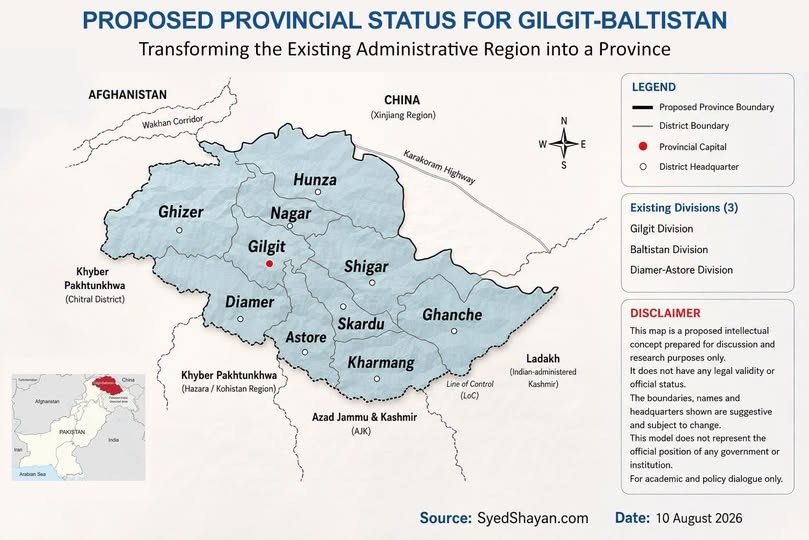
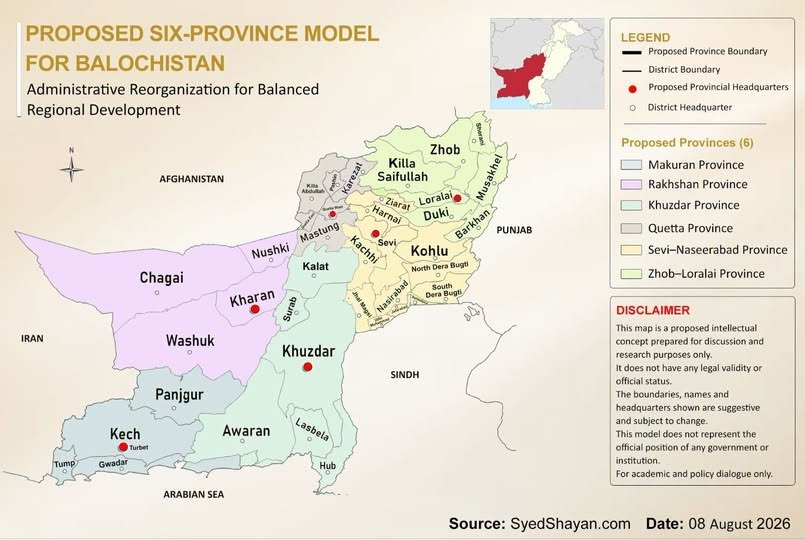
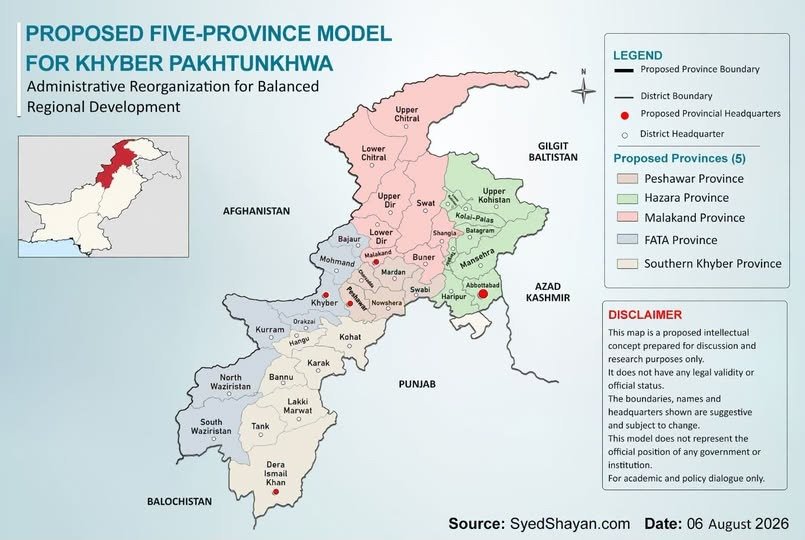
If the preparatory work has genuinely been completed, a comprehensive White Paper should be placed before the nation containing, for every proposed province, its population, area, boundaries, possible capital, revenue base, annual expenditure, dependence on the NFC, one-time establishment cost, distribution of assets and liabilities, natural resources, local government structure and complete transition plan.
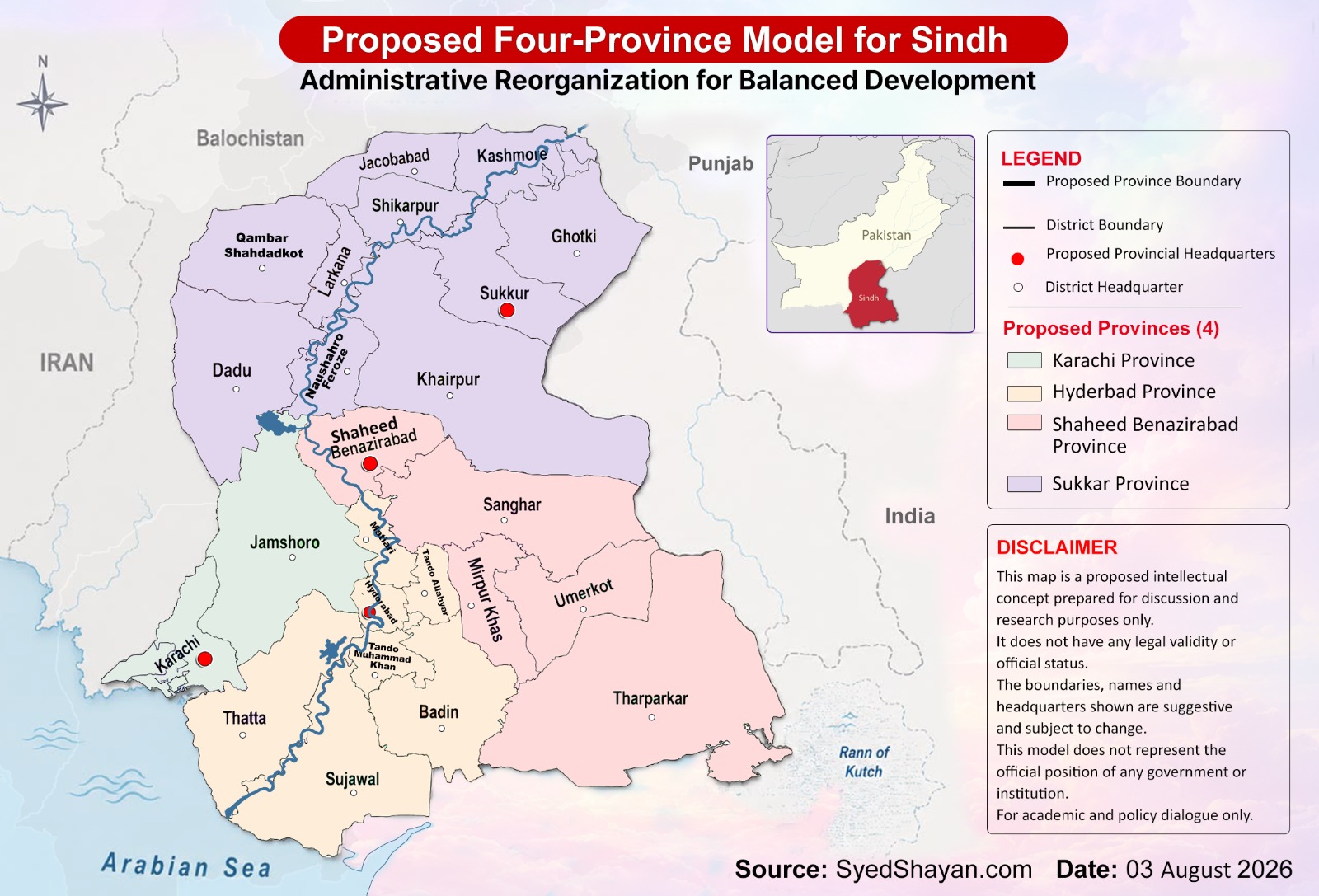
And if none of this has yet been prepared, the nation has every right to ask: on the basis of what research, what team and what planning are maps of new provinces being presented?
Mr Mohsin Naqvi,
These 15 questions are being placed before you because, if Pakistan is to undertake such a major transformation of its provincial system, the decision must not be based solely on today’s needs.
Nations do not design their fundamental institutional structures for five or ten years. They plan them with the requirements of future decades and generations in mind.
Pakistan must therefore develop a provincial system capable not only of addressing present challenges, but also of meeting the needs of the next 50 or even 100 years.
From the One Unit experiment to the City District Government system, Pakistan has undertaken several major administrative experiments in the past. Many systems were introduced under one government and then abolished or significantly altered when that government changed.
We should not repeat that mistake in the case of new provinces.
This time, the system should emerge only after comprehensive research, reliable data, public consultation and broad constitutional consensus, so that it remains sustainable regardless of changes in government.
I have been researching Pakistan’s power sector and Independent Power Producers for several years. One lesson emerging very clearly from that research is that when major national decisions are made without adequate research, open debate and public consultation, the cost is often borne not only by one generation but by generations that follow.
In considering new provinces, we should therefore ensure in advance that today’s decision does not become tomorrow’s permanent financial burden on the public.
That is why the most important question remains:
Are we merely creating new provinces, or are we designing a new provincial system for Pakistan?
In our view, the creation of new provinces requires a new concept:
Smart and Fiscally Autonomous Province
This would mean a province capable of expanding its economy, generating its own Own Source Revenue, and meeting a substantial share of its own expenditure.
Its administration should be modern and cost-efficient, with no unnecessary fiscal dependence on the federation.
The same principle should apply to government departments. Each department should have clearly defined annual targets for expenditure, revenue and performance, with transparent public accounting for every rupee spent.
Private-sector companies often perform better because their management operates against clearly defined targets. They are expected to increase revenue, control costs and deliver measurable results.
Government administration must also incorporate this form of accountability.
The success of a public official should not be measured simply by whether the official completed a term of office. It should be judged by how much the institution’s performance improved, how effectively expenditure was controlled, and what results were delivered to citizens.
For financially weaker regions, a transparent Equalization System may be established so that people are not deprived of essential public services merely because their region has a weaker revenue base.
Our proposal is that, rather than beginning with one or two provinces, Pakistan should first undertake a National Administrative and Provincial Review covering the entire country.
This review should determine where new provinces are needed and why, whether each proposed province can become financially viable, what it will cost to establish and operate, and how authority can be transferred beyond the new provincial capitals to districts, cities and local governments.
Before any final map is adopted, it should be placed before the public, Parliament, Provincial Assemblies, experts, universities, think tanks and the people of the affected regions.
Pakistan may need additional provinces, but it does not need additional oversized secretariats, unnecessary protocol, expanding bureaucracies and permanent fiscal deficits.
If new provinces are to be created, the system should be designed for future generations, not for the tenure of a particular government.
It should bring government closer to the people, accelerate decision-making, strengthen local government, define financial responsibilities clearly and ensure accountability for every public expenditure.
Times have changed.
Pakistan must therefore decide the future of its provincial system not merely with the next election in mind, but with the needs of the next several generations in view.
SyedShayan.com, as an independent think tank, is conducting research on urban and regional development, natural resources, consumer policy and other major national and administrative issues facing Pakistan.
Our purpose is to raise, before major national decisions are taken, the fundamental questions to which the people of Pakistan have a right to know the answers.
Respectfully,
Syed Shayan
Founder & President, SyedShayan.com
Think Tank for Urban and Regional Development, Natural Resources and Consumer Policy
Lahore, Pakistan
11 August 2026

No comments yet.