

How Many Provinces Should Khyber Pakhtunkhwa Be Divided Into?
🔳 Subject: Does Pakistan Really Need New Provinces? | Episode 4
Title: How Many Provinces Should Khyber Pakhtunkhwa Be Divided Into?
🔺 Differences of opinion on national issues are natural, but serious debate and national consensus are essential for finding sustainable solutions.
Written and Researched by Syed Shayan
Khyber Pakhtunkhwa, formerly known as the North West Frontier Province and historically associated with the regions of Gandhara and Afghania, acquired its present geographical form primarily on 31 May 2018, when the former FATA was merged into Khyber Pakhtunkhwa through the 25th Constitutional Amendment.
Before that, FATA was not part of Khyber Pakhtunkhwa. It was a separate territory administered by the federation.
The name of the province itself was changed from the North West Frontier Province to Khyber Pakhtunkhwa in 2010 through the 18th Constitutional Amendment.
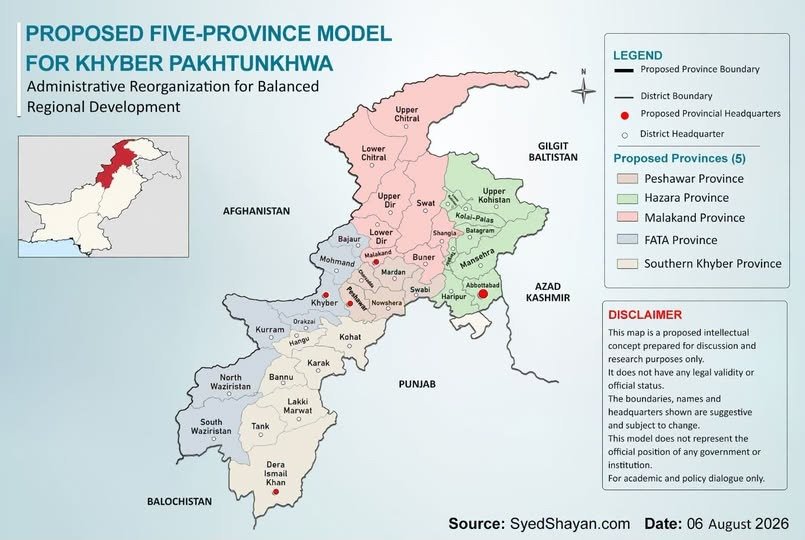
On the basis of the preliminary analysis conducted by our think tank, a model of 5 provinces for Khyber Pakhtunkhwa appears more workable in terms of population, geography, economic capacity and administrative balance.
The proposed structure is as follows.
🔘 Province of Peshawar
▫️ Districts: Peshawar, Nowshera, Charsadda, Mardan, Swabi
▫️ Population 2023: 12,974,469
▫️ Total Area: 7,437 square kilometres
The main reason for proposing Peshawar as a separate province is that Peshawar, Nowshera, Charsadda, Mardan and Swabi are located within the same geographical region and are connected through a strong road and transport network.
Peshawar, Charsadda and Nowshera have historically formed part of the urban, agricultural and commercial system of the Peshawar Valley, while Mardan and Swabi are also closely linked with the economy and everyday life of the same region.
The proposed province would not be very large in area, but it would have a substantial population and would hold particular importance within Khyber Pakhtunkhwa in terms of education, healthcare, industry, trade, agriculture and public services.
Peshawar is the largest centre for education, healthcare, employment, business and government administration. Nowshera is important for industry, defence installations and agriculture. Charsadda has a strong agricultural and food related economy, while Mardan and Swabi hold important positions in education, industry and agricultural production.
If these areas were combined into a separate province, the administrative burden on the present Khyber Pakhtunkhwa government could be reduced and decisions could be made more rapidly and more effectively according to the specific needs of this region.
🔘 Province of Hazara
▫️ Districts: Abbottabad, Haripur, Mansehra, Battagram, Torghar, Kolai Palas, Upper Kohistan, Lower Kohistan
▫️ Population 2023: 6,188,736
▫️ Total Area: 17,064 square kilometres
The demand for a separate Hazara province is not new. It has remained part of the region’s politics and public debate for several decades.
People in the region have long argued that Hazara possesses its own historical, geographical and regional identity and should therefore be granted provincial status.
Hazara already exists as a complete administrative division. If it were made a province, the existing administrative structure could be expanded and used on a broader scale.
Because of the distance from Peshawar and the mountainous terrain, access to the provincial capital is particularly difficult for people living in Kohistan, Torghar and Battagram.
Hazara also has a strong economic base.
Tourist destinations such as Naran, Kaghan, Shogran, Balakot and the Galiyat, together with Tarbela Dam, other hydropower projects, mineral resources, forests and the northern route of CPEC, constitute major economic strengths of the region.
If Abbottabad were made the provincial capital, public services, basic facilities and development resources could be delivered more effectively to remote and difficult mountainous areas.
🔘 Province of Malakand
▫️ Districts: Swat, Buner, Shangla, Upper Dir, Lower Dir, Malakand, Upper Chitral, Lower Chitral
▫️ Population 2023: 8,671,439
▫️ Total Area: 29,872 square kilometres
There is currently no strong and organised political movement demanding a separate Malakand province, but the region possesses historical, geographical and administrative characteristics that provide a strong basis for considering such a proposal.
The former states of Swat, Dir and Chitral were historically connected through the wider administrative structure of Malakand, while today Swat, Dir, Chitral, Buner, Shangla and Malakand together form a distinct mountainous region.
Because of difficult terrain and long distances, travelling to Peshawar is particularly difficult and time consuming for residents of Chitral and Upper Dir.
Much of the population lives in mountain valleys where requirements relating to roads, water, healthcare, education and public services differ substantially from those of the plains.
Tourism, hydropower, forests, fruit orchards, minerals, emeralds and other precious stones represent important economic strengths of the region.
The Kalash valleys of Chitral also provide the region with a distinctive cultural and tourism identity.
If Malakand were established as a separate province, residents of remote mountain districts could gain better access to courts, hospitals, educational institutions and government offices, while decisions could be made in accordance with the region’s own requirements.
🔘 Province of FATA
▫️ Districts: Bajaur, Mohmand, Khyber, Orakzai, Kurram, North Waziristan, South Waziristan
▫️ Population 2023: 5,743,162
▫️ Total Area: 22,407 square kilometres
The demand for FATA to become a separate province has appeared in the past, although there was never complete political consensus within the tribal areas.
A significant section of opinion supported merger with Khyber Pakhtunkhwa, while some political leaders and local groups favoured the creation of a separate province on the basis of FATA’s historical and geographical identity.
For a long period, this region was governed under a constitutional, legal and administrative framework different from the rest of Pakistan.
In 2018, it was merged into Khyber Pakhtunkhwa through the 25th Constitutional Amendment, but the border, social, security and development requirements of the tribal districts stretching from Bajaur to South Waziristan remain different from those of much of the rest of the province.
This region forms one of Pakistan’s most important border belts with Afghanistan and for decades constituted the former Federally Administered Tribal Areas.
Torkham and other border crossings are of fundamental importance for trade with Afghanistan and Central Asia.
Although customs revenues are collected by the federation, the regional economy could be strengthened through the development of trade, transport, warehousing, markets, industry, minerals, tourism and local services.
If a separate provincial government were established, the tribal districts could receive a clearer and more direct share in federal fiscal transfers, the provincial budget, development programmes and political representation.
Decisions concerning border security, roads and other infrastructure, education, healthcare, employment and the rehabilitation of conflict affected areas could also be made more closely according to local needs.
The principal advantage of creating a separate province could be that the region receives focused attention and that decisions are made locally.
If the federation provides the necessary financial assistance and development investment during the initial years, the province could gradually become more financially sustainable through border trade, minerals, tourism and the local economy.
A strong and developed border province would not only benefit the people of the region but could also serve as an important economic and security buffer for Pakistan along the Afghan border.
🔘 Province of Bannu or Southern Khyber
▫️ Districts: Kohat, Hangu, Karak, Bannu, Lakki Marwat, Tank, Dera Ismail Khan
▫️ Population 2023: 7,278,291
▫️ Total Area: 24,961 square kilometres
The principal reason for proposing Bannu or Southern Khyber as a separate province is that the needs of this region differ considerably from those of Peshawar and the northern districts.
Kohat, Hangu, Karak, Bannu, Lakki Marwat, Tank and Dera Ismail Khan are geographically connected and already share commercial, economic and social linkages.
Because of their distance from Peshawar, reaching the provincial capital can be difficult and time consuming for residents of these districts.
Karak and Kohat are important for oil, gas, mineral resources and industry, while Bannu, Lakki Marwat, Tank and Dera Ismail Khan are major centres of agriculture, livestock, fruit and grain production.
Dera Ismail Khan is located on the western route of CPEC and can also develop into an important commercial centre connecting Punjab, Balochistan, Khyber Pakhtunkhwa and the tribal districts.
If this region were established as a separate province, greater attention could be given to local resources, oil and gas, agriculture, industry and development projects, while citizens could gain better access to government offices, courts, hospitals and educational institutions.
(To be continued in the next instalment)
No comments yet.