
Home

This article is available in two languages:

Should Azad Jammu and Kashmir Become a Province of Pakistan?

Should Azad Jammu and Kashmir Become a Province of Pakistan?

Azad Jammu and Kashmir and Pakistan’s Federal Framework: Revisiting a Constitutional Question
 
▫️ Did Pakistan miss a historic opportunity in the 1970s when Azad Jammu and Kashmir was not made the country’s fifth province, despite a proposal by Zulfikar Ali Bhutto—an opportunity that might have provided the people of AJK with greater rights, representation, and participation in the federation?
 
▫️ Much of the territory that we today call Azad Jammu and Kashmir was never geographically part of the Kashmir Valley. Mirpur, Bhimber, and Kotli had geographical and cultural links with Jhelum, Potohar, and the mountainous areas of Jammu. Poonch and Sudhanoti lay on the western side of the Pir Panjal range, while the upper Neelum region was geographically more closely connected with Hazara, Kaghan, and the northern mountain regions.
 
▫️ Seventy-nine years later, it is reasonable to ask a basic question: AJK’s interim constitutional status has now continued for 52 years. How long is it intended to remain interim? Every interim arrangement must ultimately have some limit.
 
▫️ Instead of immediately granting full provincial status to Azad Jammu and Kashmir or Gilgit-Baltistan, Pakistan could consider an interim provincial status that would provide representation in the National Assembly and Senate, as well as participation in the NFC framework, while preserving the position that the final settlement of the Kashmir dispute remains to be determined.
 
▫️ It is striking that per capita public expenditure on education, healthcare, policing, and several other sectors in AJK is higher than in Punjab and some other provinces, yet its citizens remain without direct representation in Pakistan’s federal constitutional system.
 
▫️ This article examines the possible economic and political implications of transforming AJK’s existing administrative structure into a new province of Pakistan.
 
Subject: Does Pakistan Need New Provinces? | Episode 9
 
Should Azad Jammu and Kashmir Become a Province of Pakistan?
 
The Debate over New Provinces in Pakistan and the Status of Azad Jammu and Kashmir
 
Our think tank has so far published eight instalments examining whether Pakistan should create new provinces. This is the ninth instalment in the series.
 
On 5 November 1973, former Prime Minister Zulfikar Ali Bhutto addressed a large public gathering at Neelum Stadium in Muzaffarabad. He stated that, if the people of Azad Jammu and Kashmir so desired, they could be given a parliamentary system similar to Pakistan’s, AJK could be accorded a status comparable to that of a province, and the State of Jammu and Kashmir could also be represented in Pakistan’s federal legislature. Most importantly, Bhutto presented this as an interim arrangement pending the final settlement of the Kashmir dispute, rather than as permanent accession. At the same time, he maintained Pakistan’s position on the right of self-determination.
[Reference: Dawn Archives, 6 November 1973]
 
A subsequent study of AJK’s constitutional history by the Institute of Policy Studies also noted that Zulfikar Ali Bhutto wanted to establish closer constitutional links between AJK and Pakistan and had presented the people of AJK with the option of becoming Pakistan’s fifth province.
[Reference: Irshad Mahmud, “Status of AJK in Political Milieu,” Institute of Policy Studies (IPS), Islamabad, 2006]
 
However, a section of AJK’s political leadership, particularly Sardar Muhammad Abdul Qayyum Khan and his Muslim Conference, opposed this approach. Other nationalist and Kashmiri circles also feared that making AJK a province of Pakistan could weaken the position on the Kashmir dispute, the right of self-determination, and the demand for a plebiscite. There was also concern that such a step could provide India with a justification for permanently integrating the part of Kashmir under its administration.
 
Consequently, rather than creating a full province, an intermediate arrangement was developed. Following considerable political debate and negotiations, an agreement on a new constitutional framework was reached in Islamabad on 10 June 1974 between Bhutto, AJK President Sardar Abdul Qayyum Khan, and leaders of AJK’s political parties. This agreement led to the Azad Jammu and Kashmir Interim Constitution Act, 1974, which established a parliamentary system in AJK and created the Kashmir Council as an institutional mechanism governing its relationship with Pakistan.
 
The preamble to the 1974 Constitution stated that the final status of Jammu and Kashmir remained to be determined and that the arrangement for the better administration of AJK was being established “until such time as the status of Jammu and Kashmir is determined.”
[Reference: AJ&K Interim Constitution, 1974, official text]
 
Yet by 2026, this interim arrangement has continued for 52 years. The Kashmir dispute remains unresolved; the interim status has not ended; AJK has not become a formal province of Pakistan; and its people have not obtained the same level of representation in the National Assembly and Senate as the provinces.
 
During the 1970s, one concern was that if Pakistan incorporated AJK as a province, India might use that decision to justify incorporating the part of Kashmir under its own administration. However, on 5 August 2019, without any such action by Pakistan, India revoked Jammu and Kashmir’s special status and subsequently reorganised the territory into two separate Union Territories, Jammu and Kashmir and Ladakh.
 
Fifty-two years later, Pakistan therefore faces a straightforward question. If the central concern that originally contributed to AJK’s interim status no longer exists in precisely the same form under changed circumstances, what should Pakistan’s policy now be?
 
▫️ Should AJK remain under the same interim arrangement for several more decades?
▫️ Should it receive formal representation in Pakistan’s National Assembly and Senate?
▫️ Should it move towards a clearly defined and permanent constitutional status, or should the existing interim framework continue?
▫️ And if the existing system is to continue, what is its intended duration and ultimate destination?
 
AJK’s status remains interim, while its administration, development expenditure, and financial requirements are closely linked with Pakistan. It is therefore no longer sufficient simply to repeat arguments formulated decades ago. After 52 years, the government must explain what the way forward is.
 
An important dimension of this question is financial. AJK’s existing system cannot easily function without financial support from Pakistan, while Pakistan itself is facing severe economic pressures. It is therefore necessary to consider how long the present form of financial assistance can continue, what financial responsibilities AJK itself should assume, and how a clearer, more sustainable, and accountable fiscal relationship between Pakistan and AJK might be established.
 
In the 2025–26 budget, AJK was allocated Rs149 billion as a Federal Variable Grant, while Rs49 billion was provided for the development budget. Pakistan’s financial support continued in 2026–27, including a Rs146 billion Federal Variable Grant and Rs36 billion for the development budget. This means that approximately Rs198 billion in 2025–26 and Rs182 billion in 2026–27 were allocated by Pakistan for AJK in these two categories alone.
 
What surprised me most was the result when I examined these allocations in relation to AJK’s population. In several essential sectors, including healthcare, education, and policing, per capita public expenditure in AJK is considerably higher than for citizens of Punjab and some other provinces.
 
On the one hand, therefore, AJK’s existing fiscal system depends substantially on federal funding from Pakistan; on the other, per capita public expenditure in certain sectors is higher than in some of Pakistan’s larger provinces. The question is not why the people of AJK should receive better public services—they certainly should. The real question is why, when Pakistan carries such a substantial financial responsibility, the people of AJK do not have full representation and corresponding accountability within Pakistan’s federal constitutional system.
 
The central question, then, is how long this arrangement should continue and for what purpose. Pakistan itself faces inflation, debt, and significant fiscal pressures. It is therefore entirely legitimate to ask under what policy framework, and towards what objective, public funds are being spent on AJK.
 
This question becomes particularly relevant at a time when the Pakistan Muslim League-Nawaz is in a position to form a government in AJK and further public facilities and development projects are being discussed. The straightforward question is: where will the money come from? And if it is to come from Pakistan, how will a balance be maintained between the needs of Pakistan’s own population and expenditure on AJK?
 
If AJK’s present relationship with Pakistan is to continue, its constitutional status should also be clarified: what representation will it have at the federal level, how will it increase its own revenues, and how much will Pakistan contribute towards its expenditure? These questions should be addressed through a clear framework. Otherwise, even after 52 years, the fundamental question will remain unchanged: where, ultimately, are we heading?
 
AJK has its own government, Legislative Assembly, Supreme Court, High Court, Board of Revenue, Inland Revenue Department, and taxation system, but it is not financially self-sufficient. Following reforms in 2018, several taxation powers were transferred to the AJK government. Nevertheless, it continues to receive a Variable Grant from Pakistan’s federal revenues, while federal assistance also contributes to development expenditure.
 
A recurring argument among nationalist and public circles in AJK is that the annual funds provided by Pakistan should not be described as “charity”; rather, they represent AJK’s legitimate share arising from water, hydropower, taxation, and other resources. These groups maintain that the economic benefits Pakistan receives from AJK are no less than the financial assistance provided in return.
 
Available official figures, however, do not yet provide a complete accounting capable of conclusively establishing this claim. What is therefore required is a transparent and audited assessment of how much AJK contributes to Pakistan in aggregate and how much Pakistan provides to AJK in aggregate. Until such an accounting is available, competing claims on both sides will continue to generate uncertainty and mistrust.
 
At a time when Pakistan is debating the possible reorganisation of provincial territories, boundaries, and administrative structures, it is also appropriate to address AJK’s 52-year interim status.
 
If, through a constitutional amendment, Azad Jammu and Kashmir were to become a formal province of Pakistan, its existing institutional structure could be adapted into a provincial framework rather than being abolished altogether. The office of Prime Minister could be replaced by that of Chief Minister, the President by a Governor, and the existing Legislative Assembly could become a Provincial Assembly. Such an arrangement could provide the people of AJK with several significant benefits:
 
1. Representation in the National Assembly and Senate
The people of AJK would, for the first time, acquire direct constitutional representation in Pakistan’s National Assembly and Senate, giving them a formal role in the federal government, national legislation, and national decision-making.
 
2. Full Participation in Pakistan’s National Politics
Kashmiri voters would no longer be confined to AJK’s local political system. They would acquire the constitutional right to participate in the formation of Pakistan’s federal government, the election of the Prime Minister, and the shaping of national policies.
 
3. Formal Participation in the NFC and Federal Fiscal System
Instead of relying on special grants and temporary financial arrangements, AJK’s fiscal relationship with the federation could be placed on a constitutional and permanent footing comparable to that of Pakistan’s other provinces.
 
4. Clearer Rights over Hydropower and Natural Resources
AJK’s share and rights in revenues generated from rivers, hydropower, forests, minerals, and other natural resources could be defined more clearly under constitutional and fiscal principles.
 
5. A Defined Share in Federal Development Projects and Institutions
AJK’s participation in roads, motorways, hospitals, universities, electricity, water, and other major development projects, as well as federal employment and national institutions, could be placed on a clearer constitutional basis.
 
6. Provincial Government alongside Federal Rights
AJK could retain its own government, Chief Minister, Governor, Provincial Assembly, High Court, and administrative structure, while also acquiring full participation in the National Assembly, Senate, and federal fiscal system.
 
7. An End to 52 Years of Interim Status
Perhaps the most significant benefit would be the conclusion of the ambiguous interim arrangement that has existed since 1974. AJK’s constitutional identity, relationship with the federation, fiscal rights, and political representation could then be explicitly defined within the Constitution of Pakistan.
 
These seven points demonstrate that provincial status could provide the people of AJK with clearer political, fiscal, and constitutional rights. A closer understanding of AJK’s map and geographical form is also important to any serious consideration of its future, since geography itself has implications for the region’s peace, development, and long-term planning.
 
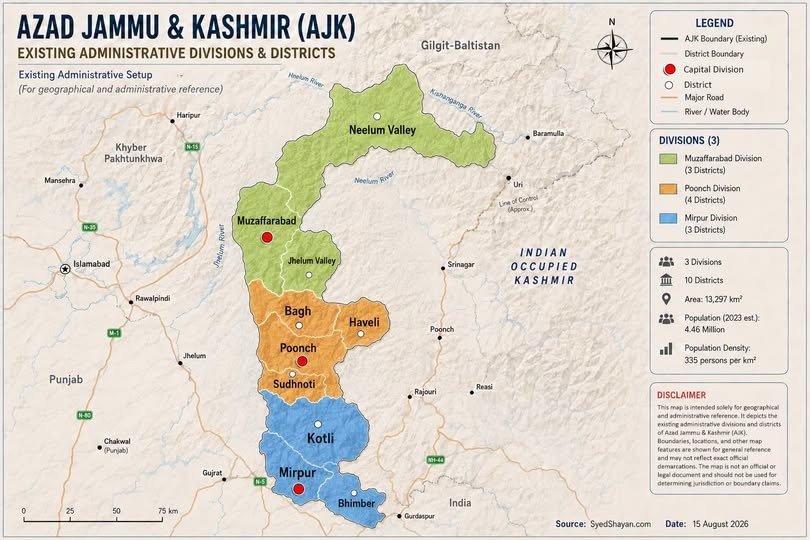
A close examination of the map shows that AJK extends from Bhimber to the Neelum Valley in a long, narrow, arc-shaped strip. Its geography tells an interesting story. Beginning near Gujrat in the south at Bhimber, it passes through Mirpur and Kotli, curves towards Poonch, reaches Muzaffarabad, and then continues along the Neelum Valley far into the northeast. It is therefore neither a compact circular nor rectangular territory, but a long, narrow and irregular strip extending through mountains and valleys.
 
Its length from one end to the other is commonly estimated at approximately 400 kilometres, while its width varies considerably, narrowing to only a few dozen kilometres in some places and becoming substantially wider in others. Its total area is 13,297 square kilometres. Today, it is divided into three divisions and ten districts, with an estimated 2023 population of approximately 4.46 million.
 
Looking at the map raises another interesting question: was the entire elongated territory that we now call “Azad Kashmir” historically and geographically part of the Kashmir Valley?
 
An important historical distinction is necessary here. Most of present-day AJK was not geographically part of the Kashmir Valley. The Kashmir Valley proper is the bowl-shaped valley centred around Srinagar, which is today under Indian administration. The present-day areas of Mirpur, Bhimber, and Kotli were geographically connected with Jammu and Potohar, while Poonch lay on the western side of the Pir Panjal range. In 1947, however, all these areas formed part of the princely State of Jammu and Kashmir, and it is through this historical association that they are today collectively known as Azad Jammu and Kashmir.
 
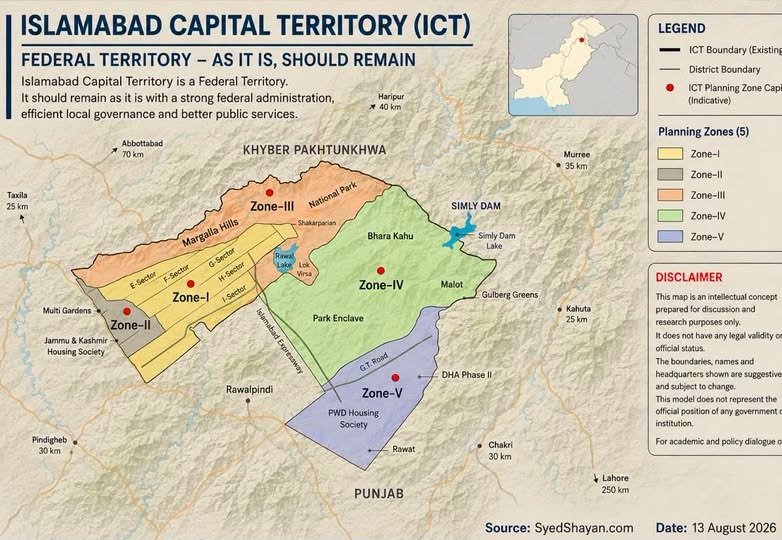
The distinction can be understood through a simple comparison with Islamabad. The legal area of Islamabad remains approximately 906 square kilometres, constituting the Islamabad Capital Territory. The urban footprint associated with Islamabad, however, has expanded far beyond these legal boundaries. Today, housing developments, businesses, and new settlements around Rawat, Chakri, the new Islamabad International Airport, and even beyond frequently use “Islamabad” in their names and addresses.
 
Consider Islamabad International Airport itself: it carries the name Islamabad and is universally referred to as Islamabad Airport, yet the land on which it stands is not part of the Islamabad Capital Territory; it lies within Punjab, towards Fateh Jang and Rawalpindi. (Dawn) Does calling it Islamabad make the land itself part of Islamabad? Clearly not.
 
Similarly, describing an area around Rawat, Chakri, or Fateh Jang as Islamabad for commercial purposes or in everyday usage does not alter its actual district or provincial jurisdiction. The broader urban region may conveniently be described as “Greater Islamabad”, but this does not alter the legal boundaries of Islamabad itself. Keeping this distinction in mind makes it easier to understand the difference between the broader use of the name Kashmir and the geographical limits of the Kashmir Valley.
 
In much the same way, “Kashmir” developed into a political and historical identity extending well beyond the geographical Kashmir Valley. This does not invalidate the identity of the people living in present-day AJK. The point is simply that the Kashmir Valley and the former State of Jammu and Kashmir were two distinct geographical concepts. Without understanding this distinction, it becomes difficult to think clearly about possible solutions to the contemporary issue.
 
Readers,
 
The purpose of this discussion is neither to reject any historical position nor to establish any particular decision as unquestionably correct. It is to ask why, even after 52 years, the constitutional and political status of AJK remains unresolved.
 
If Kashmir’s future is to remain associated with Pakistan, then questions of representation, fiscal rights, resources, and constitutional status need to be addressed within a clear and workable framework. If, instead, the existing interim status is to continue, the public should also be told how long that interim arrangement is intended to last.
 
One possible middle course would be to grant AJK interim provincial status rather than immediately making it a full province. Its status could remain interim until the final settlement of the Kashmir dispute, but that interim arrangement could be given a clearly defined constitutional form. Its people could receive representation in the National Assembly and Senate, participation in the NFC, and other federal rights.
 
Such an arrangement could allow Pakistan to maintain its position on Kashmir while ensuring that the people of AJK are not left indefinitely within an ambiguous interim framework. Put simply, the final settlement can take place whenever circumstances permit, but why should the constitutional, political, and fiscal rights of the people remain suspended until then?
 
In my instalment on Gilgit-Baltistan, I repeatedly raised the question that if the Gilgit-Baltistan Assembly itself has repeatedly called for the region to become a formal constitutional part of Pakistan, what exactly is preventing Pakistan from moving forward? In that case, at least, there is clarity regarding the direction in which elected representatives wish to proceed.
 
The Kashmir question is different. Its final settlement is to be determined in accordance with the wishes of the people. If such a stage is ever reached, a referendum or another mechanism for determining public opinion would provide the means through which that choice could be expressed.
 
The time has come to examine the Kashmir issue through the lens of realism and prevailing realities on the ground. Fifty-two years have passed under the weight of emotional narratives and slogans such as “Kashmir Banega Pakistan”—“Kashmir will become Pakistan”—but it is no longer possible to continue ignoring changing realities.
 
India has already taken action on the territory under its control, while Pakistan continues to carry the burden of a narrative formulated more than half a century ago. Changing geopolitical circumstances and the need for administrative reform now require a serious and open-minded assessment of what is realistically possible.
 
If slogans alone could resolve the issue, 52 years would have been more than sufficient. The time has come for both the Kashmiri people and Pakistani policymakers to move beyond uncertainty and acknowledge the reality of what is within our control.
 
(To be continued in the next instalment)
3
0
Views
20
0

Previous Articles

Is It Constitutionally Possible to Give Islamabad Provincial Status or Its Own Assembly?

Should Islamabad Have a Provincial Assembly? Rethinking the Governance of the Federal Capital ▫️ Islamabad should, in our view, remain a Federal Territory. Its constitutional identity should not be tied to provincial politics; rather, it should continue to function as the shared federal capital of all constituent units of Pakistan. ▫️ A national capital belongs to the federation as a whole. Granting it the status of a province may raise concerns regarding federal neutrality. The administration and security of federal institutions, foreign diplomatic missions, and the central offices of the federal government are generally considered matters of direct federal responsibility. ▫️ At this stage, Islamabad’s civil society, residents, experts, lawyers, think tanks, and elected representatives should not remain silent. Before any new legislation is introduced, there should be an open process of public consultation, and the complete proposed model should be placed before the country. Subject: Does Pakistan Need New Provinces? | Episode 8 Is It Constitutionally Possible to Give Islamabad Provincial Status or Its Own Assembly? On national issues, disagreement is natural, but serious debate and broad national consensus are essential to finding sustainable solutions. Written and Researched by Syed Shayan During the ongoing debate over the creation of new provinces in Pakistan, another proposal has emerged which, in my view, requires careful consideration before the process moves any further. In June 2026, Federal Minister for Planning Ahsan Iqbal proposed the creation of a new provincial-style assembly for Islamabad. Under the proposal, an Islamabad Capital Territory Assembly could consist of 27 members, including 21 directly elected members, five reserved seats for women, and one seat for minorities. The assembly would elect either a Chief Minister or a Mayor, while the proposed ICT Government could be granted administrative and financial autonomy similar to that of a provincial government in areas such as health, education, the environment, and municipal services. Law and order and master planning, however, would remain under federal control. This raises a basic question for Federal Minister for Planning Ahsan Iqbal: If Islamabad is a Federal Territory, why is there a need to establish another provincial-style government within it? Islamabad does not necessarily need to become a province. What it needs is a strong and empowered Metropolitan Government. Decisions concerning water, sanitation, roads, parks, transport, health, education, and other municipal services should be made by Islamabad’s elected representatives. Residents should directly elect a Mayor with clearly defined powers and an adequate budget, and citizens should be able to hold that local government accountable for the everyday functioning of the city. According to the 2023 Census, Islamabad’s population has reached approximately 2.36 million, so the need for a strong elected local government can hardly be disputed. But why should this require the creation of a provincial-style assembly, a Chief Minister, an additional government, and an entirely new layer of institutions? This question is also relevant because Ahsan Iqbal, who is now proposing a new provincial assembly for Islamabad, served as Planning Minister between 2013 and 2018, when major coal-based power projects, including Sahiwal and Port Qasim, were rapidly advanced under CPEC. The question today is whether a formal post-project evaluation was ever conducted to determine which aspects of that planning proved successful, which became costly, and who ultimately bore the consequences. If the outcomes of major past decisions are not properly assessed, how can public confidence be established in new institutional proposals? It should also be remembered that the residents of Islamabad are not excluded from national politics. Islamabad currently has three seats in the National Assembly — NA-46, NA-47, and NA-48 — through which citizens directly elect their Members of the National Assembly. The reason Islamabad’s residents do not vote for a provincial assembly is that Islamabad is not part of any province. Under Article 1 of the Constitution, it is a separate Islamabad Capital Territory and the Federal Capital. While some residents of Islamabad argue that they lack full provincial representation because the capital is not a province, citizens of Washington, D.C., the capital of one of the world’s largest and most influential democracies, face an unusual constitutional situation of their own. Washington, D.C. is not part of any U.S. state. It remains under federal jurisdiction. Its residents pay federal taxes, yet they have no Senator representing them in the U.S. Senate, and their elected Delegate in the House of Representatives does not possess a full vote on final legislation. This lack of representation has produced a long-running campaign for Washington, D.C. to become the 51st state of the United States. Even official D.C. licence plates carry the slogan “End Taxation Without Representation.” The idea of granting Islamabad provincial-style status is not new. According to available newspaper records, in January 2011, Federal Law Minister Dr Babar Awan proposed that Islamabad should have a provincial-style legislative assembly and greater self-government. On 22 January 2011, Dawn, in an editorial, described the announcement as a proposal that could move Islamabad towards becoming a new province and questioned its constitutional and administrative justification. Later, certain circles within the Pakistan Peoples Party also considered the possibility of making Islamabad the fifth province and dividing the ICT into two districts. In March 2011, Babar Awan stated that two districts would first be established, after which proposals for provincial status and a legislature would be taken forward. Broadly speaking, three principal models are used around the world for governing national capitals. The first is the Federal District model, as seen in Washington, D.C. in the United States, Canberra in Australia, and Brasília in Brazil. Under this arrangement, the national capital is not incorporated into any province or state but remains under direct federal authority in order to preserve balance among the constituent units. The second is the City-State or Province model, seen in Berlin in Germany and Vienna in Austria. Berlin is both a city and a federal state, while Vienna is one of Austria’s nine federal states. The third model places the capital within an ordinary regional or municipal structure. Ottawa, for example, is located within the Canadian province of Ontario and has its own elected City Council. London, meanwhile, operates under a metropolitan arrangement comprising the Mayor of London and the London Assembly at the Greater London level. Among these three models, Islamabad’s existing constitutional arrangement most closely resembles the first: the Federal District model, comparable to Washington, D.C. and Canberra. Islamabad was developed as the federal capital during the 1960s on the principle that the country’s central city should not fall under the political or administrative influence of any single province. It was therefore designated as a separate Federal Territory, allowing the federal government, constitutional institutions, diplomatic missions, and important security installations to remain under direct federal administration. The central argument for retaining Islamabad as a Federal Territory is that it should remain the shared and politically neutral capital of all constituent units of Pakistan. At the same time, the rapid growth of Islamabad’s population and physical expansion of the city have raised legitimate questions about how residents can be given greater local authority, a stronger municipal system, and more effective representation in decision-making. The real debate, therefore, is whether these powers should be granted without turning Islamabad into a province, or whether the city should instead be given an entirely new provincial-style administrative structure. For this article, we also prepared a cartographic map of Islamabad. An interesting feature of Pakistan’s national map is that Punjab, Sindh, Khyber Pakhtunkhwa, Balochistan, Azad Jammu and Kashmir, and Gilgit-Baltistan are visible as distinct geographical territories, while Islamabad is often not shown in its full territorial shape. Instead, it is usually represented by a red dot, star, or other capital symbol. The principal reason is scale. Against Pakistan’s total area of approximately 882,000 square kilometres, Islamabad covers only about 906 square kilometres, or roughly 0.1 percent of the country’s total area. At the scale of a national map, its actual territorial shape therefore becomes almost invisible. For this reason, we have attempted in our map to show Islamabad’s geographical form and boundaries more clearly. (To be continued in the next instalment)
Before creating new provinces, the nation must have answers to these 15 questions.

The Honourable Mohsin Naqvi Federal Minister for Interior Government of Pakistan Islamabad Assalam-o-Alaikum, The question of creating new provinces in Pakistan is once again under discussion. My submission is simply that, before any such decision is taken, the nation should be clearly informed why new provinces are considered necessary and what model will be followed in creating them. If the objective is to provide citizens with essential public services closer to where they live, much of this can also be achieved through strong and empowered local governments. If so, where and why does the need for new provinces arise? With this fundamental question in mind, I am placing 15 questions before you and your government on behalf of our think tank. I respectfully request that the answers, together with the relevant reports, be published on the websites of the Ministry of Interior and other concerned government institutions so that this important issue may be debated on the basis of facts and data rather than political statements. 15 Fundamental Questions 1. Where are the national survey, public consultation process and comprehensive roadmap for the creation of new provinces? Major decisions involving the creation of new provinces or administrative units are generally preceded by detailed research, extensive public consultation, expert input and a clearly defined transition roadmap. Has the Government of Pakistan established a formal national commission or high-level committee for this purpose? If so, who are its members, what are its terms of reference, and what recommendations has it made so far? Has any systematic nationwide assessment been conducted of population, territorial size, travel distances, administrative difficulties, economic linkages and citizens’ access to public services? Has a phased roadmap for the creation of new provinces been prepared? If this work has already been completed, it should be placed before the nation. 2. Have the people been consulted on the proposed creation of new provinces? In areas where new provinces are being proposed, have residents been formally consulted? Have elected representatives, business communities, experts, universities, the media, think tanks, civil society and political parties also been consulted? Has the government created a national online portal through which Pakistanis at home and abroad can express their views on the need for new provinces, their number and their proposed boundaries? If not, how and at what stage will public opinion be incorporated into a decision of such national importance? 3. On what basis will the identity and boundaries of new provinces be determined? Mr Mohsin Naqvi, The most fundamental question is this: what principle will guide the creation of new provinces in Pakistan? Will boundaries be determined by language, ethnicity and identity, or will population, geography, resources, distance and good governance serve as the principal criteria? Different models exist internationally. India reorganised its states in 1956 substantially along linguistic lines, while Nigeria created additional states largely in response to administrative requirements. Ethiopia’s ethnic federal model also demonstrates that excessive politicisation of identity can carry serious risks. The identities of Pakistan’s existing provinces are closely associated with historical, linguistic and regional foundations. Punjab immediately evokes Punjabi identity, Sindh a Sindhi identity, Khyber Pakhtunkhwa a Pashtun identity, and Balochistan a Baloch identity. This is an established regional and identity-based model. The question is whether new provinces will also be created according to the same concept, or whether Pakistan will now adopt a more modern economic and administrative model in which population, territorial size, travel distance, geographical continuity, natural resources, agriculture, industry, education, employment and economic linkages are given greater importance than language or identity. If a modern model is being considered, what precise criteria will determine provincial boundaries? Has an independent and impartial Boundary and Economic Viability Commission been established for this purpose? If so, its criteria, recommendations and report should be made public. 4. What will be the constitutional procedure? Will new provinces be created through the formal constitutional procedure prescribed under Article 239 of the Constitution, or does the government intend to proceed through an administrative order or some other mechanism? Where the boundaries of an existing province are to be altered, approval by a two-thirds majority of the concerned Provincial Assembly is required. If the relevant Provincial Assembly does not approve the proposal, what constitutional course will the government follow? Will the process stop, will further consultation take place, or has some alternative constitutional mechanism already been identified? The nation should be informed in advance of the complete constitutional roadmap for the creation of new provinces and how disagreement or non-approval would be addressed. 5. Where is the financial model for each proposed province? How will a new province generate enough revenue to sustain itself? What proportion of its expenditure will be financed through Own Source Revenue? What will its permanent sources of taxation and other income be? To what extent will it remain dependent on the NFC and federal transfers for its recurring expenditure? The central question is whether new provinces are being created under the same traditional model or whether a new Smart Provincial Model is being designed in light of contemporary international experience. If every new province is to have a new assembly, Governor House, secretariat and bureaucracy, with the associated expenditure ultimately financed through the federation and the NFC, then every additional province will increase the fiscal burden on the state. But if the objective is to create a modern and financially responsible province, the model should require each province to expand its economy, generate its own revenue, finance as much of its own expenditure as possible, contribute its share towards federal responsibilities, and remain directly accountable to the public for every rupee spent. The nation therefore needs to know whether we are merely creating new provinces, or designing an entirely new provincial system for Pakistan. 6. How will the NFC operate after the creation of new provinces? If the number of provinces increases beyond four, the distribution of financial resources between the federation and the provinces will necessarily change. Has the government assessed what the NFC formula would look like after the creation of new provinces and what impact this would have on the shares of the existing provinces? 7. What safety net will exist for financially weaker provinces? If a new province is unable to meet its expenditures, remains in persistent deficit or experiences a serious economic crisis, who will support it? Will there be a predefined Equalization, Fiscal Support or Bailout Framework, or will every such crisis eventually become a liability of the federal treasury? 8. What will be the one-time cost of establishing each new province? How many billions of rupees will be required to establish a new assembly, secretariat, police command structure, judicial facilities, government offices, official residences, IT systems and other essential infrastructure? Where will this money come from? Will expenditure on education, health and development projects be affected in order to finance these costs? 9. How much will recurring government expenditure increase? What will be the additional annual cost of new ministers, assemblies, departments, officials, salaries, pensions, vehicles and government buildings? Has the government considered a Lean and Digital Government model rather than replicating a large and expensive traditional bureaucracy? 10. How will assets, liabilities and employees be divided? Under what formula will the existing province’s public assets, debts, liabilities, institutions, employees, pension obligations and ongoing development projects be divided between the existing and newly created provinces? Is there a written Asset and Liability Division Framework? 11. How will rights over water and natural resources be determined? On what basis will rights over water, dams, electricity, oil, gas, minerals, royalties and shared infrastructure be divided between new and existing provinces? Will a legal formula be established before the province is created so that new inter-provincial disputes do not emerge afterwards? 12. How will powers reach districts and cities? Reducing the geographical size of provinces is not enough. If all powers are again concentrated in the new provincial capital, Lahore or Karachi may simply be replaced by another dominant central city. Will empowered local governments, elected mayors and district governments be established in accordance with Article 140A? And will their financial resources be protected through a District Finance Commission? 13. What practical benefit will the ordinary citizen receive? How much will the creation of a new province reduce the distance citizens must travel to reach government offices? How much faster will services relating to land records, policing, education, healthcare and other basic needs become? Will the government establish measurable targets so that, after a few years, it can be objectively determined whether the creation of the new province succeeded or failed? 14. How will governance and accountability be ensured? If a new province fails to collect sufficient taxes, accumulates unnecessary debt, expands its bureaucracy, mismanages public finances or becomes affected by corruption and administrative failure, what legal safeguards will exist? Will independent audit, performance indicators, fiscal responsibility rules and an early warning mechanism form part of the system from the outset? 15. When did work on Pakistan’s new-provinces plan begin, and which committee, commission or institution has been assigned responsibility for it? Who are its members? The creation of a new province, state or major administrative unit does not take place overnight. Such processes require months, and sometimes years, of research, consultation, fiscal assessment, boundary determination, legislation and institutional transition. For example, India’s States Reorganisation Commission worked for approximately two years before submitting its report. In the United Kingdom, major administrative and devolution reforms have also typically been preceded by White Papers, public consultation and phased planning. The government should therefore explain when work on Pakistan’s proposed new provinces actually began. Which institution or committee has been entrusted with this responsibility? Who are the members of the team, what expertise do they possess, and what work has been completed so far? If the preparatory work has genuinely been completed, a comprehensive White Paper should be placed before the nation containing, for every proposed province, its population, area, boundaries, possible capital, revenue base, annual expenditure, dependence on the NFC, one-time establishment cost, distribution of assets and liabilities, natural resources, local government structure and complete transition plan. And if none of this has yet been prepared, the nation has every right to ask: on the basis of what research, what team and what planning are maps of new provinces being presented? Mr Mohsin Naqvi, These 15 questions are being placed before you because, if Pakistan is to undertake such a major transformation of its provincial system, the decision must not be based solely on today’s needs. Nations do not design their fundamental institutional structures for five or ten years. They plan them with the requirements of future decades and generations in mind. Pakistan must therefore develop a provincial system capable not only of addressing present challenges, but also of meeting the needs of the next 50 or even 100 years. From the One Unit experiment to the City District Government system, Pakistan has undertaken several major administrative experiments in the past. Many systems were introduced under one government and then abolished or significantly altered when that government changed. We should not repeat that mistake in the case of new provinces. This time, the system should emerge only after comprehensive research, reliable data, public consultation and broad constitutional consensus, so that it remains sustainable regardless of changes in government. I have been researching Pakistan’s power sector and Independent Power Producers for several years. One lesson emerging very clearly from that research is that when major national decisions are made without adequate research, open debate and public consultation, the cost is often borne not only by one generation but by generations that follow. In considering new provinces, we should therefore ensure in advance that today’s decision does not become tomorrow’s permanent financial burden on the public. That is why the most important question remains: Are we merely creating new provinces, or are we designing a new provincial system for Pakistan? In our view, the creation of new provinces requires a new concept: Smart and Fiscally Autonomous Province This would mean a province capable of expanding its economy, generating its own Own Source Revenue, and meeting a substantial share of its own expenditure. Its administration should be modern and cost-efficient, with no unnecessary fiscal dependence on the federation. The same principle should apply to government departments. Each department should have clearly defined annual targets for expenditure, revenue and performance, with transparent public accounting for every rupee spent. Private-sector companies often perform better because their management operates against clearly defined targets. They are expected to increase revenue, control costs and deliver measurable results. Government administration must also incorporate this form of accountability. The success of a public official should not be measured simply by whether the official completed a term of office. It should be judged by how much the institution’s performance improved, how effectively expenditure was controlled, and what results were delivered to citizens. For financially weaker regions, a transparent Equalization System may be established so that people are not deprived of essential public services merely because their region has a weaker revenue base. Our proposal is that, rather than beginning with one or two provinces, Pakistan should first undertake a National Administrative and Provincial Review covering the entire country. This review should determine where new provinces are needed and why, whether each proposed province can become financially viable, what it will cost to establish and operate, and how authority can be transferred beyond the new provincial capitals to districts, cities and local governments. Before any final map is adopted, it should be placed before the public, Parliament, Provincial Assemblies, experts, universities, think tanks and the people of the affected regions. Pakistan may need additional provinces, but it does not need additional oversized secretariats, unnecessary protocol, expanding bureaucracies and permanent fiscal deficits. If new provinces are to be created, the system should be designed for future generations, not for the tenure of a particular government. It should bring government closer to the people, accelerate decision-making, strengthen local government, define financial responsibilities clearly and ensure accountability for every public expenditure. Times have changed. Pakistan must therefore decide the future of its provincial system not merely with the next election in mind, but with the needs of the next several generations in view. SyedShayan.com, as an independent think tank, is conducting research on urban and regional development, natural resources, consumer policy and other major national and administrative issues facing Pakistan. Our purpose is to raise, before major national decisions are taken, the fundamental questions to which the people of Pakistan have a right to know the answers. Respectfully, Syed Shayan Founder & President, SyedShayan.com Think Tank for Urban and Regional Development, Natural Resources and Consumer Policy Lahore, Pakistan 11 August 2026

What Is Preventing Gilgit Baltistan from Becoming a Constitutional Province?

Gilgit Baltistan and Pakistan’s Constitutional Framework: Why Has Provincial Status Remained Unresolved? 🔳 If present day realities are taken into account, Gilgit Baltistan today arguably holds greater strategic importance for Pakistan than Kashmir itself. Pakistan’s land connection with China, the China Pakistan Economic Corridor, billions of dollars in investment, the Diamer Bhasha Dam, and important defence routes are all located in this region. For this reason, continuing to keep Gilgit Baltistan under an unclear federal status rather than granting it formal constitutional provincial status requires serious reconsideration. ▫️ Was linking Gilgit Baltistan with the Kashmir dispute a historical mistake? ▫️ There is considerable debate about creating new provinces in Pakistan, but why is there silence when it comes to making Gilgit Baltistan a province? ▫️ Why has Pakistan still not been able to make Gilgit Baltistan a formal constitutional province? What constitutional, diplomatic, or political obstacles have delayed such a decision for decades? Subject: Does Pakistan Need New Provinces? | Episode 7 What Is Preventing Gilgit Baltistan from Becoming a Constitutional Province? 🔺 The constitutional status of Gilgit Baltistan is a sensitive national issue. In light of the resolution adopted by its present Legislative Assembly, immediate progress should therefore be made towards granting the region the status of an interim constitutional province. Written and Researched by Syed Shayan Gilgit Baltistan is not currently a formal constitutional province of Pakistan. It is a separate territory administered by the federation and is generally regarded as a federally administered Administrative Unit. Spread over 72,496 square kilometres of difficult mountainous terrain, it had a population of approximately 1.71 million according to the 2023 Census, with an average population density of about 24 persons per square kilometre. Under the present administrative structure, Gilgit Baltistan consists of 3 divisions, Gilgit, Baltistan and Diamer, and 10 established districts. Gilgit Division comprises Gilgit, Ghizer, Hunza and Nagar. Baltistan Division comprises Skardu, Shigar, Ghanche and Kharmang. Diamer Division comprises Diamer and Astore. Basic Statistics of Gilgit Baltistan Total Area: 72,496 square kilometres Population 2023: 1,709,049, approximately 1.709 million Divisions: 3 Districts: 10 Tehsils: 34 Average Population Density: approximately 24 persons per square kilometre 1. Gilgit Division Gilgit District Area: 4,208 square kilometres Population: 324,552 Tehsils: Gilgit, Danyor, Jaglot Ghizer District Area: 12,381 square kilometres Population: 200,069 Tehsils: Punial, Ishkoman, Gupis, Yasin, Phander In the official 2026 EMIS records, Gupis and Yasin continue to be shown as part of Ghizer District. Hunza District Area: 10,109 square kilometres Population: 65,497 Tehsils: Aliabad, Gojal, Shinaki Nagar District Area: 4,137 square kilometres Population: 87,410 Tehsils: Nagar I, Sikandarabad Nagar II, Chalt 2. Baltistan Division Skardu District Area: 10,168 square kilometres Population: 278,885 Tehsils: Skardu, Gamba, Roundu, Gultari Shigar District Area: 4,173 square kilometres Population: 84,608 Tehsils: Shigar, Gulabpur Kharmang District Area: 6,144 square kilometres Population: 61,304 Tehsil: Kharmang Ghanche District Area: 8,531 square kilometres Population: 157,822 Tehsils: Khaplu, Mashabrum, Daghoni, Chorbat, Keris, Ghawari In the current official EMIS records, Ghawari is listed as a separate tehsil, while Haldi falls under Mashabrum Tehsil. 3. Diamer Division Diamer District Area: 7,234 square kilometres Population: 337,329 Tehsils: Chilas, Darel, Tangir, Babusar, Goharabad In the official 2026 records, Darel and Tangir continue to be shown as part of Diamer District. Astore District Area: 5,411 square kilometres Population: 111,573 Tehsils: Astore, Shounter A review of the above details concerning divisions, districts and tehsils shows that Gilgit Baltistan already has an established governmental structure. The central question is therefore simple: when will it be granted constitutional provincial status? For several decades, the people of Gilgit Baltistan have consistently demanded that the region be recognised as a constitutional province of Pakistan so that its citizens can obtain full and formal representation in the National Assembly, the Senate and other constitutional institutions, including the NFC and CCI. The strongest formal basis for this public and political demand is the unanimous resolution adopted by the Gilgit Baltistan Legislative Assembly on 11 August 2015. The resolution called upon the federation to declare Gilgit Baltistan an interim constitutional province, or Provisional Province, until the final international settlement of the Kashmir dispute, so that the region’s citizens could receive all basic constitutional rights without prejudicing Pakistan’s international position. This resolution was not merely symbolic. It explicitly stated that the people of Gilgit Baltistan had liberated the region from Dogra rule in 1947 and 1948 and had acceded to Pakistan without conditions. Since then, the people of the region have used Pakistani passports and have remained part of the administrative system of the State of Pakistan, yet constitutionally they still remain outside the formal federal structure. The demand continued after 2015. In March 2021, the Gilgit Baltistan Assembly once again unanimously adopted a resolution seeking interim provincial status. In July 2026, the Assembly again unanimously reiterated the same position and called for implementation of the recommendations of the Sartaj Aziz Committee. That committee had also recommended interim provincial status so that Pakistan’s international position on Kashmir could remain protected until a final settlement. The people of the region have also demanded constitutional rights and full national representation for many years. The question of making Gilgit Baltistan a formal Constitutional Province of Pakistan should therefore no longer be indefinitely postponed. It should now be taken seriously towards a final decision. The question, then, is this: why does Pakistan not make Gilgit Baltistan a legal province? Pakistan has refrained from granting Gilgit Baltistan permanent constitutional provincial status primarily because of its connection with the Kashmir dispute. The official position is that if Article 1 of the Constitution were amended to incorporate the region as a permanent province, it could create the international impression that Pakistan had permanently integrated the territory. This could, in turn, weaken Pakistan’s position on the right of self determination under United Nations resolutions concerning Kashmir. For this reason, the Sartaj Aziz Committee recommended interim constitutional provincial status in 2015. Later, in 2020, Imran Khan also announced that Gilgit Baltistan would be granted interim provincial status, but the required constitutional amendment was never completed. The same formula remains under discussion so that the region’s citizens can receive representation and constitutional rights while Pakistan’s international position remains protected. If Gilgit Baltistan is granted interim constitutional provincial status, its existing 3 divisions, Gilgit, Baltistan and Diamer, appear sufficient and reasonably balanced for the present. There is no strong and sustained demand for the creation of a fourth or fifth division. It may therefore be preferable to begin with the existing administrative boundaries. Gilgit could remain the provincial capital, while a permanent second secretariat or seasonal sessions of the Assembly could be established in Skardu so that the people of Baltistan also have greater administrative access. As a student of history and politics, I often ask myself whether linking Gilgit Baltistan with the Kashmir dispute was a historical mistake on the part of Pakistan’s former rulers. My own view is that making Gilgit Baltistan’s constitutional status conditional upon the Kashmir dispute proved to be a political decision that left the people of this region constitutionally suspended for decades. Looking further back into history, the region has a distinct political, geographical and cultural identity that extends over many centuries. Historical records from the 7th and 8th centuries contain references to Great Bolor for Baltistan and Little Bolor for the Gilgit region. The distinguished historian Dr Ahmad Hasan Dani, in his book History of Northern Areas of Pakistan, also discusses the region’s distinct historical identity and makes clear that the whole of present day Gilgit Baltistan did not have one continuous and permanent historical constitutional relationship with Kashmir. In the 19th century, the Dogra rulers established control over different parts of Gilgit and Baltistan through military force. However, a few decades of Dogra rule cannot reasonably be treated as a substitute for the region’s separate historical identity extending over centuries. In 1947, a revolt against Dogra rule took place in Gilgit, and independence was declared on 1 November, after which the local leadership chose the path of association with Pakistan. Nevertheless, Gilgit Baltistan had no direct representation in the Karachi Agreement of 1949. Its administrative affairs were handed over to the Government of Pakistan, while its constitutional status remained linked with the Kashmir dispute. In my view, this reflected both insufficient attention to history and a lack of political foresight on the part of earlier policymakers. Had the region’s long and distinct history been fully considered at the time, Gilgit Baltistan might not have been linked to the Kashmir dispute in the manner that it was. The consequence of that decision is that even today Gilgit Baltistan does not enjoy the status of a full province under the Constitution of Pakistan. It does not have provincial level constitutional representation in the National Assembly and Senate, and its position within important federal constitutional institutions, including the NFC, remains unclear. India’s actions in 2019 changed the political context of the region when it removed the special constitutional status of Jammu and Kashmir under its administration and incorporated it into its federal system. Following that development, a view also emerged within Pakistan that, as a corresponding measure and without prejudicing Pakistan’s position at the United Nations, Gilgit Baltistan could be granted interim provincial status so that its people could obtain constitutional rights and the problem of its incomplete administrative status could be addressed. The question is: how long is Gilgit Baltistan to remain under its present Administrative Status? Gilgit Baltistan is not an ordinary region. It contains some of the world’s highest mountains, including K2, the great Karakoram and Himalayan ranges, vast glaciers, the Karakoram Highway, Pakistan’s land connection with China, and national assets such as the Diamer Bhasha Dam. The region is therefore of exceptional importance not only because of its natural wealth, but also for Pakistan’s water resources, energy, tourism and national security. A brief examination of its economic and mineral potential shows that Gilgit Baltistan contains valuable gemstones, including rubies, emeralds and topaz, as well as important industrial and rare minerals such as copper, gold and Rare Earth Elements. Its tourism economy alone attracts hundreds of thousands of domestic and international tourists every year, generating billions of rupees in economic activity within the region. If Gilgit Baltistan were granted a formal fiscal share under the NFC Award, together with clear provincial laws governing local minerals and tourism, the region could potentially become financially self sufficient rather than remaining dependent on the federation and could contribute billions of rupees to the national economy. The question therefore arises: is it appropriate for a region of such extraordinary geographical, economic and strategic significance to remain merely an Administrative Unit under federal administration? The time has come to review this historical issue afresh and grant Gilgit Baltistan the status of an interim constitutional province, thereby giving it a clearly defined place within Pakistan’s constitutional system, parliamentary representation and full constitutional rights. Pakistan now needs a clear and serious national decision on the constitutional status of Gilgit Baltistan. (To be continued in the next instalment)

How Many Provinces Could Be Created in Balochistan?

Balochistan: When the Provincial Capital Is 900 Kilometres Away If a resident of Balochistan has to travel from a distant area such as Gwadar, Turbat or Khuzdar to Quetta for official work, the journey may cover as much as 900 kilometres one way. A return trip can therefore extend to approximately 1,800 kilometres, with two or three days consumed largely by travel. The question is simple: should a provincial capital be this far from its citizens? Subject: Does Pakistan Need New Provinces? | Episode 6 How Many Provinces Could Be Created in Balochistan? 🔺 Pakistan’s problem is not simply the number of provinces. It is also the growing distance between government and the people. A central conclusion of my research is that provinces should not be so large that, for an ordinary citizen, reaching the provincial capital feels like entering an entirely different world. Written and Researched by Syed Shayan The demand for new provinces in Balochistan is not new. In the past, proposals have been made for a separate province for Pashtun majority areas, while in more recent years the idea of creating a separate province in southern Balochistan has also emerged. The model presented in this article, however, proposes six provinces across Balochistan. It is a new administrative concept developed by our think tank after considering historical demands, geography, population, distances and economic potential. Following a notification issued by the Revenue Department of the Government of Balochistan on 8 July 2026, the province now consists of 11 divisions and 41 districts. Quetta has been divided into East Quetta and West Quetta, Mastung has been included in Quetta Division, and four new divisions, Pishin, Khuzdar, Lasbela and Koh e Suleman, have been created. The new structure is as follows. 1. Quetta Division: 3 Districts East Quetta, West Quetta, Mastung 2. Pishin Division: 4 Districts Pishin, Killa Abdullah, Chaman, Barshore 3. Khuzdar Division: 4 Districts Khuzdar, Kalat, Surab, Wadh 4. Lasbela Division: 3 Districts Lasbela, Hub, Awaran 5. Rakhshan Division: 4 Districts Chagai, Kharan, Nushki, Washuk 6. Makran Division: 4 Districts Kech, Gwadar, Panjgur, Tump 7. Naseerabad Division: 5 Districts Naseerabad, Jaffarabad, Jhal Magsi, Sohbatpur, Usta Muhammad 8. Sevi Division, formerly Sibi: 3 Districts Sevi, Kachhi, South Dera Bugti 9. Zhob Division: 3 Districts Zhob, Killa Saifullah, Sherani 10. Loralai Division: 5 Districts Loralai, Duki, Musakhail, Ziarat, Harnai 11. Koh e Suleman Division: 3 Districts Kohlu, Barkhan, North Dera Bugti Total: 11 divisions and 41 districts. Under this new arrangement, Quetta has been divided into two districts, the former Kalat Division has been replaced by Khuzdar and Lasbela Divisions, and several new districts have been created with newly defined boundaries. 🔘 Balochistan is Pakistan’s largest province by area, covering 347,190 square kilometres. According to the 2023 Census, its population is 14,894,402. In terms of population density, Balochistan differs dramatically from the other provinces. It has only about 43 people per square kilometre, compared with approximately 622 in Punjab, 402 in Khyber Pakhtunkhwa and 395 in Sindh. This contrast makes it clear that Balochistan’s administrative challenges cannot be assessed on population alone. Its vast area, long distances and dispersed population must also be taken into account. How far does a citizen living in a remote part of Balochistan have to travel if provincial level official work requires a visit to Quetta? For example, the road distance from Gwadar to Quetta is approximately 900 kilometres, and the journey can take between 12 and 14 hours. Turbat is around 750 kilometres from Quetta, while Zhob is approximately 330 kilometres away. For residents of some parts of the province, therefore, reaching their own provincial capital can require almost a full day of travel. In large and sparsely populated regions around the world, the solution is not to force citizens to travel to government. The objective is to bring government closer to citizens. The United States, Australia, India and China have each developed different systems for devolving authority and administrative services closer to local populations. Australia even measures how far communities are located from essential services. The same principle raises a fundamental question for Balochistan: how far should government be from the people? This is where the question of Balochistan’s administrative restructuring begins. If the objective is to bring government closer to citizens, will the creation of new districts alone be sufficient, or does a province of this size also require additional provincial centres? And if new provinces are to be created, how many should there be, where should their boundaries lie, and where should their capitals be located? The answer cannot be found through population figures alone. Area, distance, travel time, economic resources, and regional and cultural realities must all be considered. Before considering a new administrative structure for Balochistan, it is also necessary to understand its linguistic and cultural composition. The 2023 Census records mother tongue rather than ethnicity. According to the census, Balochi, Pashto and Brahui speakers constitute the major linguistic groups in the province, while Sindhi, Saraiki, Urdu and other languages are also spoken. Balochi speaking populations are concentrated primarily in Makran, Rakhshan and southwestern Balochistan. Pashto speaking populations are more prominent in Quetta, Pishin, Chaman, Zhob, Killa Saifullah and northern areas, while Brahui speaking populations are more concentrated in Kalat, Khuzdar, Mastung and central Balochistan. In many areas, however, these communities are also intermixed. For this reason, we believe that new provinces cannot be designed solely on the basis of area and distance. Linguistic sensitivity, regional identity and social cohesion must also be considered so that administrative reform does not create a new sense of deprivation or separation among any major community. With these considerations in mind, we examined Balochistan’s regions, existing divisions, demographic linkages, distances, employment opportunities and sources of income, and developed the following model of six proposed provinces. The objective is to make government more accessible while avoiding unnecessary division of regions or communities. 1. Proposed Province of Makran Existing Division: Makran Division Districts: Gwadar, Kech, Panjgur, Tump Proposed Capital: Turbat Population 2023: approximately 1.876 million Area: 52,067 square kilometres Population Density: approximately 36 persons per square kilometre Languages and Culture: Balochi speaking communities are predominant in this region, although other local languages and dialects are also spoken in different areas. Makran is one of Balochistan’s most distinctive regions in terms of Balochi language, culture, coastal traditions and historical regional identity. Prominent Tribes and Communities: Gichki, Buledi, Bizenjo, Dashti, Hot, Rind and other local Baloch tribes and communities. Rationale for the Proposed Province: Makran forms a naturally connected coastal and southwestern region whose districts already share historical, linguistic, cultural and economic links. Gwadar, because of its port, coastal economy and international commercial importance, could become the principal economic centre of the proposed province, while Kech, Panjgur and Tump are important for agriculture, border trade and the local economy. Turbat has been proposed as the capital instead of Gwadar primarily because of administrative accessibility and geographical balance. Gwadar is the region’s most important port, economic and commercial centre, but Turbat occupies a relatively more central location within Makran and offers more balanced access between Panjgur, Kech, Tump and Gwadar. This would allow Gwadar to function as the economic centre while Turbat serves as the administrative capital. Note: Tump was part of Kech District at the time of the 2023 Census and became a separate district later. For this reason, the total population and area calculations for 2023 include the complete figures of the former Kech District. 2. Proposed Province of Rakhshan Existing Division: Rakhshan Division Districts: Chagai, Nushki, Kharan, Washuk Proposed Capital: Kharan Population 2023: approximately 1.040 million Area: 98,596 square kilometres Population Density: approximately 11 persons per square kilometre Languages and Culture: Balochi speaking populations are predominant in this region, while Brahui and other languages are also spoken. Prominent Tribes and Communities: Rakhshani, Nausherwani, Sanjrani, Muhammad Hasni, Badini, Jamaldini, Reki and other local Baloch and Brahui tribes and communities. Rationale for the Proposed Province: Rakhshan is one of Balochistan’s largest and most sparsely populated regions. Chagai’s mineral resources, proximity to the Iranian and Afghan borders, Nushki’s role as a transport connection, and the vast geography of Kharan and Washuk provide a strong basis for considering it as a separate provincial unit. Kharan has been proposed as the capital because of its relatively central location, which could provide more balanced administrative access across this extensive region. 3. Proposed Province of Khuzdar Existing Divisions: Khuzdar Division and Lasbela Division Districts: Khuzdar, Kalat, Surab, Wadh, Lasbela, Hub, Awaran Proposed Capital: Khuzdar Population 2023: approximately 2.408 million Area: 88,459 square kilometres Population Density: approximately 27 persons per square kilometre Languages and Culture: Brahui and Balochi speaking populations are prominent in this region, while Lasi, Sindhi and other languages are also spoken in Lasbela and Hub. Prominent Tribes and Communities: Mengal, Zehri, Bizenjo, Muhammad Hasni, Sumalani, Sajidi, Jamot, Lasi and other Baloch, Brahui and local tribes and communities. Rationale for the Proposed Province: Khuzdar is an important administrative, educational and commercial centre of central Balochistan. The historical and geographical connections among Khuzdar, Kalat, Surab and Wadh, combined with the inclusion of Lasbela, Hub and Awaran, would create a relatively integrated provincial unit. Hub and Lasbela connect the region with Karachi’s industrial, commercial and coastal economy, while Khuzdar’s relatively central location and existing urban and administrative capacity make it an appropriate choice for the proposed capital. Note: Wadh was part of Khuzdar District at the time of the 2023 Census and was made a separate district in 2026. Its territory and population are therefore already included in the 2023 figures for Khuzdar District. 4. Proposed Province of Quetta Existing Divisions: Quetta Division and Pishin Division Districts: East Quetta, West Quetta, Mastung, Pishin, Barshore, Killa Abdullah, Chaman Proposed Capital: Quetta Population 2023: approximately 4.572 million Area: 17,867 square kilometres Population Density: approximately 256 persons per square kilometre Languages and Culture: Pashto speaking communities are prominent in this region, while Quetta itself is a multilingual and multicultural urban centre inhabited by Pashtun, Baloch, Brahui, Hazara, Urdu speaking and other communities. Prominent Tribes and Communities: Achakzai, Tareen, Kakar, Kasi and other Pashtun tribes and communities. Baloch, Brahui, Hazara and other local and urban communities are also present in Quetta and Mastung. Rationale for the Proposed Province: Keeping the complete Quetta and Pishin Divisions within one provincial unit would preserve the geographical and administrative continuity of northwestern Balochistan without dividing any existing division. Quetta is already the largest administrative, educational, medical and commercial centre of this region and possesses the principal infrastructure required at the provincial level. Retaining it as the proposed capital is therefore the most appropriate option. Note: East Quetta, West Quetta and Barshore assumed their current administrative form after the 2023 Census. The 2023 figures have therefore been compiled by aligning the geography of the former districts with the present boundaries. 5. Proposed Province of Sevi Naseerabad Existing Divisions: Sevi Division, Naseerabad Division and Koh e Suleman Division Districts: Sevi, Kachhi, South Dera Bugti, Naseerabad, Jaffarabad, Jhal Magsi, Sohbatpur, Usta Muhammad, Kohlu, Barkhan, North Dera Bugti Proposed Capital: Sevi Population 2023: approximately 3.094 million Area: 43,534 square kilometres Population Density: approximately 71 persons per square kilometre Languages and Culture: The region includes Baloch, Brahui, Sindhi, Saraiki and other local populations. Baloch tribal communities are prominent in Kohlu and Dera Bugti, while Khetran and other local communities are present in Barkhan. Sindhi and Saraiki linguistic and cultural influences are particularly visible in the plains of Naseerabad, Jaffarabad, Sohbatpur and Usta Muhammad. Prominent Tribes and Communities: Marri, Bugti, Khetran, Magsi, Jamali, Domki, Umrani, Rind, Khosa and other Baloch and local tribes and communities. Rationale for the Proposed Province: This could form a large but geographically connected provincial unit covering eastern and southeastern Balochistan. Naseerabad and Jaffarabad are important centres of agricultural production. Dera Bugti is significant for natural gas and mineral resources, while Kohlu and Barkhan are important for livestock and other natural resources. Sevi occupies a relatively balanced location between the mountainous and plains regions of Balochistan and serves as a natural point of connection between them. It is therefore proposed as the provincial capital. Under this arrangement, all three existing divisions would remain intact and no district or division would need to be divided. Note: North Dera Bugti and South Dera Bugti assumed their present administrative form as separate districts after the 2023 Census. The combined 2023 population and area figures therefore include the complete geography of the former Dera Bugti District. 6. Proposed Province of Zhob Loralai Existing Divisions: Zhob Division and Loralai Division Districts: Zhob, Killa Saifullah, Sherani, Loralai, Duki, Musakhail, Ziarat, Harnai Proposed Capital: Loralai Population 2023: approximately 1.904 million Area: 46,667 square kilometres Population Density: approximately 41 persons per square kilometre Languages and Culture: Pashto speaking populations are predominant in this region, while individual districts also contain local linguistic, cultural and tribal diversity. Prominent Tribes and Communities: Kakar, Mandokhel, Sherani, Musakhail, Luni, Nasar and other Pashtun and local tribes and communities. Rationale for the Proposed Province: A look at the map shows that the Zhob and Loralai regions are naturally connected. Their populations share broadly similar patterns of life and environment. One of the most important advantages of creating this province would be that residents of distant districts such as Zhob, Sherani, Killa Saifullah and Musakhail would no longer need to undertake long and exhausting journeys to Quetta for relatively routine government work. Loralai has been proposed as the capital because it lies in a comparatively central position among these districts. It provides relatively convenient access from across the proposed province and would allow residents of different areas to reach the provincial centre more easily. This arrangement would also keep the region’s Pashtun population within a broadly connected social and cultural administrative unit. An important advantage is that the proposal does not divide any existing district or area within the present Zhob and Loralai Divisions. The two divisions would simply be combined in their existing form to constitute a new province. 🔘 Readers, In developing these six proposed provinces, the principal criteria have been area, population, travel accessibility, the existing administrative structure, economic autonomy, urban capacity and geographical connectivity. Although language, culture and the tribal and sardari systems have not been used as the basis of the proposed division, they have been recognised as important social realities. The objective is to avoid unnecessarily dividing historically connected communities in a manner that could create new disputes. Accordingly, historical and administrative continuity has been preserved wherever possible. The districts of Makran have been kept together. Rakhshan has been retained in its existing administrative form. The historical continuity of Kalat has been preserved as far as possible. In restructuring Quetta and northeastern Balochistan, particular attention has been given to geographical continuity, distance, economic linkages and the administrative capacity of central cities. The discussion of the tribal system in this article is not intended to endorse a tribal approach. It is included because the history, geography and social realities of Balochistan cannot simply be ignored. Administrative reform that disregards these realities is unlikely to succeed. This is neither a final judgement nor a definitive map. The proposed boundaries can be improved through local consultation and further research. The central and sole objective of this entire exercise is the establishment of better governance. The History of Demands for New Provinces in Balochistan The idea of creating new provinces in Balochistan is not new. When Pakistan was created in 1947, the territory now known as Balochistan did not exist in its present form. The area administered by the British had a separate status, while the states of Kalat, Makran, Lasbela and Kharan also had their own distinct status. Following several political developments, and after the abolition of the One Unit system in 1970, Balochistan acquired the provincial form that exists today. The present province of Balochistan is therefore itself the product of an earlier administrative restructuring. Since 1970, demands for a separate administrative identity for the Pashtun areas of northern Balochistan have repeatedly emerged. This demand was initially raised by Khan Abdul Samad Khan Achakzai and was later carried forward by the Pashtunkhwa Milli Awami Party. December 2006: Mahmood Khan Achakzai proposed the creation of a separate administrative unit for Pashtun areas and suggested names including Pakhtunkhwa, Pashtunistan and Afghania. October 2010: Dr Mir Haji Tareen, head of the Balochistan Pashtun Movement, called for a separate province comprising Pashto speaking areas and argued that the region could finance its own expenditure from its own resources. 2016: On the anniversary of Khan Abdul Samad Khan Achakzai, Mahmood Khan Achakzai again presented the idea of an Afghania Province for the Pashtun population. Historically, therefore, the most persistent and longstanding demand for administrative restructuring within Balochistan has concerned a separate province or administrative unit for the northern Pashtun areas. Southern Balochistan and the Government’s Own Experience Another dimension of the debate concerns southern Balochistan. In 2020, the federal government announced a special development initiative for districts including Washuk, Kharan, Panjgur, Kech, Lasbela, Awaran, Khuzdar and Gwadar. Prime Minister Imran Khan travelled to Turbat to inaugurate the development package. Although this was not an announcement of a new province, it did demonstrate that the government itself recognised southern Balochistan as a region with distinct development challenges and needs. Then, in July 2026, the Government of Balochistan itself undertook a major administrative restructuring. Quetta was divided into two districts, East Quetta and West Quetta, while new districts and divisions were created. As a result, the total number of divisions increased to 11 and districts to 41. Balochistan covers approximately 44 percent of Pakistan’s total land area. Gwadar, Reko Diq, gold and copper deposits, and maritime trade could transform the region into a major economic centre in the coming decades. For this reason, decisions concerning Balochistan’s administrative system should not be based solely on present conditions. They should be made with the needs of the next 50 or 100 years and future generations in mind. (To be continued in the next instalment)
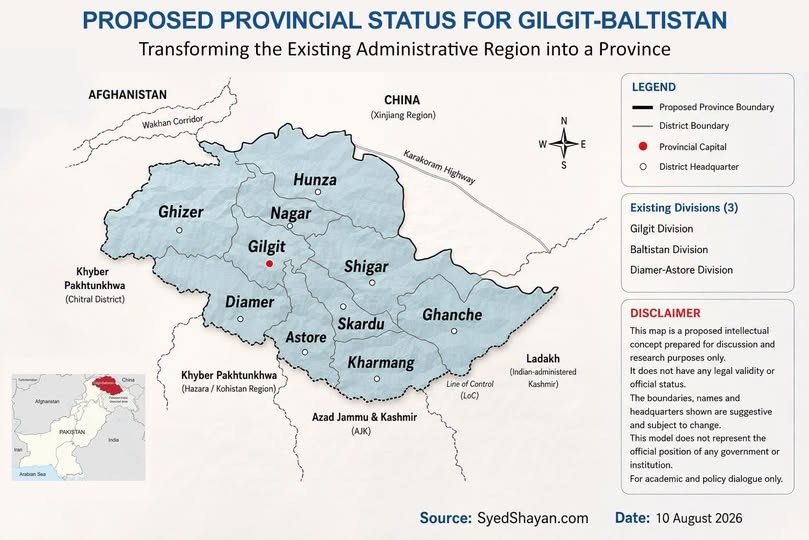
Does Pakistan Really Need New Provinces?

The Debate on New Provinces in Pakistan Is a Valid Question Raised at the Wrong Time 🔳 The debate on creating new provinces in Pakistan is undoubtedly a valid issue, but it has been raised at the wrong time. Various international studies have shown that when new provinces or administrative units are created, people become less dependent on major cities for healthcare, employment and judicial matters, allowing economic activity to spread more widely across the country. ▫️ People in Pakistan need to understand that a province is not a separate state. It is an administrative unit through which the state governs. ▫️ Administrative division should not be confused with political division. Just as a large institution, bank or company creates different zones or branches in order to operate more efficiently, provinces are also a means of improving governance. ▫️ People strongly prefer that the taxes they pay should be spent in their own regions. The smaller and more accessible a province is, the easier it becomes to monitor the misuse of funds and corruption. ▫️ When administrative units are smaller and empowered, the burden on central and provincial governments is reduced and the federation becomes stronger because citizens are less dependent on the centre or a distant provincial capital for the protection of their rights. ▫️ In countries with ethnic, linguistic or geographical diversity, the creation of new provinces or the granting of regional autonomy has, in several cases, led to a noticeable reduction in rebellion against central authority and in feelings of deprivation. ▫️ International surveys and research reports examining public views on the creation of provinces and the distribution of powers have found that more than 70 percent of respondents in some studies believed that education, healthcare and policing function more effectively and more rapidly in smaller and empowered provinces than in large provinces governed from distant centres. 🔳 Subject: Does Pakistan Really Need New Provinces? | Episode 5 Title: A Province Is Not a State. It Is an Administrative Unit Through Which Government Functions 🔺 Differences of opinion on national issues are natural, but serious debate and national consensus are essential for finding sustainable solutions. Written and Researched by Syed Shayan The purpose of creating provinces is to make government more accessible to citizens and to enable legislation according to the circumstances and needs of each region. There are seven major advantages: 1. Government Comes Closer to the People Today, many people have to travel hundreds of kilometres to a provincial capital for official work, complaints or administrative problems. When a new province is created, the government, secretariat and major institutions become more accessible to the people of that region. 2. Decisions About a Region Are Made Within the Region Mountainous areas, agricultural regions, industrial cities and desert territories do not have identical needs. When each region has its own government, decisions can be made according to its actual requirements. 3. The Budget Is Not Confined to Major Cities In large provinces, much of the public expenditure is concentrated in the provincial capital and a few major cities. When a new province is created, the region has its own budget and funds can be directed towards local roads, hospitals, schools and employment opportunities. 4. Decisions Are Made More Quickly When one government has to manage a very large population and a vast territory, decision making becomes slower. A smaller and better organised province can understand its problems more quickly and resolve them more efficiently. 5. Responsibility Becomes Easier to Identify When government is distant, institutions often shift responsibility from one department to another. When government is closer to citizens, people know who is responsible for roads, water, schools, hospitals and law and order. 6. Development Is Not Confined to One City The creation of new provinces can lead to the development of new capitals, universities, hospitals, courts, government offices, industries and employment centres. In this way, development can spread across the country instead of remaining concentrated in two or four major cities. 7. National Unity and a Stronger Federation When people in smaller or neglected regions are given meaningful authority over their own affairs and greater control over the use of local resources, feelings of deprivation are reduced. This can reduce resentment towards the centre, strengthen national unity and reinforce the federation. After reading these arguments, many people may reasonably think that most of the benefits attributed to new provinces could also be achieved through an empowered and effective local government system. Development projects and municipal services fundamentally fall within the domain of local government. In that case, how far is it correct to present these services as advantages of creating new provinces, when establishing a strong and empowered Local Government system may be a simpler and less costly solution? The distinction can be explained as follows: Local governments deal with lower level services and administrative matters such as streets, drainage and sanitation. They do not possess broad legislative and administrative powers because key areas such as policing, revenue administration, provincial taxation and policymaking remain under provincial control. The second major difference is Financial Autonomy. Local government institutions depend on provincial governments for funding, whereas a province constitutionally receives its share under the NFC framework. Most importantly, local government institutions remain dependent on provincial governments and may, under the law, be dissolved, suspended or have their powers restricted. A province, by contrast, provides its region with Constitutional Protection and meaningful Power and Authority. This raises another question. If new provinces make life easier for ordinary citizens, why do people oppose them? The reality is that ordinary citizens often benefit the most from the creation of new provinces. They no longer have to approach an MNA or MPA for every minor or major issue because many matters begin to be handled directly through institutions. This is one reason why some political figures may feel that their personal importance and influence could decline. Opposition is then often amplified by those politicians or their supporters, whereas for the ordinary citizen, bringing administration closer is not a disadvantage but a major convenience. The purpose of creating provinces is to make government more accessible to citizens and to enable legislation according to the circumstances of each region. 🔘 Let us examine why, despite the many economic and administrative advantages associated with new provinces, political parties and citizens often oppose the idea or show limited interest in it. The main reasons are as follows: ▫️ Fear of Losing Political Influence: Governing parties and major regional political groups may fear that dividing a province will divide their vote bank and weaken their political power. The creation of new provinces may also threaten established political monopolies. ▫️ Disputes over Resources and Fiscal Transfers: Conflicts may arise between existing and newly created regions over natural resources such as water, minerals and gas, as well as financial allocations, particularly under the NFC Award. No region is easily willing to surrender what it considers its existing share. ▫️ Concerns About Linguistic and Cultural Unity: Provinces are often associated with language or geography. When a province is divided, local populations may fear that their historical, cultural and linguistic identity will be weakened or fragmented. ▫️ High Administrative Costs: Creating a new province requires a new Provincial Assembly, Governor House, Chief Minister House, secretariat and administrative structure. These arrangements may require billions of rupees in additional expenditure and could place a further burden on the national economy. ▫️ Centralisation of Power: Political elites and bureaucracies are generally reluctant to transfer authority to lower levels because the creation of new provinces may reduce their central control. ▫️ A Complex Constitutional and Legislative Process: Creating a new province is an extremely complex and lengthy constitutional process requiring a two thirds majority in Parliament and in the relevant Provincial Assembly. Building consensus among all political groups can therefore be extremely difficult. These are the principal reasons why debates over new provinces often move away from administrative necessity and become political controversies. In Pakistan’s present debate, there is an additional problem: the timing. The discussion about creating new provinces began at a time when the government’s public standing and the broader national situation were themselves under serious scrutiny. As a result, an important national issue became unnecessarily controversial. However, now that the debate has begun, it should proceed through reasoned argument and research. Before taking the discussion further, one fundamental distinction must be understood. People in Pakistan need to clearly understand the difference between a province and a state. A province is not a separate state. It is an administrative unit through which the state governs. For example, if a family consists of five people, one house, one kitchen, one drawing room and one dining room may be sufficient. But if that same family grows over time to fifty members, one house will obviously no longer be enough. Some members may then build a second house and others a third. Does this mean that the family has broken apart? Certainly not. It simply means that the family has grown, and its administrative arrangements must also expand. The same principle applies to a state. As population grows, administrative structures must also expand so that government remains close to citizens, decisions reflect local needs and people do not have to repeatedly travel to distant capitals for their work. When a family grows, the number of houses may increase. When a country grows, its administrative structure must also expand. Neither the family nor the country is divided merely because its administration has expanded. Another important point is that people often treat Local Government, districts, divisions and provinces as though they were the same thing, although each performs a different function. Local Government deals with local issues. Districts and divisions primarily provide administrative convenience. A province, however, operates at the level where the secretariat, Chief Minister, cabinet, High Court, police, healthcare, education, budget and major administrative decisions are located. This is why, when citizens face significant problems relating to health, education or major legal and administrative matters, they often have to approach provincial level institutions rather than a Union Council or division. In some cases, they may even have to travel to Islamabad. To understand the debate over the creation of new provinces, some important examples from Islamic history are also relevant. As the State of Madinah expanded and Makkah, Taif, Yemen, Bahrain, Khaybar and other regions became part of the Islamic state, the Prophet Muhammad ﷺ did not administer every matter exclusively from Madinah. Governors, administrators and other officials were appointed in different regions. The purpose of this arrangement was to ensure that local matters could be resolved locally, that people could obtain justice and government services closer to where they lived, and that they would not need to travel to Madinah for every minor or major issue. This illustrates an important principle: as the territory and population of a state expand, administrative responsibilities must also be distributed so that governance remains effective and the distance between rulers and citizens is reduced. Later, during the period of Hazrat Umar Farooq رضی اللہ عنہ, when the Islamic state expanded into Iraq, Syria, Egypt and Persia, the same principle was developed in a more organised form. Separate governors, judges, treasury officials and other administrators were appointed for different regions. New administrative centres such as Kufa, Basra and Fustat were also established so that people did not have to travel to Madinah whenever they required justice, administration or government services. The development of Wilayat, meaning provinces, Jund, meaning military garrisons, Diwan, meaning financial and administrative offices, and systems of accountability during the period of Hazrat Umar Farooq رضی اللہ عنہ demonstrates that the principles of state administration are not static. As population and geographical reach expand, administrative systems must also be expanded and reformed. Wilayat is an Arabic term referring to a territory under administration, while Wali refers to its administrator or governor. In contemporary administrative terms, these concepts may broadly be understood as corresponding to a province and its governor. This demonstrates that within the Islamic tradition of governance as well, administrative structures expanded as the state and population grew, with the objective of providing better public services and more timely justice. (To be continued in the next instalment)
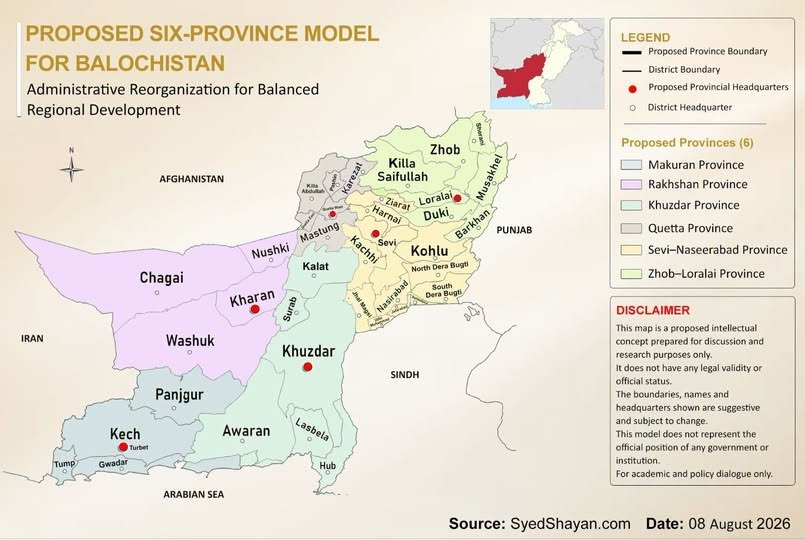
تمام تحریریں دیکھیں