

How Can Pakistan Be Administratively Reorganized?
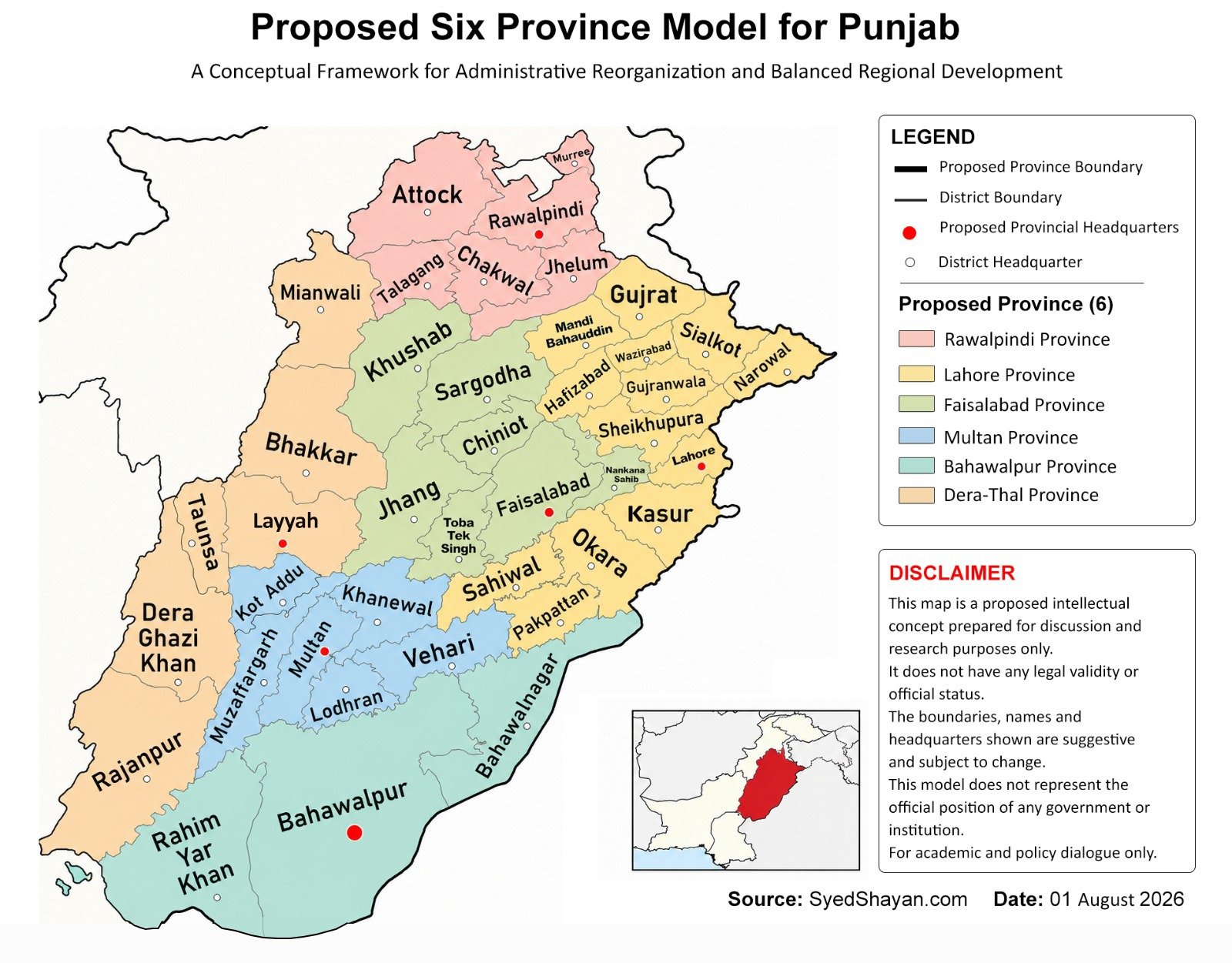
What if Punjab were divided into 6 provinces?
And what if Pakistan were divided into a total of 23 provinces?
▫️ If new provinces are created on the basis of population, economic clusters, and geographical distances rather than political, linguistic, or ethnic considerations, the distance between government and citizens could be reduced, regional economies could become stronger, and national unity could also improve.
▫️ Unless quality hospitals, colleges, universities, and employment opportunities are available in every region, people will continue moving towards major cities in search of better facilities. As a result, large cities will remain under extraordinary population pressure and face growing administrative challenges, while remote regions will continue to lag behind in development and access to basic services.
▫️ Afghanistan is relatively smaller than Pakistan in terms of area, yet it has 34 provinces, while Pakistan is divided into only 4 provinces. One of the biggest obstacles to the creation of new provinces in Pakistan is the political desire to retain power. Instead of prioritizing better administration and public convenience, political interests often remain focused on maintaining control and influence over large provinces.
Topic: How Can Pakistan Be Administratively Reorganized? | Episode 1
Title: How Many Provinces Should Punjab Be Divided Into?
🔺 Differences of opinion on national issues are natural, but permanent division and uncertainty are not a solution. Citizens, political parties, and state institutions have a responsibility to engage in an open debate and eventually move towards a clear national consensus.
Written and Researched by: Syed Shayan
For some time, I have been publishing a research series on Pakistan’s Independent Power Producers and the country’s energy crisis. However, the debate over the creation of new provinces is directly connected to two of the core areas of our think tank, Urban and Regional Development and Governance. I am therefore temporarily pausing the IPPs series to present my views on this important national issue to readers.
🔳 Pakistan is currently witnessing renewed debate over various proposals for the creation of new provinces. In this context, our think tank has also prepared a proposed map and analysis of a possible administrative division of Punjab as part of an Academic Debate.
This does not represent a government plan or an official proposal. It is intended to contribute a new research based perspective to the ongoing discussion on administrative reforms.
Today, Pakistan’s population has reached approximately 260 million. Punjab alone has a population of more than 120 million, which is larger than the population of many major countries around the world. Similarly, Balochistan accounts for around 44 percent of Pakistan’s total land area, yet its administrative capital, Quetta, is located hundreds of kilometres away from some parts of the province.
The creation of new provinces has remained part of Pakistan’s national and public debate for decades. Supporters argue that smaller provinces could help ensure a fairer distribution of resources, improve governance, provide easier access to public services, and accelerate the development of remote areas. They also believe that such reforms could reduce population and administrative pressure on major cities such as Lahore and Karachi.
Opponents of new provinces argue that the process would involve constitutional and political complications, linguistic disputes, and significant administrative costs. In their view, instead of establishing new Governor Houses, provincial assemblies, cabinets, and secretariats, the same objectives could be achieved more efficiently and at a lower cost by empowering local governments and giving them adequate funding and authority.
A significant section of those supporting new provinces has long argued that dividing Pakistan into 12 to 14 administrative units or provinces could improve governance and lead to a more equitable distribution of resources.
In 2025, the Economic Policy and Business Development Think Tank, established by Anwaar ul Haq Kakar and Gohar Ejaz, presented different models proposing that Pakistan be divided into between 12 and 20 provinces, or into approximately 38 administrative units based largely on the country’s existing divisions. The Chief Executive Officer of the think tank is former bureaucrat Ahmad Nawaz Sukhera.
In 2023, Deputy Chairman Senate Mirza Muhammad Afridi proposed dividing Punjab and Balochistan into three provinces each, while also granting separate provincial status to Karachi, Hazara, and the former FATA region. Dr Mehtab S. Karim also presented a framework proposing 20 provinces or administrative units.
Over the years, proposals for separate provinces of Bahawalpur, South Punjab, Hazara, and Karachi have also surfaced at different political and parliamentary forums.
Looking back at Pakistan’s history, one of the earliest major demands for provincial autonomy came from East Pakistan, present day Bangladesh, which was then the eastern wing of Pakistan.
By 1949, there was a growing perception in East Pakistan that despite having the majority of the country’s population, the region did not receive representation, authority, government employment, and access to national resources in proportion to its population.
In the same year, the Muslim League Parliamentary Party in East Pakistan formally demanded greater provincial autonomy. Huseyn Shaheed Suhrawardy and Maulana Abdul Hamid Khan Bhashani were among the prominent political voices associated with the broader movement for greater regional rights.
As demands for provincial autonomy gained strength in East Pakistan, federal policymakers adopted a different approach.
In 1955, Punjab, Sindh, the North West Frontier Province, Balochistan, and various princely states and territories of West Pakistan were merged into a single administrative unit known as One Unit.
The primary objective was to create political parity between East and West Pakistan and to transform West Pakistan into a single administrative entity.
However, the One Unit experiment did not succeed.
The merger of provinces with different languages, cultures, historical identities, and political traditions into a single administrative unit created a growing sense, particularly in Sindh, the North West Frontier Province, and Balochistan, that their provincial identities were being weakened or erased.
Opposition during this period was driven less by purely economic concerns and more by questions of language, culture, regional identity, and nationalism.
In Sindh, leaders such as G. M. Syed, Hyder Bakhsh Jatoi, and Sheikh Abdul Majid Sindhi, along with students, writers, and nationalist political groups, raised some of the strongest and most organized voices in defence of the Sindhi language, culture, and provincial identity.
In the North West Frontier Province, Khan Abdul Ghaffar Khan and Khan Abdul Wali Khan remained prominent voices, while in Balochistan leaders such as Mir Ghaus Bakhsh Bizenjo and Abdul Samad Khan Achakzai played important roles in demands for provincial identity, autonomy, and political authority.
It is important to note that demands for a greater share in resources and government employment also existed, but these issues were largely viewed within the wider context of provincial identity and the increasing dominance of the central government.
Against this political background, Sheikh Mujibur Rahman presented his Six Point Programme in 1966. It called for extensive political, financial, and administrative autonomy for the provinces, constitutionally referred to as Federating Units.
Following years of political opposition, the One Unit system was abolished in 1970, and Punjab, Sindh, the North West Frontier Province, and Balochistan were restored as separate provinces.
Since then, provincial autonomy and the creation of new provinces have remained recurring themes in Pakistani politics.
Sometimes the issue has appeared in the form of demands for new provinces, sometimes as a call for greater provincial autonomy, and at other times through demands for stronger local governments. The fundamental question, however, has remained the same:
How close should political and administrative authority be to the people?
Even today, in 2026, the fundamental question behind the debate over new provinces is why an ordinary citizen living in a remote area should have to travel to a provincial capital simply to resolve routine problems or gain access to basic services.
Whether someone has to travel from a distant district of Punjab to Lahore, go to Islamabad for a federal matter, or travel long distances to gain access to a higher court, the existing system can be expensive, difficult, and time consuming for ordinary citizens.
What Pakistan actually needs is an administrative and judicial structure in which most problems can be resolved within a citizen’s own city, district, or nearby region.
My view has always been that the most important element of governance is Grassroots Governance.
The closer government and authority are to the people, the more citizens will feel that solutions to their problems are available within their own city, district, or tehsil.
This is why I have consistently supported strong City and District Governments.
The City District Government system introduced during the era of Pervez Musharraf was certainly a serious attempt to transfer authority to the local level.
However, once the government changed, the entire system was dismantled as though continuity in state policy had little importance.
Pakistan Tehreek e Insaf also promised to transfer authority to the grassroots level. However, after coming to power, it was unable to implement these reforms to the extent that many had expected.
What should be the most effective model for the genuine transfer of power and authority?
Should Pakistan rely on strong local governments, smaller provinces, or a combination of both?
And perhaps the more important question is:
How can Pakistan create a constitutional and administrative structure that cannot easily be abolished, weakened, or reversed by a future government, whether elected or unelected, simply because of political considerations?
These are the fundamental questions that we will examine in detail in the upcoming episodes of this series.
In the next episode, we will present and examine our proposed model for dividing Punjab into 6 provinces, including the reasoning behind the proposal, the proposed boundaries, and the administrative principles on which the model is based.
To be continued in the next episode.
No comments yet.