
🔲 Public Inquiry Series | Episode 1
It has often been observed that my articles are lengthy. That observation is not misplaced. However, these writings are not intended for casual consumption. They address structural issues of public importance and are grounded in sustained research. If they require fifteen to twenty minutes of attention, that time is, I would suggest, well spent.
🔸 Turning to the substance.
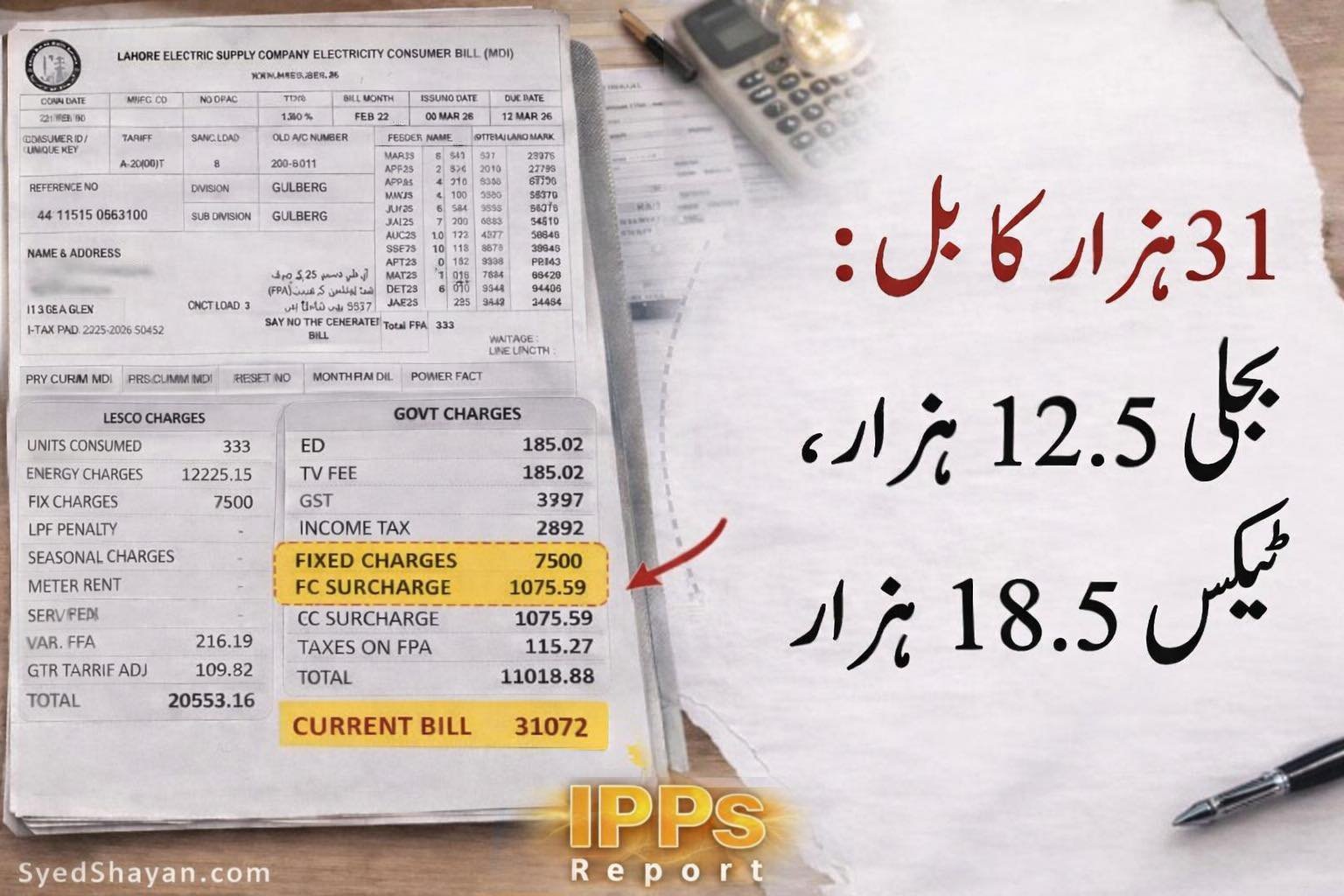
An examination of my February 2026 electricity bill, issued by the Lahore Electric Supply Company, reveals that it consists of three distinct categories of charges.
For clarity, these may be understood as follows:
Each warrants separate consideration.
🔸 Cost of Consumption
The bill records consumption of 333 units, resulting in a base charge of PKR 12,225.15. This implies an average unit cost of approximately PKR 36.71. In addition, a Variable Fuel Price Adjustment of PKR 216.19 and a Quarterly Tariff Adjustment of PKR 109.82 have been applied, bringing the total cost of consumption to PKR 12,551.16.
A notable feature is that the fuel adjustment applied relates not to the month of consumption, but to December 2025. This temporal misalignment obscures the true cost of electricity and complicates consumer understanding.
🔸 Fixed Charges
The bill includes PKR 7,500 under fixed charges. These are linked to capacity payments within the power sector, particularly those associated with IPPs. Consumers are required to pay this amount based on sanctioned load, regardless of actual usage.
In this instance, with a sanctioned load of 8 kilowatts, the charge is calculated at approximately PKR 937.5 per kilowatt. The bill further indicates that the connection is being billed under a Maximum Demand Indicator framework, despite the absence of any explicit consent.
🔸 Taxes and Surcharges
The remaining component comprises a series of taxes and surcharges:
Electricity Duty PKR 185.02
General Sales Tax PKR 3,797
Income Tax PKR 2,892
Extra Tax PKR 2,110
Further Tax PKR 844
Financing Cost Surcharge PKR 1,075.59
Tax on Fuel Adjustment PKR 115.27
Total taxes and surcharges amount to PKR 11,018.88.
🔸 Overall Structure
The bill therefore resolves into three components:
PKR 12,551.16 for actual consumption
PKR 7,500 in fixed charges
PKR 11,018.88 in taxes and surcharges
Bringing the total to PKR 31,072.
In effect, electricity valued at approximately PKR 12,500 results in a total payable amount exceeding PKR 31,000. The differential, amounting to roughly PKR 18,500, arises from charges that are not directly linked to consumption.
The tariff structure, as presently configured, resembles a complex administrative maze. Even a careful reader may struggle to identify its internal logic. One is left to consider whether the same degree of institutional effort might have yielded greater public benefit had it been directed toward transparency and system reform.
🔸 Two questions follow.
First, if payments to IPPs are already being recovered from consumers through monthly billing, on what basis is it asserted that such payments cannot be met? Where, within the system, does the breakdown occur?
Second, if line losses and theft are also being recovered through tariff mechanisms, why does the system continue to report financial losses?
These are not rhetorical questions. They go to the heart of the system’s credibility.
Turning to scale, the Lahore Electric Supply Company serves approximately 6.7 million connections across multiple districts. Even under conservative assumptions, the implications are substantial.
If fixed charges are averaged at approximately PKR 5,000 per connection per month, this suggests a monthly recovery of approximately PKR 33.5 billion under this head alone. Similarly, the Financing Cost Surcharge, when aggregated across the same consumer base, yields an estimated PKR 7.2 billion per month.
Taken together, these two components alone suggest a monthly recovery approaching PKR 40 billion, or approximately PKR 480 billion annually, from a single distribution company.
This raises an obvious question. If such sums are being recovered from consumers, how is it that the same entity is characterised as loss making?
The issue becomes even more pronounced when viewed at the national level, where multiple distribution companies, alongside K Electric and regional systems, operate concurrently.
Its purpose is not merely to criticise, but to illuminate.
Pakistan’s electricity distribution system comprises ten distribution companies, in addition to K Electric and regional arrangements in Azad Kashmir and Gilgit Baltistan. The institutional structure is extensive. The outcomes, however, remain deeply unsatisfactory.