
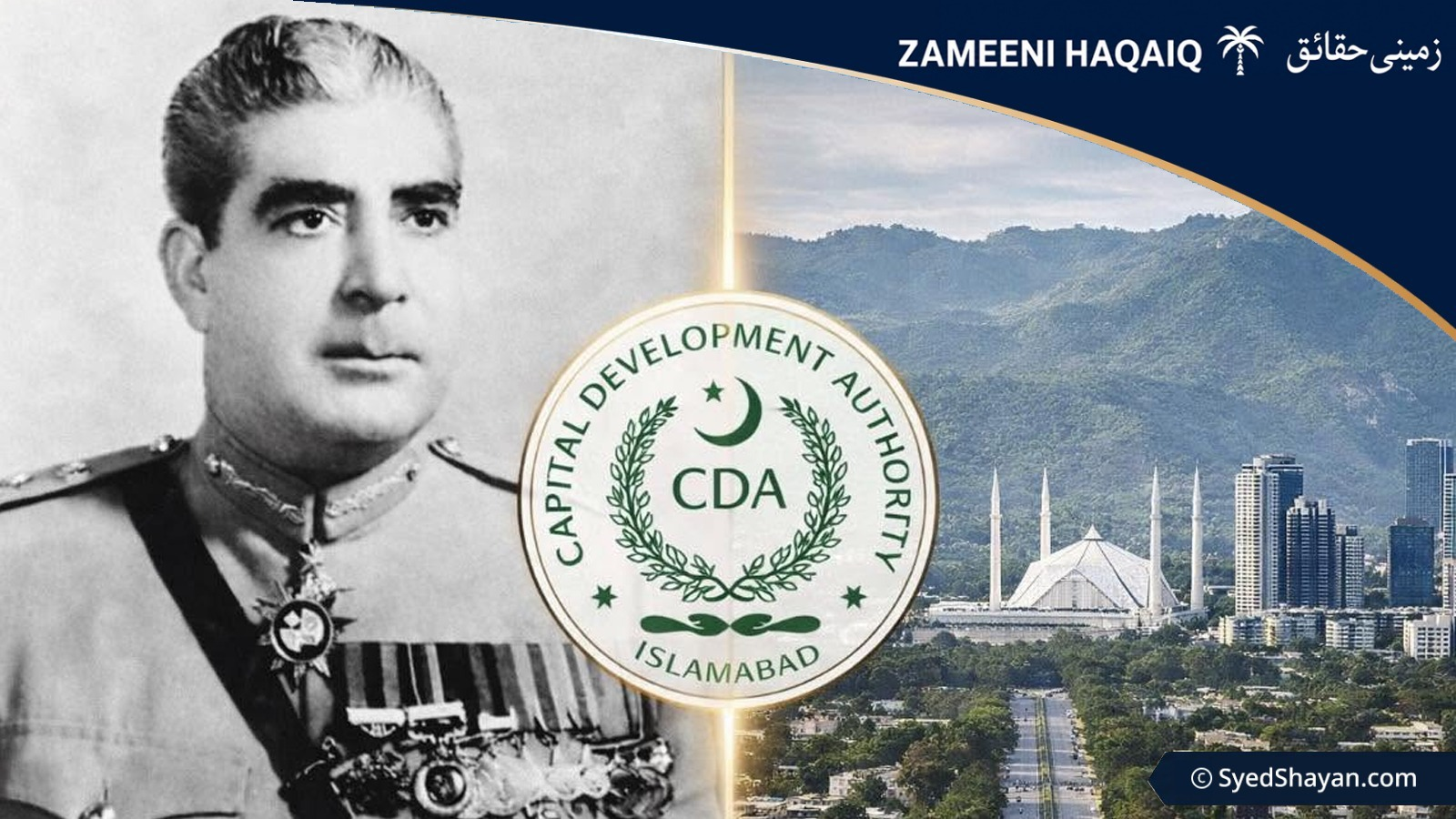
Why Does the Capital Development Authority Fail to Compensate Those Whose Land Was Used to Build Islamabad, Despite Earning Billions?
When the decision was taken in 1960 to establish Islamabad as Pakistan’s new federal capital, the Capital Development Authority was created under an ordinance issued on June 14, 1960. General Muhammad Yahya Khan was appointed as its first chairman and served as CDA chairman from 1960 to 1961.
He also headed the Capital Commission, which played a key role in selecting the final site for the new capital.
During his tenure, the large-scale acquisition of land required for the new city was carried out—an administratively complex undertaking. However, the same process also led to the demolition of local villages, displacement of residents from ancestral lands, limited compensation and inadequate rehabilitation arrangements.
The criticism generated by those actions still echoes today, particularly at a time when the same development authority sells individual plots through open auctions for billions of rupees, while many of the people whose ancestral lands formed the foundation of Islamabad have spent the past six decades struggling to secure what they claim is their full compensation.
A broader review of court records and various judgments shows that, in disputes concerning Islamabad’s acquired land, the courts have generally maintained the principle that the CDA is legally bound to provide affected landowners with timely and fair compensation in accordance with law.
On several occasions, courts have directed the authority to determine pending claims, clear outstanding dues and resolve matters involving alternative plots or other legal entitlements without unnecessary delay.
In response to such directions, CDA officials have generally maintained that the authority respects court orders and is legally obliged to make payments, but that each case remains subject to legal clearance, verification of ownership records and availability of funds.
So what is the current financial position of the Capital Development Authority, and how much funding does it actually have available? A brief review is useful.
In 2025, the CDA held three major auctions to meet its financial requirements and promote commercial activity in the federal capital. These auctions included commercial plots, residential plots, orchards and shop units in different markets.
Details of these auctions and their revenue figures were reported by official and other credible sources. The first major auction was held from February 25 to 28, 2025, at the Jinnah Convention Centre. The second took place from July 15 to 17, 2025, while the third major auction was conducted from December 22 to 24, 2025.
For the benefit of readers, here is a summary of the major auctions held during the year.
🔸 First major auction — February 25 to 28, 2025
The auction was held at the Jinnah Convention Centre in Islamabad. Seventeen commercial plots and 15 shops in the Blue Area parking plaza were sold, with the highest accepted bids amounting to approximately Rs23.404 billion, or more than Rs23.4 billion.
🔸 Second major auction — July 15 to 17, 2025
This was a three-day open auction, also held at the Jinnah Convention Centre. According to a CDA press release issued after the auction, approximately Rs19.56 billion in revenue was generated. Eight commercial plots and four shops were auctioned.
🔸 Third major auction — December 22 to 24, 2025
This was another three-day open auction at the Jinnah Convention Centre, featuring both residential and commercial plots.
According to the CDA’s official press release, plots worth more than Rs17 billion were auctioned by the end of the event.
A report by Dawn stated that around 80 residential and commercial plots had been offered, of which 16 were sold for a combined amount of approximately Rs17 billion. The authority described the proceeds as financial support for various development projects.
If the figures from these three major auctions held in February, July and December 2025 are added together, the CDA generated approximately Rs59.9 billion, or nearly Rs60 billion, in revenue.
This combined estimate is based on figures published in official press releases and credible media reports.
In addition to these three major auctions, the CDA also conducted successful auctions during 2025 involving agricultural farms, petrol pump sites, residential plots in Park Enclave, and land earmarked for educational and IT zones.
For example, valuable agricultural farms in Chak Shahzad, petrol pump sites in Blue Area and E-11, and land designated for educational and IT purposes in sectors I-8 and H-9 were also auctioned, generating substantial additional revenue. The exact amount collected from these transactions is something the CDA should ideally publish transparently on its website.
The CDA’s sources of income are not limited to the sale of plots. Broadly speaking, its revenue structure can be understood through five distinct models. Any serious economic analysis of the authority requires these streams to be examined separately in order to understand its true financial structure.
1. Land and Plot Monetisation — Sale and Auction Model
Under this model, the CDA generates immediate cash flow by auctioning commercial and residential plots.
This is generally its largest and most visible source of income. However, it is not permanent and remains dependent on market conditions and fluctuations in property demand.
2. Recurring Revenue — Service Charges Model
This category includes fees collected by the authority for administrative and regulatory services, such as building plan approvals, map and scrutiny fees, transfer charges, lease rent and licence fees.
This revenue is relatively stable because it comes from routine transactions that take place throughout the year.
Citizens regularly need building plans approved for houses and commercial properties, ownership transferred, commercial licences issued and leases renewed. Since these activities continue year-round, they provide the authority with a recurring stream of income.
3. Lease and Rental Income
This includes rental income generated from CDA-owned markets, shopping centres, parking plazas and advertising spaces.
Such assets create an ongoing revenue stream that can help support the authority’s operational expenses.
4. Utility and Infrastructure Charges
This category includes water and sewerage charges, infrastructure fees and other service-related collections.
Because these revenues are directly linked to service delivery, they can provide a relatively predictable financial flow.
5. Penalties and Regulatory Fees Model
This category includes regulatory fines, profit earned on bank deposits and federal grants.
These sources are not substitutes for core operating revenue, but they can play an important role in filling budget gaps and easing financial pressure.
Approved budget documents and media reports for fiscal year 2024-25 also indicate that the CDA’s annual revenue target was set at approximately Rs90 billion to Rs92 billion, while its actual revenue collection was reported at more than Rs50 billion.
Against this financial background, a fundamental question arises:
If the CDA has such diverse revenue streams and earns tens of billions of rupees, why does it still fail to make complete and timely payments to the original owners of the land on which Islamabad was built?
To be continued — the remaining part will follow in the next instalment.