
▫
Why Was Net Metering Restricted, and Why Will New Solar Consumers No Longer Receive the Same Benefits?
▫
The Ministry of Finance has released figures that raise serious questions about Pakistan’s state-owned power sector.
Those producing cheaper electricity are being penalised, while entities losing billions in electricity generation continue to be protected.
On February 13, the Ministry of Finance released its Aggregate Annual Report on Federal State-Owned Enterprises for FY2025. According to the official figures, loss-making SOEs collectively recorded losses of approximately Rs832.8 billion during FY2025, while the overall net adjusted loss of the SOE sector stood at Rs122.9 billion. Losses remained heavily concentrated in major public-sector entities, particularly transport and power-distribution companies.
Pakistan currently has four major government-owned thermal generation companies — commonly known as GENCOs — operating within the federal power-sector structure: Jamshoro Power Company Limited (GENCO-I), Central Power Generation Company Limited (GENCO-II), Northern Power Generation Company Limited (GENCO-III) and Lakhra Power Generation Company Limited (GENCO-IV). All four also remain part of the government’s privatisation programme.
▫
Jamshoro Power Company — GENCO-I, Jamshoro, Sindh
The company operates ageing thermal generation assets. Older units that depend on furnace oil and operate at relatively low thermal efficiency illustrate one of the fundamental problems facing conventional public-sector generation: a substantial proportion of the energy contained in fuel is lost during conversion into electricity.
In simple terms, when thermal efficiency is low, significantly more fuel must be consumed to generate the same amount of electricity.
▫
Central Power Generation Company — GENCO-II, Guddu
The FY2025 SOE report records a loss of approximately Rs10.3 billion for GENCO-II. The company’s generation fleet includes the 747 MW combined-cycle facility at Guddu, which was intended to improve generation efficiency, but operational and maintenance problems have repeatedly affected the performance of the wider generation complex.
The FY2025 SOE report records a loss of approximately Rs10.3 billion for GENCO-II. The company’s generation fleet includes the 747 MW combined-cycle facility at Guddu, which was intended to improve generation efficiency, but operational and maintenance problems have repeatedly affected the performance of the wider generation complex.
▫
Northern Power Generation Company — GENCO-III, Muzaffargarh
GENCO-III operates ageing thermal generation infrastructure where old machinery, fuel costs and operational efficiency remain important financial challenges. The company is also included in the federal government’s privatisation programme.
GENCO-III operates ageing thermal generation infrastructure where old machinery, fuel costs and operational efficiency remain important financial challenges. The company is also included in the federal government’s privatisation programme.
▫
Lakhra Power Generation Company — GENCO-IV, Sindh
Lakhra represents another older public-sector generation operation. Its ageing coal-based infrastructure and efficiency limitations illustrate the wider challenge of maintaining older conventional power plants at economically competitive generation costs. It too remains on the government’s privatisation list.
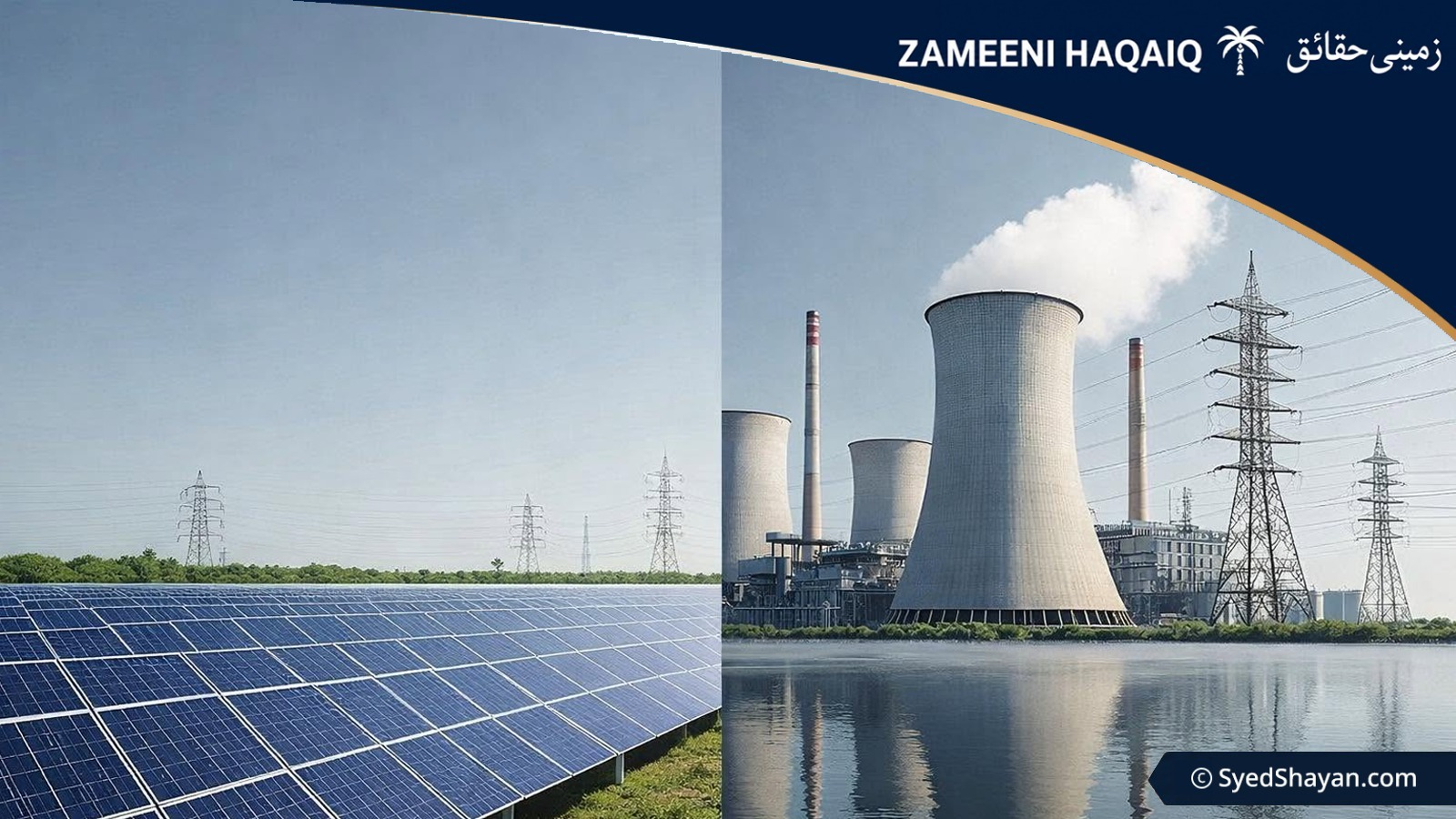
These are government-owned generation companies supported by large investments in power plants, fuel, infrastructure and administration.
Against this background, consider what happens when an ordinary citizen installs a solar system on the roof of a home or business.
That citizen effectively establishes a small Distributed Generation unit — commonly described in energy policy as Rooftop Solar or Microgeneration.
The initial investment is made privately. The consumer purchases the panels, inverter and other equipment and assumes the investment risk.
On a simplified lifetime-cost basis, if the total cost of a rooftop solar system is spread over an operating life of around 25 years, its Levelized Cost of Electricity, or LCOE, can become very low relative to conventional thermal generation.
LCOE means the average cost of producing one unit of electricity after the total cost of a power system over its lifetime is divided by the total electricity it is expected to generate.
Once a solar system has been installed, its marginal fuel cost is effectively zero, because sunlight itself has no fuel cost.
Under earlier net-metering arrangements, consumers could export surplus electricity to the national grid and receive compensation for it.
The economic logic was therefore straightforward: a citizen invested private capital, generated relatively low-cost electricity and exported excess generation to the grid.
Conventional thermal generation presents a very different cost structure.
Government-owned GENCOs require large power plants, fuel supply, employees, maintenance, fixed infrastructure and significant operating expenditure. Their economics are also affected by plant efficiency, utilisation rates and the cost of keeping generation capacity available even when a plant is not producing at full output.
That produces an obvious policy question:
If citizens can invest their own money to generate cheaper electricity, why should public policy make that investment less attractive instead of improving the system through better regulation?
The issue becomes even more important when the financial condition of the wider power sector is considered.
Pakistan’s power sector continues to carry substantial costs associated with capacity payments, circular debt, transmission and distribution losses, inefficient generation and fixed system costs. The Finance Division itself reported substantial fiscal support for SOEs during FY2025, including major equity injections connected with power-sector circular-debt management and payments to IPPs.
When a citizen generates electricity through rooftop solar, that household or business purchases less electricity from the grid.
This reduces grid-based electricity sales.
But many of the system’s fixed costs — including contracted generation capacity, network infrastructure and other obligations — do not disappear simply because electricity sales fall.
This is where the real conflict begins.
The financial challenge is not necessarily that rooftop solar is expensive.
Rather, as more consumers generate their own electricity, the traditional power system has fewer electricity sales through which it can recover costs that were already built into the system.
Pakistan subsequently introduced the NEPRA Prosumer Regulations 2026, changing the regulatory framework governing new distributed solar consumers. The regulations were notified on February 9, 2026, and NEPRA subsequently published proposed amendments for public consultation.
The policy argument presented for reforming the system has centred on the financial sustainability of the grid and the distribution of costs between solar and non-solar consumers.
But the Finance Division’s figures raise a broader question.
If Pakistan’s electricity sector is already carrying enormous fixed costs, losses, capacity-payment obligations and inefficient public-sector assets, should the burden of correcting that system be shifted primarily towards private citizens who invested their own money in lower-cost distributed generation?
In economic terms, a more sustainable approach would be to regulate and integrate Distributed Generation more intelligently rather than discourage it.
Private rooftop solar can reduce demand for imported fuels, diversify electricity generation and bring private capital into the energy sector without requiring the government itself to finance every additional megawatt.
That does not mean solar consumers should make unlimited use of the grid without contributing towards legitimate network costs.
A financially sustainable grid still requires a fair mechanism for recovering the cost of transmission, distribution, balancing and backup capacity.
But those costs should be identified transparently and recovered through a rational tariff structure.
The solution should therefore be to determine:
What is the genuine cost of keeping the grid available to a solar consumer?
What proportion of that cost should the solar consumer reasonably pay?
How much of the wider power-sector burden actually comes from rooftop solar, and how much comes from capacity payments, inefficient generation, line losses, debt and poor governance?
Without answering these questions transparently, restricting rooftop solar risks addressing the symptom rather than the underlying problem.
The economically stronger approach would have been to recognise this emerging Distributed Generation model, regulate it properly, facilitate its integration into the grid and create a framework in which both solar consumers and the national electricity system contribute fairly towards shared network costs.
The objective should not be to protect expensive electricity from cheaper electricity. The objective should be to redesign the system so that cheaper, cleaner and more efficient generation can become part of Pakistan’s long-term energy solution.