
On World Cities Day, 31 October 2026, the world was presenting plans for urban development and a brighter future, while Sindh’s Chief Minister was recounting tales of Karachi’s decline and governmental folly.
A column by Syed Shayan 🌴 Zameeni Haqaiq
World Cities Day was observed across the globe on 31 October. This year’s theme was:
Regenerating the City: Adequate Housing
In other words, improving ageing and deteriorating cities and ensuring adequate housing for every citizen.
The main event was held under the auspices of the United Nations in Fuzhou, China, where experts and government representatives from around the world considered how ageing and deteriorating cities and declining settlements could be made liveable again, how adequate housing could be ensured, and how urban development could respond to climate change, human needs and the requirements of future generations. The world was, in effect, seeking solutions to its urban problems and exploring ways to build a better future.
In Pakistan, the Sindh Master Planning Authority (SMPA), in collaboration with NED University and the United Nations Human Settlements Programme (UN Habitat), organised the Sindh Cities Forum 2026 at the Karachi Golf Club Convention Centre.
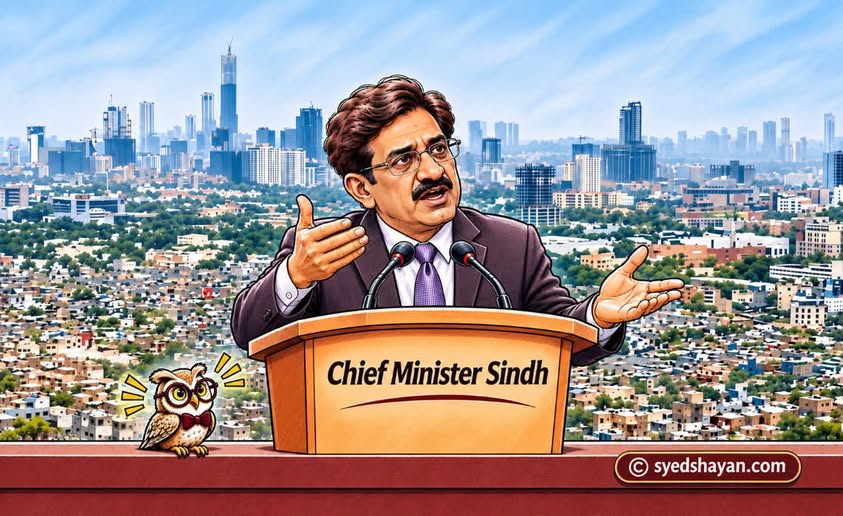
Sindh Chief Minister Syed Murad Ali Shah addressed the gathering. The defining feature of his speech was not a new vision for the development of future cities, but an admission of the deterioration of Karachi, his own provincial capital, and the failures of government.
The Chief Minister said he had watched Karachi expand rapidly and deteriorate before his very eyes. He attributed the city’s present condition to failures in urban planning and acknowledged that past governments, including his own, had made mistakes.
Consider the contradiction. On the very day when the world was discussing how to regenerate deteriorating cities, improve urban life and plan for the future, Sindh Chief Minister Syed Murad Ali Shah was recounting the disastrous state of urban planning in his own provincial capital, Karachi. His account of that decline included an admission of his own government’s mistakes.
There is, as the saying goes, a time and a place for everything. One must consider what is being said, on what occasion, in what manner and to what purpose.
At an event marking this international day, organised in collaboration with UN Habitat, the Chief Minister should have highlighted his province’s urban development, future plans and practical achievements over the preceding years.
Yet the discussion took an entirely different course. On a global day dedicated to the development of cities, the Chief Minister of Sindh was recounting stories of electricity poles standing in the middle of roads, first in Hyderabad and now in Sukkur. At one moment, he spoke of an institution’s lack of cooperation; at another, of obstacles to road construction.
How astonishing. The Chief Minister of a province where his political party has been in power for eighteen years was presenting, as an account of administrative performance, the fact that institutions could not cooperate even on matters as basic as road construction and the relocation of electricity poles.
The event also included an update on master plans for 31 cities in Sindh. It was reported that master plans for 17 cities had been completed, while those for 14 remained under preparation. Official notifications, however, had been issued for the master plans of only nine cities.
One of the most astonishing aspects of this discussion is that the 14 cities whose master plans remain under preparation include Sindh’s two largest and most important cities, Karachi and Hyderabad.
Pause for a moment and consider this. The Pakistan Peoples Party has been in power in Sindh for the past eighteen years. During that period, there were only three caretaker governments, two lasting approximately two and a half months each and one lasting approximately six and a half months. Despite this lengthy period in office, new master plans for the province’s two most important cities have yet to be completed.
The question, then, is this: what has this prolonged rule actually achieved?