

In the Future, Property Values Will Be Determined More by Groundwater Levels Than by Location
When purchasing a plot in a new housing society, always remember that, in the future, the value of a house or plot may depend more on the availability of groundwater than on its location.
Zameeni Haqaiq
: A Column by Syed Shayan
Traditionally, property prices and values around the world have been assessed according to the principle of “Location, Location, Location.” However, changing environmental conditions and the growing water crisis are fundamentally reshaping the standards that will determine the future of real estate.
In the future, the value of a plot or residential development will not be determined solely by its location, roads, and amenities, but also by the continuous availability of water. In areas where groundwater levels are declining rapidly, the cost of living may increase, potentially affecting property values. This is an important yet relatively overlooked aspect of Pakistan’s real estate market.
Water scarcity in Pakistan is no longer merely an environmental issue. It is increasingly becoming a major concern affecting residential expenses and access to essential services.
According to a Dawn report published on 6 October 2026, residents of Clifton and Defence in Karachi are becoming increasingly dependent on water tankers. Complaints about delays of two to three months in government-operated tanker services have become common, while the price of some private water tankers has reportedly reached Rs12,000. This means that a household using four tankers per month could be spending Rs48,000 on water alone.
Similarly, residents of Doctors Town, a private housing society in Islamabad, complained in a 2023 report by the Associated Press of Pakistan (APP) that, despite paying water bills to the society, they were still forced to purchase water tankers costing between Rs2,000 and Rs4,000 each.
The report also highlighted water shortages in the PWD area. On 12 September 2022, Dawn reported that residents of Islamabad’s sectors I-14 and I-16 were relying on private boreholes and water tankers because of the absence of a regular water supply and declining groundwater levels. At the time, private tankers reportedly cost between Rs3,500 and Rs4,000 each.
Furthermore, on 19 July 2026, Islamabad Tribune reported complaints from residents of Sector H-13, who were being forced to purchase expensive water tankers because tube wells had dried up and groundwater levels had declined.
These examples demonstrate that when purchasing a home, buyers must consider not only the price and location of the property but also the long-term availability and cost of water.
I fear that, in the future, housing societies where groundwater levels continue to decline or water becomes increasingly contaminated will rapidly lose their attractiveness and importance. Unless a reliable supply of clean drinking water is ensured, property values in such housing societies could be adversely affected, and residents may eventually begin relocating to other areas.
In the coming years, demand for environmentally friendly and sustainable real estate (Eco-friendly & Sustainable Real Estate) will continue to grow. Housing schemes that invest in water management, water treatment plants, and the protection of groundwater resources will be better positioned to become some of the safest and most profitable long-term real estate investments.
The fundamental purpose of this article is to highlight that, in Pakistan, there is virtually no established practice of assessing water availability or conducting technical groundwater investigations before purchasing plots in newly developed housing societies. Yet this issue has become extremely important because groundwater levels are continuously declining in various cities across the country.
This responsibility is equally important for property buyers and housing society developers. Whenever a new housing scheme is developed or a plot is purchased, the following five essential factors should be carefully verified.
1. Groundwater Depth (Water Table Depth): At what depth, measured in feet, is groundwater available in the local area, and how much has the water table declined over the past five to ten years?
2. Water Quality (TDS Testing): Is the groundwater suitable for drinking, or is it saline or hard (Hard/Saline Water)? If the concentration of Total Dissolved Solids (TDS) is excessively high, water filtration systems and reverse osmosis (RO) plants may be required.
3. Groundwater Recharge System: Does the housing society's master plan include a dedicated system for collecting rainwater (Rainwater Harvesting) and replenishing underground water reserves through groundwater recharge?
4. Drainage System: Does the housing society have an effective drainage system for the proper disposal of rainwater and wastewater?
5. Independent Water Supply Network: What arrangements does the housing society have for its own tube wells, water filtration plants, and overhead water storage tanks?
The availability of these facilities will strengthen buyers' confidence, make plots easier to sell, and potentially increase demand for such housing societies compared with developments lacking these arrangements.
These facilities may also contribute to stronger property market values in the future, as buyers will increasingly prioritize reliable water supplies and lower residential expenses rather than simply choosing inexpensive plots.
The importance of environmental protection can be understood from the fact that approximately 200 countries participate in the United Nations' global climate conferences (COP), where world leaders, government representatives, and experts discuss climate change, clean drinking water, environmental conditions, and their long-term consequences.
Now consider this: when the entire world is taking these challenges so seriously, how much importance are we giving them while planning new housing societies in Pakistan?
In our traditional joint-family system, many households remain in the same home for 30 to 40 years. Today, it is 2026. Add another 40 years, and we arrive at 2066.
When purchasing a home or plot today, have we considered what groundwater levels, water availability, and environmental conditions might look like by that time?
That is why I repeatedly raise this question before the federal and provincial governments and all development authorities: No new housing society should be approved unless its master plan includes practical and workable arrangements for a continuous water supply, water treatment, Rainwater Harvesting, Groundwater Recharge, and effective Drainage.
I reviewed the regulations of the development authorities in Lahore, Karachi, Islamabad, and Faisalabad and found that laws and regulations concerning environmental protection and water management do exist. However, the real question concerns their implementation and whether they can ensure the long-term availability of water.
The Lahore Development Authority (LDA), through its Building and Zoning Regulations 2019, includes requirements relating to Rainwater Harvesting and groundwater recharge.
In Islamabad, the Capital Development Authority (CDA), under its 2023 regulations, requires housing societies to make provisions for water supply, sewage treatment, and environmental approval.
In Karachi, the Sindh Environmental Protection Agency's Environmental Assessment Regulations 2021 establish a framework for the environmental assessment of housing developments.
Meanwhile, the Faisalabad Development Authority (FDA), through its Building and Zoning Regulations 2020, includes specific requirements relating to Rainwater Harvesting and Groundwater Recharge.
Despite these regulations, the fundamental question remains: Before approving a new housing society, do the relevant authorities assess where its water will come from over the next 30 to 40 years?
How rapidly is the groundwater table declining? Is the available water suitable for drinking? And how will sufficient water be provided for a growing population?
I carefully examined the laws and regulations of the development authorities in all four cities. However, I could not identify any condition or mandatory requirement that would provide reasonable assurance that water supplies in newly developed housing societies would remain sustainable for the next 30 to 40 years.
From the agricultural belt of Okara and Sahiwal to the industrial areas of Faisalabad and Chiniot, the groundwater crisis is becoming increasingly serious. In certain parts of these regions, groundwater salinity is increasing, and TDS levels are exceeding prescribed limits.
In Lahore, particularly in its southern and eastern areas, excessive groundwater extraction and the limited flow of water in the Ravi River are contributing to a continuous decline in groundwater levels. The presence of arsenic and other contaminants in certain areas is also a matter of serious concern.
Islamabad's groundwater reserves are also under increasing pressure because of population growth, the expansion of new housing societies, and growing dependence on tube wells.
The situation is even more serious in Balochistan, particularly in Quetta, Zhob, and surrounding areas, where limited rainfall, insufficient natural groundwater recharge, and excessive use of tube wells have caused groundwater levels to decline to dangerously low depths.
Meanwhile, along the coastal belt of Karachi and Thatta, seawater intrusion into underground freshwater reserves, water contamination, and inadequate public water supply arrangements have further increased the difficulties faced by residents.
Under these circumstances, my fundamental question is this: When groundwater levels are continuously declining in major cities across Pakistan, and water in many areas is no longer suitable for drinking, why do we continue to pursue policies that encourage the further expansion of cities through the development of new housing societies?
Would it not be more appropriate to prioritize vertical housing instead of allowing the uncontrolled expansion of new housing societies?
Should we not focus on improving the infrastructure of existing cities, modernizing water supply, sewerage, and drainage systems, and ensuring more efficient use of available resources?
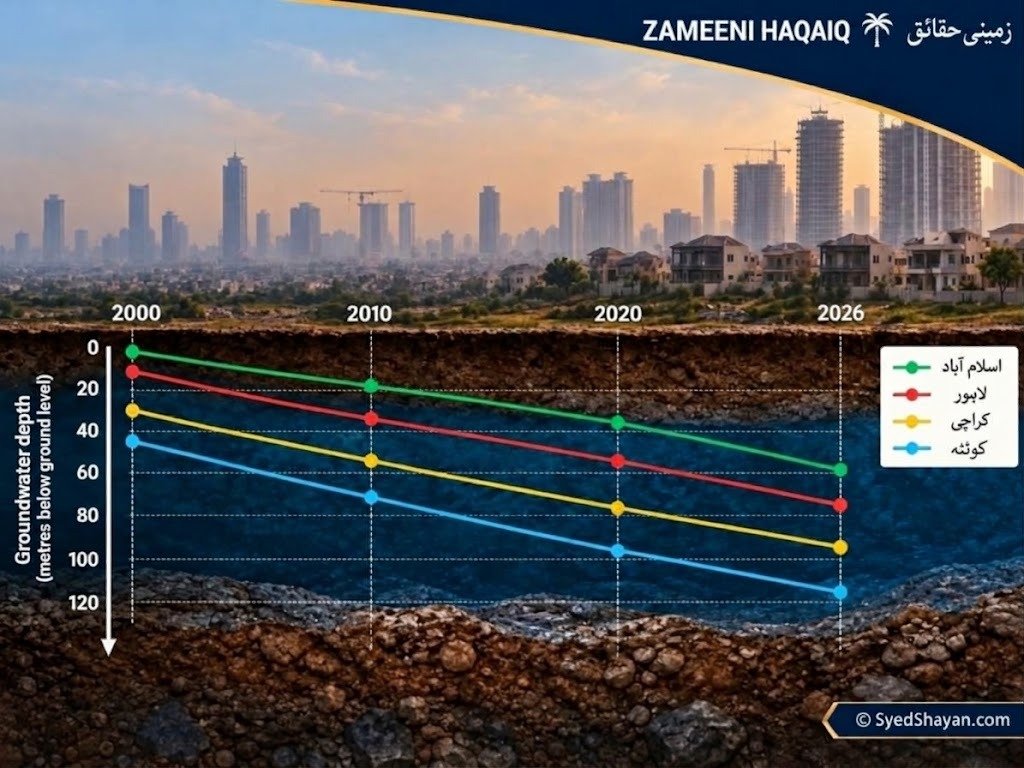
Along with this article, I am publishing a conceptual graph illustrating the declining groundwater levels in four major Pakistani cities: Lahore, Karachi, Islamabad, and Quetta, from 2000 to 2026.
This graph is not based on actual measurements or year-by-year statistical data. Instead, it has been developed as an illustrative representation to help readers understand the seriousness of the growing groundwater crisis.
I request you to spare a few moments of your valuable time to carefully examine the conceptual graph presented in the accompanying image.
The illustration itself will help you understand a great deal about the challenges that lie ahead.